Parliament likely to face ‘business’ crunch after budget talks as bills dry up
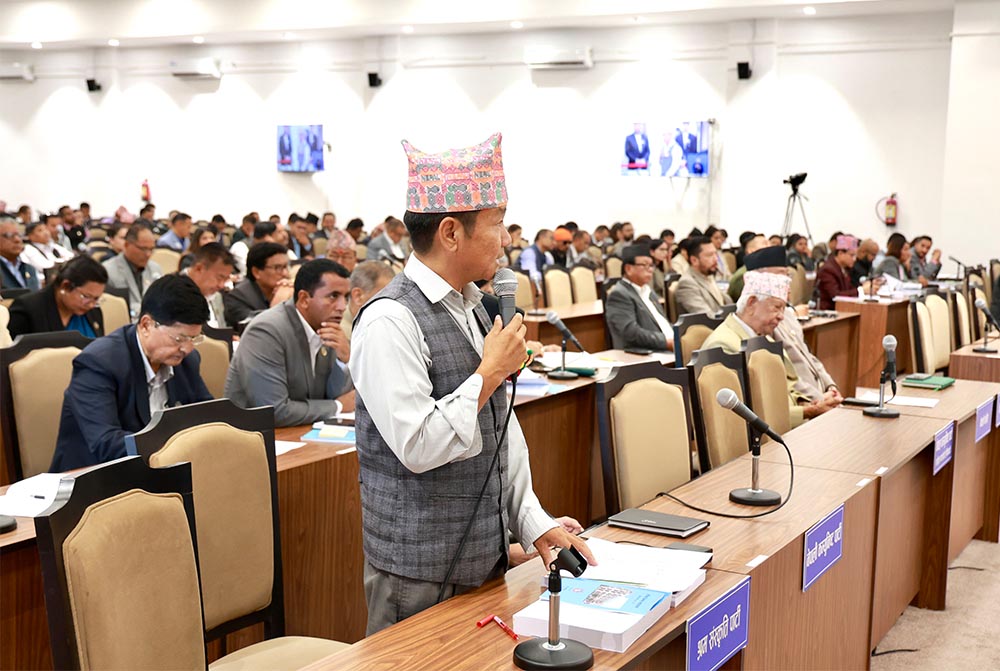
Only one regular bill has been registered in the federal legislature since the formation of the current government, apart from the budget and ordinance-replacement bills. Lawmakers taking part in the meeting of the House of Representatives on Tuesday. RSS
The Ministry of Law, Justice and Parliamentary Affairs has prepared a list of 45 potential bills submitted by various ministries for the current fiscal year. However, none are ready for immediate tabling in Parliament.
The government has been unable to introduce new bills to the federal parliament. Since the formation of the current government on March 27, only one regular bill has been registered, alongside the annual budget and ordinance-replacement bills. This shortage of fresh legislation means the Parliament is likely to face a “business crunch” after the budget talks conclude. According to the parliamentary calendar, deliberations on financial bills are scheduled to end by June 22.
Although the ongoing session is widely known as the budget session, it is standard practice for regular bills to be taken up and passed during the session alongside financial legislation.
“The main priority of this session is, of course, the budget. However, we anticipate a shortage of parliamentary business once the budget debate concludes,” an official at the Parliament Secretariat said on condition of anonymity. “It is the government’s responsibility to provide business to the House, but bills have not arrived as expected.”
The official added that bills were expected to be tabled in quick succession under the government’s 100-day roadmap, but progress has stalled. This is despite the Law Ministry holding a list of 45 potential bills forwarded by various ministries for the current fiscal year. At present, none are ready for immediate presentation.
On May 8, two ordinance-replacement bills were registered in the House of Representatives. These replaced ordinances introduced by the former Sushila Karki-led government, which had amended the Electoral Roll Act and the House of Representatives Election Act for electoral purposes. Both the Voter List (First Amendment) Bill, 2026, and the Member of the House of Representatives Election (First Amendment) Bill, 2026, were subsequently passed by both chambers and authenticated by the President on May 31.
The Karki government had also issued an ordinance amending the Special Service Act. Under this ordinance, the National Investigation Department (NID) was transferred from the Prime Minister’s Office (PMO) to the Ministry of Home Affairs. However, the current Balendra Shah-led government decided to retain the NID under the PMO and did not introduce a replacement bill. After the ordinance expired, the NID automatically came back under the jurisdiction of the PMO.
In addition, the government has not tabled replacement bills for eight other ordinances issued last month to amend various laws, nor has it moved motions to accept or reject those ordinances. Under constitutional provisions, an ordinance automatically lapses if no decision is taken within 60 days of its presentation at the first sitting of Parliament. If the government does not initiate the approval process, these eight ordinances will expire after July 10.
Shram Sanskriti Party chair Harka Raj Rai taking part in the meeting of House of Representatives on Tuesday. RSS
Finance Minister Swarnim Wagle presented the annual budget in Parliament on May 29. Three budget-related bills—the National Debt Recovery Bill, the Appropriation Bill, and the Finance Bill—have already been registered in the lower house. Apart from the two ordinance-replacement bills and the three financial bills, the Nepal Rastra Bank (Third Amendment) Bill is the only other regular legislation registered in the House of Representatives so far, introduced on May 25.
At present, 10 draft bills are being processed at the Law Ministry. These, prepared by respective line ministries and forwarded to the ministry, include bills relating to liabilities of domestic airlines, amendments to the Passport Act, urban development, amendments to the Building Act, and control of infectious animal diseases.
In addition, draft bills on the Citizen Investment Trust (Amendment), mining, federal civil service, mediation, and prohibition of child labour are also awaiting drafting consent at the Law Ministry. Once the ministry grants approval, these drafts will return to their respective ministries before being placed before the Cabinet.
A bill is formally registered in Parliament only after review by the relevant Cabinet committee and approval by the full Cabinet, a process that takes time.
Dal Bahadur Adhikari, spokesperson for the Law Ministry, said that for bills introduced in the previous Parliament that lapsed following the dissolution of the House, ministries can resume drafting without seeking fresh principle approval. He said ministries may already be working to fast-track such bills.
Adhikari further said the ministry has granted in-principle approval to draft new legislation on artificial intelligence, cybersecurity, information technology, company law, human body burn control, the Nepal Academy of Tourism and Hotel Management (NATHM), cooperatives, and savings and credit cooperatives.
In-principle approval has also been given to amend the Nepal Rastra Bank Act, the Nepal Special Service Act, and the Payment and Settlement Act. Among these, only the central bank amendment bill has reached Parliament. He added that since several bills are at different stages of drafting, they will be tabled sequentially in the House once all legal procedures are completed.
Meanwhile, Ekram Giri, spokesperson for the Federal Parliament Secretariat, said that since this is the budget session, presentation and debate on the government’s policies, programmes, and the budget remain the primary focus.
“Given that the budget takes precedence, the government may have delayed introducing other bills,” Giri said. “There are also a few bills sent by the National Assembly. We expect more bills to come in gradually, so parliamentary business should not face a major crisis.”
He expressed optimism that additional legislation would be tabled by the time the budget and related financial bills are fully cleared.
A Law Ministry official suggested the delay could be linked to the government’s effort to revise existing drafts in line with its policies and programmes, alongside preparing entirely new bills.
The official also noted that legislative drafting follows a strict and time-consuming legal process. Before drafting a bill, the ministry concerned must prepare a concept paper and secure approval from both the Law Ministry and the Cabinet.
Following this, under the Legislative Act, an initial draft must be prepared and made public for feedback from citizens. After receiving concurrence from the Ministry of Finance, the draft is sent back to the Law Ministry for final drafting approval. Only after the Law Ministry signs off can the line ministry submit a proposal to the Cabinet seeking permission to introduce the bill in the federal Parliament. A draft bill can enter Parliament only after receiving final Cabinet approval.




 14.69°C Kathmandu