Government to cut around 1,800 civil service posts in bureaucracy overhaul
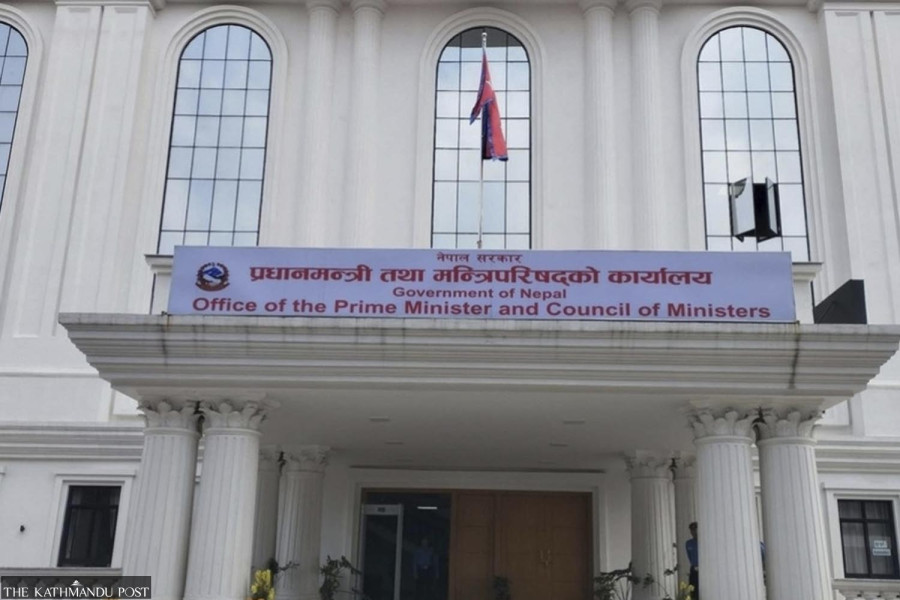
Restructuring will eliminate ten secretary-level positions and reduce dozens of senior administrative posts as the Shah administration pushes ahead with governance reforms. Post file photo
The government is preparing to cut around 1,800 civil service posts, including ten secretary-level positions, as it moves ahead with a major restructuring of the federal bureaucracy aimed at making the state administration leaner and more efficient.
The planned reductions follow a government-wide Organisation and Management (O&M) survey conducted across all ministries after the Balendra Shah administration pledged to reform the civil service, reduce administrative costs and streamline government operations.
According to the Department of National Personnel Records (Civil), the federal government currently has around 52,000 sanctioned posts across 1,885 ministries, departments and offices. Officials involved in the restructuring said the proposed cuts amount to roughly 3.5 percent of the total workforce, although the final number will be confirmed after all ministries complete reviews of their revised staffing structures.
The Cabinet on May 13 reduced the number of federal ministries to 18, including the Office of the Prime Minister and Council of Ministers. Following the decision, the Prime Minister’s Office instructed ministries on May 26 to identify staffing requirements based on their revised responsibilities.
Administrative reform, institutional restructuring and fiscal discipline were among the priorities included in the government’s 100-point governance reform agenda unveiled after Shah took office. Finance Minister Swarnim Wagle also announced in the budget presented on May 29 that the government would make the civil service structure more efficient and less cumbersome.
The Cabinet on July 16 approved revised organisational structures and staffing levels based on the O&M survey, allowing ministries to begin implementing the changes. The revised proposals are currently being reviewed by the Prime Minister’s Office before being forwarded to the Ministry of Land Management, Cooperatives, Federal Affairs and General Administration for final approval.
A joint team from the Prime Minister’s Office, the Ministry of Finance and the federal affairs ministry is working to finalise the remaining staffing structures.
“Some ministries still require another week to complete the review of their O&M reports and finalise staffing levels,” an official involved in the process said. “Overall, around 1,800 posts are expected to be cut.”
The restructuring will remove ten secretary-level posts, including five administrative secretaries and five technical secretaries. It will also reduce 45 joint secretary positions, including 41 from the administrative service, two from the education service and two from other technical groups.
The federal government currently has 73 secretary-level positions and 706 joint secretary posts across all service groups. Both figures will decline under the new structure.
Among administrative services, the largest reduction in joint secretary posts will be in the Ministry of Home Affairs, where nine positions are being cut, followed by seven in the Ministry of Land Management, Cooperatives, Federal Affairs and General Administration.
Four joint secretary posts each will be removed from the Ministry of Finance and the Ministry of Industry, Commerce and Supplies. Two positions each will be cut from the Office of the Prime Minister and Council of Ministers, the Ministry of Health, the Ministry of Youth, Labour and Employment, the Ministry of Infrastructure Development, and the Ministry of Agriculture, Forests and Environment. The Ministry of Information and Communication will lose one joint secretary post.
The Ministry of Foreign Affairs has proposed cutting seven administrative joint secretary posts and nine under-secretary positions from the administrative and accounts services while retaining all posts under the foreign service.
The proposal has drawn objections from the federal affairs ministry, which argues that administrative officers continue to perform important overseas responsibilities, including heading consulates general and handling economic diplomacy and labour affairs.
The restructuring will also reduce the number of districts with joint secretary-level chief district officers.
The Home Ministry has removed joint secretary-level chief district officer positions in Baitadi, Dadeldhura, Achham, Jumla, Salyan, Jajarkot, Rolpa, Bhojpur and Khotang.
Of Nepal’s 77 districts, 61 currently have joint secretary-level chief district officers. Under the new structure, the number will fall to 52.
The secretary-level position under the Home Ministry at Gautam Buddha International Airport in Bhairahawa has also been removed.
At the same time, the Home Ministry has added one joint secretary post for the newly established Department of Narcotics Control and created 95 new section officer and non-gazetted first class officer positions for the department, Tribhuvan International Airport and district administration offices.
According to sources, the Prime Minister’s Office had proposed reducing the number of joint secretaries at the Home Ministry headquarters from six to four. The proposal was dropped after the ministry argued that its workload required retaining the existing positions.
The newly established Ministry of Science, Technology and Innovation will have one secretary, two engineering service joint secretaries and one administrative service joint secretary, with a total approved workforce of 90.
The Ministry of Health will lose 17 posts, including two additional secretary positions.
The newly formed Ministry of Infrastructure, created by merging the former ministries of Water Supply, Physical Infrastructure, and Urban Development, has largely retained its staffing levels. Officials said some technical positions have instead been added.
O&M reviews for district-level offices under the Ministry of Land Management, including land revenue and survey offices, have yet to be completed. As a result, staffing changes in those offices have not yet been finalised. District Coordination Committees have also not undergone restructuring.
The Ministry of Finance itself will retain its current staffing level, but four joint secretary posts under its subordinate agencies will be cut. The reductions include two positions in the Department of Revenue Investigation and one each in the Inland Revenue Department and the Department of Money Laundering Investigation.
Although the Department of Revenue Investigation is being dissolved, not all of its 150 sanctioned posts will be removed. Many employees are expected to be reassigned elsewhere, while around 100 positions are proposed for reduction.
The Ministry of Law is among the few ministries expected to retain its existing staffing structure.
Once the revised staffing structures receive final approval from the Prime Minister’s Office, they will be endorsed by the respective ministries and sent to the Department of National Personnel Records (Civil) for registration.
So far, only the revised staffing structures of the Ministry of Land Management, Cooperatives, Federal Affairs and General Administration and the newly established Ministry of Science, Technology and Innovation have reached the record office.
Director General Shravan Kumar Pokharel said the staffing list of the federal affairs ministry was received on Friday, while the science ministry’s list arrived on Monday. A dedicated team has been assigned to process the revised staffing structures as quickly as possible, he said.




 17.29°C Kathmandu