Nepal cuts federal ministries to 18 in administrative overhaul
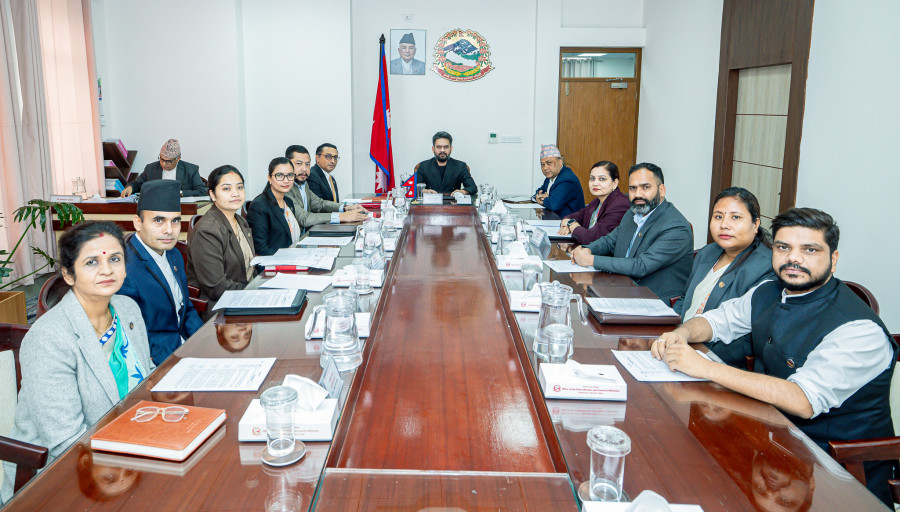
Government says restructuring aims to reduce state expenditure, improve efficiency and streamline governance. The current Cabinet has 15 members, with Prime Minister Shah also holding the defence and home portfolios. Photo: Courtesy of Prime Minister’s Office
The federal government has decided to reduce the number of ministries from 21 to 18 as part of a major administrative restructuring aimed at cutting recurrent expenditure and improving efficiency.
A Cabinet meeting on Wednesday approved the Government of Nepal (Allocation of Business) Regulations, 2026, paving the way for the restructuring. The decision will come into effect after publication in the Nepal Gazette on Thursday, according to the Prime Minister’s Office.
Nepal’s constitution allows a maximum 25-member Cabinet, including the prime minister. Successive governments, however, have often been criticised for expanding ministries and ministerial positions to accommodate coalition partners.
The decision follows a recommendation by a committee led by Govinda Bahadur Karki, secretary at the Office of the Prime Minister and Council of Ministers, which had proposed limiting the number of ministries to 17. The 100-point roadmap endorsed by the Cabinet on the day Prime Minister Balendra Shah formed the government had also pledged to reduce ministries to 17. However, the Cabinet ultimately decided to maintain the count at 18.
Minister for Communications and Information Technology Bikram Timalsina said some ministries had been merged while others were renamed. The Rastriya Swatantra Party (RSP) had previously committed to the downsizing and restructuring of ministries in its election manifesto.
Finance Minister Swarnim Wagle said the restructuring was intended to improve transparency, administrative efficiency, and reduce the state’s financial burden.
According to Wagle, the Ministry of Physical Infrastructure and Transport and the Ministry of Urban Development have been merged into a single ministry overseeing infrastructure and construction.
“This was done by linking infrastructure and urban development with the construction sector,” Wagle said. “It emphasises infrastructure and construction.”
Deepa Dahal, press and research expert to the prime minister, said the ministries of finance, home affairs, foreign affairs, defence, and law, justice and parliamentary affairs would remain unchanged.
No changes have been made to the ministries of industry, commerce and supplies; culture, tourism and civil Aviation; and energy, water resources and irrigation.
A new Ministry of Science, Technology and Innovation has been created by separating science and technology functions from the Ministry of Education, Science and Technology, expanding its mandate to include innovation.
Other ministries in the new structure include the Ministry of Education and Sports, the Ministry of Communications, the Ministry of Youth, Labour and Employment, and the Ministry of Land, Cooperatives, Federal Affairs and General Administration.
The government has also formed the Ministry of Women, Children, Gender and Sexual Minorities and Social Security, the Ministry of Health and Food Security, the Ministry of Infrastructure Development, and the Ministry of Agriculture, Forests and Environment.
The current Cabinet has 15 members, with Prime Minister Shah also holding the Defence and Home portfolios.




 25.02°C Kathmandu