A protagonist’s moral ambiguity is rarely announced in a celebratory, character-driven story. However, such is the creative risk taken by the makers of ‘Kokuho’ and it is the very quality that defines the film’s artistic triumph.
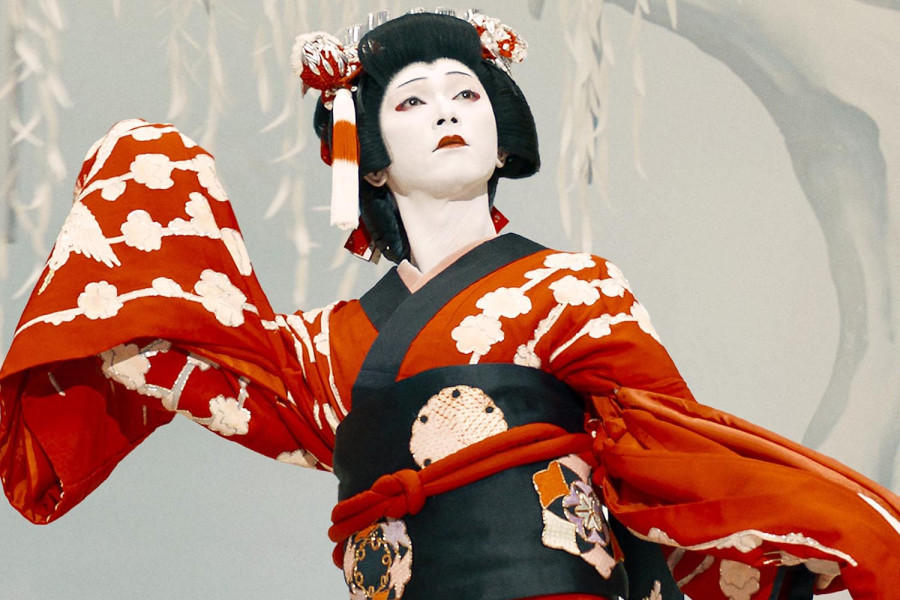
The film opens with the New Year’s celebration hosted by the leader of a yakuza gang. There, his son, Kikuo performs Kabuki; a traditional Japanese theatre in which onnagata (male actors who specialise in female roles) occupy a revered place. Among the audience is Hanjiro Hanai, regarded as Osaka’s greatest Kabuki actor, who is immediately captivated by the fourteen-year-old’s talent.
Soon after, the child witnesses his father’s murder. Although the story initially appears to be steering toward revenge, it swiftly pivots into the demanding and disciplined world of Kabuki, where Kikuo is taken under Hanjiro’s guidance along with his own biological son Shunshuke.
Kabuki ultimately replaces vengeance for Kikuo. Rather than fighting fire with fire, he channels his grief toward Kabuki as the only choice for survival and refuge. But along the way, it consumes every part of his identity, making it a matter of esteem, then eventually an irresistible pride.
With Shunshuke’s and Kikuo’s journeys existing with equal depths of characterisation and narrative arc, the audience is made to empathise, question, relate, resist, all while the story moves with a memorable flow.
Spanning over five decades of timeline, ‘Kokuho’ follows their relentless pursuit of artistic greatness. Within this, it explores the tradition of onnagata, born from the historical exclusion of women on stage. Eventually, through the performers’ embodiment of femininity, the film reveals a devotion to art along with the defiance of gender norms.
Kikuo’s one particular recurring vision drives the film’s exploration of moral ambiguity. A dark expanse filled with falling white fragments and scattered sparks of light shows a mind caught between innocence and obsession. Kikuo’s battle becomes the one with himself and his desire to become indispensable to Kabuki, rather than the one against the men who killed his father.
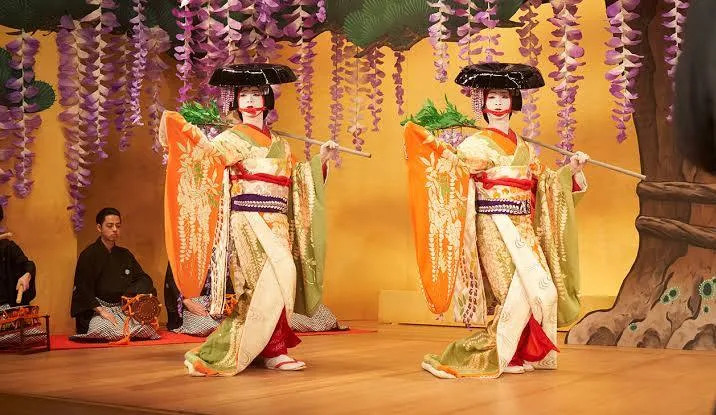
Along this depiction, ‘Kokuho’ leaves a cinematic mark with its cinematography and masterful use of light and colour. The interplay of light and shadow, bright and muted colours, warm and cool texture surely heightens the film’s aesthetic beauty.
Photo: Screengrab via YouTube
The juxtaposition between life on and off the Kabuki stage is also rendered with precision through its visual language. On the stage, luminous lighting becomes a matter of elegance and grandeur. Offstage, natural lightings and restrained compositions create a contrast apart from the dialogue’s impacts.
‘Kokuho’ can also be claimed as the gateway to Japan’s theatrical heritage. Even without prior knowledge of Kabuki or the centuries-old tradition of onnagata, the film remains accessible. Each play is contextualised with its meaning being kept as a subtitle before its start. Therefore, rather than assuming familiarity, it immerses the audience in the art form’s rigorous discipline and cultural significance, resulting in the universality of the cultural specificity rather than making it alien.
As a film about theatrical acting, the heights it promises and sacrifices it demands, the cast leaves a remarkable legacy. Blending the technical precision of Kabuki with the psychological depiction exacted by a lifetime devoted to artistic perfection, the actors’ improvisations make the film particularly memorable.
We are initially told that Shunshuke is bound to carry his father’s legacy. Yet Kikuo's expertise unsettles that expectation. Crushed by the impossible weight of comparison and the fear of being eclipsed, Shunshuke’s, with his identity overlooked by his own father, withdraws out of inadequacy.
A scene where Shunshuke helps Kikuo apply his makeup backstage, ultimately leads to an imbalance between them, resulting in Kikuo’s emotional collapse. It is here that Kikuo confesses he wishes to drink a glass of Shunshuke’s blood. This startling expression of his desire to possess the effortless lineage and legitimacy that Shunshuke was born with, becomes one of the most emotionally daunting instances of the film.
“He is a national treasure. He will leave nothing but his art when he dies.”
The remark, made about Japan’s most celebrated Kabuki actor in his final moments, becomes Kikuo’s own aspiration, suggested by the film’s title ‘Kokuho’ which is translated as the ‘national treasure’.
Kabuki is an artform built upon the transformation of pain into beauty, and so is Kikuo’s life. Every moral compromise he embraces is transfigured into artistic brilliance on stage, making it an uneasy coexistence of empathy and moral dilemma for the audience.




 23.39°C Kathmandu