Leopard rescues highlight rising human-wildlife conflict in Nepal’s far west
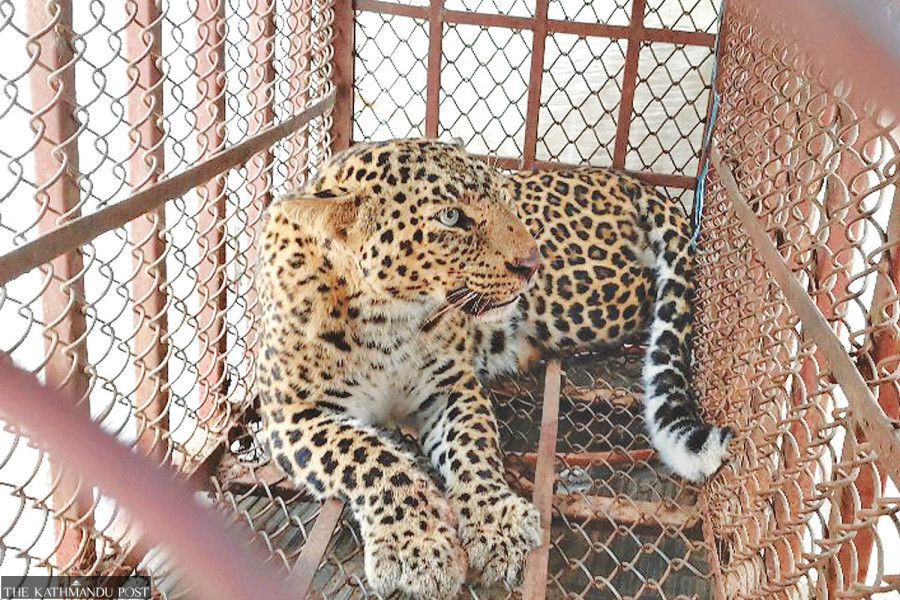
Conservation study finds big cats increasingly roaming near settlements in Sudurpaschim as shrinking prey and habitat push wildlife closer to people. Post file photo
Conservation teams in Sudurpaschim Province have rescued 28 leopards trapped in snares over the past decade, highlighting a growing human-wildlife.
The rescues were carried out by technical teams from the National Trust for Nature Conservation (NTNC) in Kailali and Kanchanpur districts, as well as several hill areas of Sudurpaschim Province. Officials said many other leopards escaped from traps before rescue teams arrived, while some died after being caught.
Researchers and conservationists said the figures reflect a broader rise in encounters between people and wildlife across the province, where attacks on livestock, crop damage and occasional assaults on humans have become increasingly common.
A recent NTNC study conducted in the hill districts of far western Nepal found that leopards are now moving and hunting close to human settlements in several areas. The study was carried out under the Shuklaphanta Conservation Programme.
Leopard activity was found to be particularly high near settlements in the lower Saurad region of Baitadi district, the Chaulani corridor and Api Base Camp area in Darchula, and along much of the Mahabharat range in Doti district.
“We need activities that promote coexistence between humans and wildlife,” said Laxmiraj Joshi, chief of the conservation programme. “Human-wildlife conflict can only be reduced if people understand animal behaviour, local communities are linked to sustainable livelihoods, and awareness programmes are expanded.”
According to forest and national park authorities, more than 3,300 incidents related to human-wildlife conflict have been officially reported across the province over the past decade. Most involved leopards, followed by monkeys, wild boars and elephants.
Conservationists said a decline in prey inside forests has forced leopards to move closer to villages in search of food. Officials also believe many incidents go unreported.
“It is time for humans to change their behaviour as well,” Joshi said. “We have to develop coexistence for both humans and wildlife.”
He said reducing conflict requires understanding wildlife movement patterns and adapting human behaviour accordingly.
The NTNC conducted field studies in Darchula, Baitadi, Dadeldhura, Doti, Achham, Bajhang and Bajura districts to examine wildlife populations, habitat conditions and interactions between animals and local communities.
Researchers installed automatic camera traps in multiple forest areas and also carried out occupancy surveys, in which technicians trekked through forests to identify wildlife presence through footprints, markings, prey availability and habitat conditions.
Camera traps were placed for at least 15 days in each selected location. Much of Dadeldhura district was covered during the survey, while partial areas of other districts were also included.
The year-long study, conducted between February 2024 and early 2025 in Doti, Dadeldhura, Baitadi and Darchula, documented 22 species of mammals.
Researchers also recorded 18 mammal species in the Badimalika and Ramaroshan regions.
Beyond wildlife, the trust also studied medicinal herbs and plant diversity in the region. Researchers documented 301 plant species in Ramaroshan and 517 species in Badimalika.
Joshi said the study also recorded 128 butterfly species and 190 bird species in the surveyed areas.
The conservation programme has also trained local facilitators across Sudurpaschim Province to help reduce conflict between people and wildlife. These facilitators work within communities to spread awareness about animal behaviour, ways to avoid attacks and the importance of wildlife conservation.




 12.9°C Kathmandu