Prolonged delays in approving initial public offerings (IPOs) have disrupted capital mobilisation plans and affected project execution and business expansion, stakeholders said.
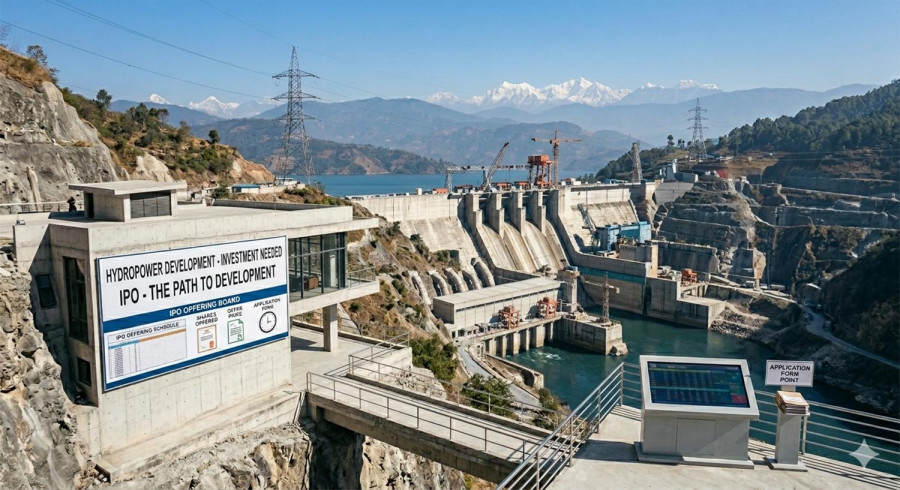
The impact has been most visible in the hydropower sector, where developers say financing structures have been strained due to delays in equity mobilisation.
Uttam Bhlon Lama, vice-president of the Independent Power Producers’ Association, Nepal (IPPAN), said projects are facing funding gaps as bank financing plans are tied to expected IPO proceeds.
He said companies typically structure projects with 70 percent bank financing, with the remaining 30 percent raised through public share issuance. Delays in issuing shares have left several projects unable to meet financial commitments.
“Failure to issue IPOs within the stipulated time has stalled projects for a prolonged period,” he said, adding that banks are pressing developers to fulfil equity obligations, further complicating project development.
He added that companies must also obtain credit ratings and enter underwriting agreements before issuing shares. Underwriting agreements are valid for six months, requiring repeated renewals if approvals are delayed, increasing costs for developers.
As of now, 98 companies have applied to the Securities Board of Nepal (SEBON) for IPO approval, seeking to raise a combined Rs66.23 billion.
Officials said the backlog has built up due to past leadership gaps at the regulator, employee protests, and delays in approval processes, even after the appointment of a new SEBON chair.
Market participants said several companies have been unable to proceed with share issuance despite being in the approval pipeline. Once approved, companies are required by law to issue shares within two months.
According to SEBON, the 98 companies are seeking approval to issue a total of 442.17 million shares. Of these, 18 companies from the hotel and tourism sector plan to raise Rs6.45 billion. Thirty-two hydropower companies have applied to raise Rs15.54 billion, while five investment companies have sought approval for IPOs worth Rs3.41 billion.
Similarly, 26 manufacturing and processing companies are in the pipeline to raise Rs34.23 billion. Three micro-insurance companies have applied for IPOs worth Rs67.5 million, while 14 companies from other sectors plan to raise Rs5.90 billion.
Stakeholders said prolonged delays have disrupted project financing structures, particularly in hydropower, where equity mobilisation is closely linked to debt arrangements. Promoters typically invest 70 percent of capital and raise the remaining 30 percent through public share issuance.
Of this, 10 percent is allocated to project-affected locals and 20 percent to the general public. Delays in raising funds have affected project implementation, industry representatives said.
Chandra Prasad Dhakal, outgoing president of the Federation of Nepalese Chambers of Commerce and Industry, said IPO approvals should not be delayed as they directly affect projects and businesses. He said restricted access to capital markets disrupts investment planning and project timelines.
Kamlesh Kumar Agrawal, president of Nepal Chamber of Commerce, said regulatory delays should not happen without clear decisions. He said the issue has been repeatedly raised with authorities, including the finance minister, but no clear arrangements have been made.
He said the supply of shares should not be obstructed, and applications should not remain pending without approval or rejection. Delays in capital mobilisation affect both construction and operations of projects, he said.
“It may look like a small issue, but for a company or project, it carries significant value,” he said. “When the capital cycle itself is disrupted, construction and operations are seriously affected.”
He added that the Securities Board should not only enforce regulatory compliance but also facilitate companies in the process.
SEBON officials, however, defended their position, saying approvals are processed based on compliance. Spokesperson Niranjaya Ghimire said companies that meet all requirements are granted approval without delay.
He said only applications that fulfil regulatory conditions are processed. He added that a new framework has been implemented from mid-April to make IPO issuance faster and more transparent.
SEBON was without a chairperson from late 2023, during which IPO approvals slowed significantly.
The government appointed Santosh Narayan Shrestha as chair in November 2024. He resigned on April 17, 2026, raising concerns about potential delays in IPO approvals again. His tenure saw a limited number of approvals, drawing criticism from stakeholders.
Some hydropower developers also accused the regulator of irregularities in the approval process. The allegations were investigated by the Commission for the Investigation of Abuse of Authority, although no case has yet been filed. The former chair has denied the claims.
Officials said only companies meeting criteria such as a minimum net worth of Rs90 per share, absence of disputes, and full compliance with requirements are being processed.
As of mid-March 2026, 286 companies were listed on the Nepal Stock Exchange, up from 268 a year earlier.
Of these, 133 are banks, financial institutions and insurance firms, followed by 97 hydropower companies, 27 manufacturing and processing industries, eight hotels, seven investment companies, four trading firms and 10 others.
Banks, financial institutions and insurance companies account for 52.2 percent of total market capitalisation. Hydropower companies hold 15.9 percent, investment companies 7.4 percent, manufacturing and processing industries 7.2 percent, trading firms 4.4 percent, hotels 3.1 percent, and other sectors 9.8 percent.




 26.87°C Kathmandu