After Balkhu’s demolition, families have nowhere to go
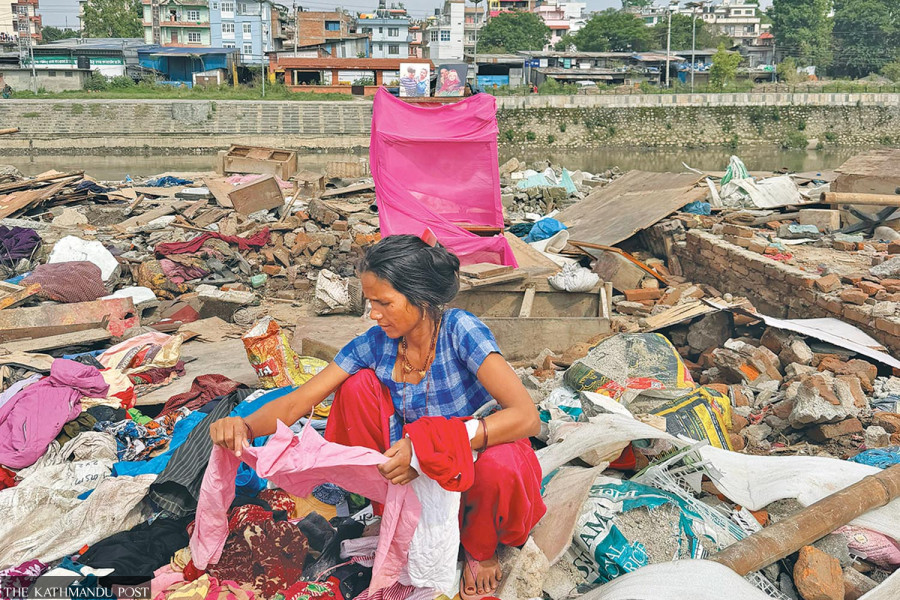
Squatter families scour the debris of their homes for belongings. Promised aid has yet to materialise.A woman salvages her belongings from among the rubble at Balkhu, Kathmandu on Sunday. Tara Prakash/TKP
In Balkhu, Mandira crouches in the rubble. Just two days ago, her home stood here. Now, she searches for clothing for her 10-year-old son and five-year-old daughter. They, like many families, did not have time to take everything from their home before the bulldozers arrived on Friday.
She pulls a blue sweatshirt out from under a slab of concrete. The fabric is torn at the sleeve, caked in a thick coat of dust, but she folds it anyway and places it into the plastic bag at her feet. Next is a pair of pants, splayed out a few feet away. She stretches them in front of her, trying to rub off the dust, scrubbing at the hem with cracked, calloused fingers.
Her wrist is fractured. She injured it while rushing to collect everything before the bulldozers began the demolition. She tries to flex her fingers, but her forefinger does not move.
Her hand is the least of her worries. Her husband is ill with tuberculosis. A hospital visit is too expensive. Once she finishes collecting these clothes for her children, she will return to take care of her husband. The family is staying at a friend’s, but the friend’s landlord wants them gone. They spend their days outside, coming back to the room only at night to sleep.
In recent weeks, the federal government has intensified eviction drives across the Kathmandu valley, deploying bulldozers and police to clear informal settlements on riverbanks and public land. The campaign is part of a broader push to remove encroachments and verify the status of landless populations. On May 1, a total of 486 temporary structures in Balkhu were demolished.
“We have nowhere to go,” says Mandira, who works as a cook for a party venue. Right now, her son and daughter are at school. She cannot afford to pay their school fees, but the school is teaching them anyway, at least temporarily. But with the children constantly moving and no stable place to live, they cannot properly learn. “People expect children to be doctors,” she says with a sigh, shaking the dust off a pair of faded jeans. “But they can only be good people when they receive an education.”
Close to Mandira is an altar-like structure, one of the only structures still standing. Draped across the table is a pink cloth, with two photos propped on it. In one photograph, a baby sits beaming in a woman’s lap. The woman’s arm rests over the child’s body. She is smiling, her eyes creased at the edges.
In the photograph beside it, a young man and woman stand with their arms around each other. “These are pictures of the family that used to live here,” a man nearby says, glancing up.
It is hard to know where the subjects of those photos have since gone.
The man is still staring at the family pictures. His name is Dilbahadur. He is 48 years old and, like Mandira, is searching for items for his family. “I am trying to pick out anything that can be useful,” Dilbahadur says.
Mandira’s friend approaches. Mandira waves her over, holding something in her raised hand. “Tarkari!” she calls out. She has found a vegetable in the debris: chickpeas. She unzips her bag to show her friend, then pops a few in her mouth. They are going to share them.
Further down the strip, a family of four sits under a makeshift structure of bamboo poles. They have two children under two years old. Curled in his mother’s lap, the 18-month-old son starts to cry. The mother peels up her shirt and begins to breastfeed him. As he drinks, his tiny fist uncurls, revealing fingernails lined with grime and dirt. When he is done, she lays him down on a piece of cardboard, tucking a folded blanket beneath his head to soften the rubble below, and he dozes into sleep.
His father waves a splintered baby rattle above his son as he rests, trying to keep the flies off of him. He is unsuccessful. The flies land at any skin they can find.
This family once lived in a rented room near Balkhu. Because of the father’s alcoholism, they were forced to leave. For a time, they lived on the streets with their children. Three months ago, they arrived here. “The government says that certain organisations will give us aid,” the woman says.
The family has not had a proper meal in several days. They cannot afford cooking gas, and the place they once relied on to make fire was destroyed by the police. “We cannot return to our village because we cannot afford the bus fare,” the mother says.
A few feet away, an older woman, Lakshmi, sits on a stool. She is 55 years old and living with her daughter-in-law and eight-year-old granddaughter. Her husband died a few years ago. “I am looking at my demolished house,” she says, her eyes trained on a certain pile of rubble in the distance. She has lived in that space for 22 years.
Before, her granddaughter went to school inside a nearby church. That building is gone now, too. “She has nowhere to study,” Lakshmi says. Her granddaughter walks over and leans into her, then climbs onto her lap.
The girl keeps her eyes downcast. Right now, she should be in Grade 2. Only two of her friends are here. “I don’t go and play with them,” she says. She has no idea where the rest of her friends are.
A group of men crouch beside an open manhole, feeding a black pipe through. They watch the pipe swell with fluid. When it releases into the street, it is sewage—thick and dark—that spills onto the dirt. A girl, Smriti, sidesteps the spreading pool, trying to keep her bare feet clean.
Though Smriti never lived here, she knows many of the people who did. One of her friends, who once lived on this strip, is now in Taudaha, renting a room. “We used to play here as kids,” she says. “I feel bad for her.” Smriti currently has her board exams at school, where she is in Grade 12. “My friend comes to school to take the exam, but it is difficult since she has to constantly move from one place to another,” she says.
A man is walking down the road with his wife and two children. His name is Pratap Mahat, and he is 24 years old. He arrived here from Nepalgunj years ago and married four years ago. Right now, his family is renting a place in Kalimati. “Even our beds were destroyed,” his wife says, staring out over the wreckage, her baby daughter at her hip. The child squirms in her mother’s arms.
“My son asks me to buy different things for him,” Mahat says. “I cannot afford them. It is embarrassing.” His son is standing next to him, tugging at his arm. Mahat wants to educate his children, but he cannot afford to. He used to carry loads for work, but now jobs are harder to find. “I have heard that if someone has no land, the government will provide,” he says. “I am not sure if it is true.” An older woman comes over and tells the wife she should have left her husband and taken her children to a nearby shelter.
The conversations happening here are strictly practical. People move between one another, asking about rooms, about rent, about where they might stay for the night. The questions repeat: Where will you sleep? What will you eat?
Many spent the night on the street the day their homes were demolished. They say the government should have given them more notice to find a new place to live. One woman argues the government should have never allowed people to settle here in the first place. A father says that as soon as he heard about the government’s plan, he spent the rest of the day looking for a room. But the rent was too high wherever he travelled. That night, his family slept on the street.
“If this happened to the rich, they would be able to do something, but us poor have to rely on government aid,” Dilbahadur said. Many are uncertain what the government will do for them, and do not know what comes next. For now, they focus on finding food and a place to sleep.
Towards the end of the land strip, a temple still stands, its shrine visible. Through the archway, several idols sit in a glass case, untouched. It is unclear which deities are depicted. A few women stand nearby. They say that many people, especially the elderly who cannot travel to Pathibhara Mandir, come here for puja.
Nearby, two people ride a motorcycle down the road. The person in front suddenly slides off the seat. He looks young, no older than 20. He crumples to the dirt, his feet buckling beneath him. The other man rushes to lift him under the armpits. “Over here!” he shouts in Nepali to someone nearby. They walk on either side of the boy, guiding him toward a makeshift shack. There is no clinic in sight. Here, even a minor injury becomes something to weigh against food, clothing, or now, rent. For many, treatment is delayed, improvised, or avoided altogether.
Mandira is still moving through the rubble, placing what she finds into the plastic bag at her feet. It is slowly filling with items. Underwear. A sweatshirt. A pair of pants. Things her children may still wear. Things she may be able to eventually wash clean. Around her, others do the same. By evening, she will leave with what she can carry. The rest will remain behind.
Names have been changed to protect the identities of residents.




 14.69°C Kathmandu