Suspension bridges were once lifelines for mountain communities. Whether crossing turbulent monsoon streams or year-round rivers, these swaying structures provided a safe and dependable crossing for travellers.
For schoolchildren, families rushing the sick to health posts, and locals heading to markets for daily needs, these bridges did more than shorten journeys. They made daily life possible.
Today, many of these bridges in Dhankuta, which once connected neighbouring settlements, are falling into disuse. The suspension bridge over the Tankhuwa Khola, linking Khaniyabas in ward 5 of Dhankuta Municipality with Banchare Puchhar in ward 3 of Chhathar Jorpati Rural Municipality, reflects this shift.
At its peak, the bridge served as a key crossing for people from Teliya and Tankhuwa in Dhankuta, as well as from Phayak, Shukrabare, and Phakchamara in Tehrathum. It now stands abandoned. Since the blacktopped road from the district headquarters through Bhimbare Haat, Karmitar, and Teliya to Khoktap was completed, foot traffic has disappeared.The bridge is now used only occasionally, when passengers step out of vehicles briefly to take photographs.
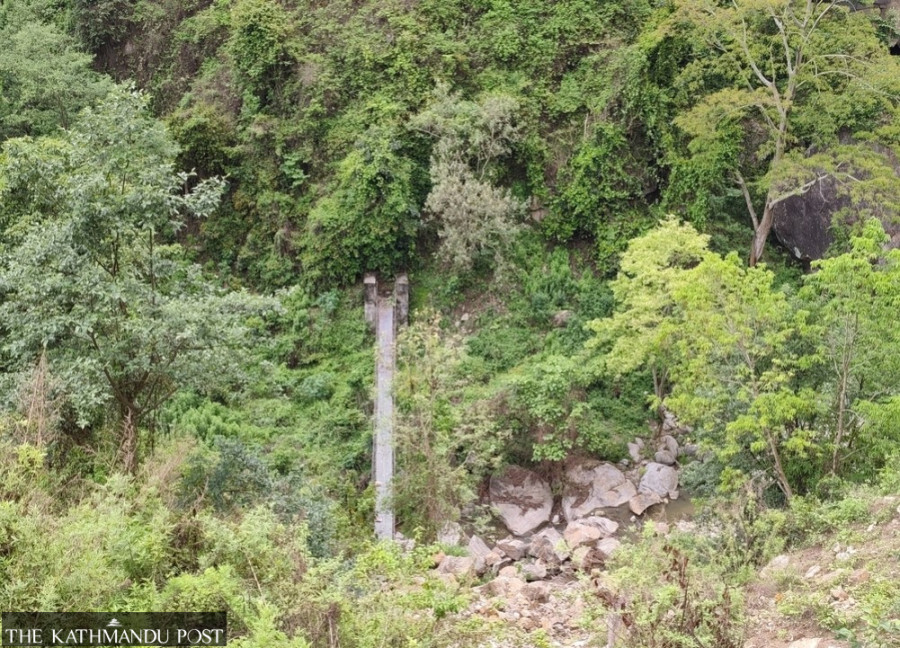
A similar situation exists at the bridge over the Nibuwa Khola, which connects Sipting Puchhar in ward 3 of Dhankuta Municipality with Bhirgaun in ward 2. Falling rocks from nearby cliffs have already damaged parts of the structure. With the old foot trails no longer in use, the bridge remains isolated and partially broken.
The Kangsuwa bridge over the Teliya Khola in ward 4 of Chhathar Jorpati Rural Municipality tells the same story. It has remained unused for years, as both travellers and farmers have shifted to newer and more accessible routes.
These examples reflect a broader trend across the district. With the rapid expansion of road networks in Dhankuta, dozens of suspension bridges have become redundant. As motorable roads and culverts replace foot trails, these structures, built with significant public investment, have been left neglected and unprotected.
Sitaram Gautam, a former officer at the then district development committee in Dhankuta, recalls that more than 60 suspension bridges were constructed across the district. “Many bridges built to meet the needs of that time have now lost their relevance,” he said. “There are provisions to relocate them to areas where they are still needed, but no action has been taken.”
According to Gautam, at least 15 bridges across the district’s seven local units are now completely out of use.
Min Prasad Subedi of Poverty Alleviation and Rural Development Programme (Pardep) Nepal, Dhankuta, an organisation involved in social mobilisation for bridge construction since 2008, said each bridge represents an investment ranging from Rs3 million to Rs10 million. “While a few are still in limited use, most have lost their significance,” Subedi said. “As roads and new tracks replaced old walking paths, many of these bridges no longer lay on active routes.”
These bridges were originally built to reduce the risks of crossing rivers and streams while accessing schools, health centres, and markets. However, the past decade has seen a rapid expansion of rural roads. As motor tracks reached villages, traditional foot trails gradually disappeared. Routes once used by pedestrians have been replaced by roads, shifting movement from foot to vehicles.
Milan Khadgi, ward 6 chair of Dhankuta Municipality, said this transition has significantly reduced the usefulness of suspension bridges.
Allowing these structures to deteriorate risks wasting millions in public funds. Steel components and suspension cables are already showing signs of deterioration. Gautam, who served at the District Development Committee for nearly two decades, suggested that such bridges could be dismantled and reinstalled in remote areas that still lack road access, or repurposed for trekking routes and tourism.
Subedi stressed the need for urgent action. “These unused bridges should be relocated to places where they are needed as soon as possible. Otherwise, they will simply rust away,” he said.
Responsibility for the maintenance and management of suspension bridges now lies with local governments. However, these authorities have yet to show clear interest in reclaiming or relocating the structures that have been left behind by expanding road infrastructure.




 17.63°C Kathmandu