Homes razed, futures shaken: Evictions hit students at a critical juncture
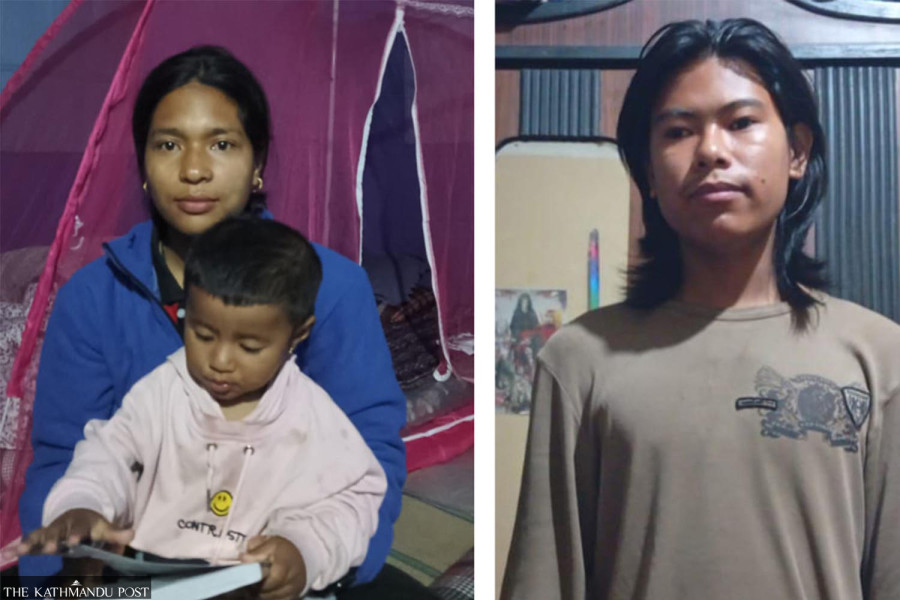
As bulldozers tear through informal settlements in Kathmandu, displaced students sit for exams under extreme distress. Girwanika Thapa (left) and Sushal Limbu Post photos
In Nepal’s education system, the Class 12 examinations mark a decisive threshold. It shapes access to higher education and often determines the trajectory of a student’s career. For many students from informal settlements in Kathmandu, however, this year’s exams have become far more than an academic assessment. They have turned into a test of endurance amid sudden displacement, loss and psychological strain.
Last Saturday, government-led demolition drives in Thapathali, Gairigaun and Manohara settlements flattened hundreds of makeshift homes. Along with them, they disrupted the lives of students who were days away from sitting their final school examinations. For these students, the destruction was not only physical. It struck at their sense of stability at a moment that demanded focus and composure.
The demolitions have left many grappling with dual pressures. On one hand is the trauma of watching their homes, neighbourhoods and years of lived experience reduced to rubble. On the other hand is the urgency of performing in examinations that could define their future.
The Class 12 exams began on Monday. In the days leading up to them, students from these settlements had been immersed in preparation. That routine collapsed overnight. Displaced by the state, some are now taking exams while living under tarpaulin sheets in open spaces, while others have crowded into relatives’ small rooms. The disruption has been both logistical and psychological.
Kalpana (name changed) grew up in the Manohara settlement. For her, the exams that began on April 27 were meant to be a turning point. She had committed herself to thorough preparation and had even attended tuition classes on the morning of the demolition.
When she returned home, there was no home left.
In place of her house stood a heap of broken bricks, corrugated sheets and splintered wood. She had no time to retrieve her books, notes or even her school uniform. Standing before the debris, she broke down.
Her family had lived in the settlement for 25 years. They had not believed their home would be demolished abruptly. Like many others, they had assumed that warnings issued in the past would not translate into immediate action.
Kalpana’s mother, Shubhadra, recalls the moment with visible anguish. “We never believed the government would act this harshly,” she said. “We didn’t even tell our daughter that the house might be demolished. We wanted her to focus on her exams. She went to tuition, thinking everything was fine. When she came back and saw the house gone, she just cried.”
The family lost everything within minutes. Clothes, documents and Kalpana’s study materials were buried under the rubble.
“We wouldn’t wish this on an enemy,” Shubhadra said. “Everything we had built over 25 years is gone. Even my daughter’s books were crushed in the house.”
Kalpana now lives in a relative’s cramped room in Lokanthali. From there, she travels to her exam centre in Kupandole. The environment is far from conducive to study, but she has little choice.
“We took loans to educate her up to Class 12, hoping she would have a better future,” Shubhadra said. “But just as her exams began, the state pushed us onto the street.”
***
In Thapathali, Girwanika Thapa’s story underscores a different dimension of the crisis. A mother of two, she had returned to formal education after a gap of nine years. Determined to complete her schooling, she saw the Class 12 exams as a chance to fulfil a long-delayed goal.
That hope, too, was shaken.
The uncertainty began days before the demolition, when municipal authorities issued warnings through loudspeakers, instructing residents to vacate. From that moment, her attention shifted away from studies.
Her concern turned to her children’s safety and the question of where they would live.
When the bulldozers finally arrived on Saturday, her home was destroyed. The shock left her so overwhelmed that she initially decided not to sit for the exams at all.
“With small children to care for, I didn’t know where to keep them or how to feed them,” she said. “At the same time, the exams were approaching. I felt completely torn. At one point, I decided I wouldn’t take the exams this year.”
It was her husband who persuaded her otherwise.
“He told me that after coming back to studies after so many years, I shouldn’t give up now,” she said. “Only because of his support did I gather the courage to go to the exam centre.”
Even so, the psychological toll has been severe.
“It’s very difficult mentally,” she said. “So many thoughts keep coming to mind. You cannot study properly in this kind of chaos. It’s not like sitting in a quiet corner of your own home.”
After losing her house, Girwanika moved to a holding centre in Kirtipur, where she now lives under a tent. The conditions are cold and insecure. Her books and notes were destroyed in the demolition, leaving her without study materials at a crucial time.
Following public attention, Kathmandu Metropolitan City’s acting mayor Sunita Dangol provided her with replacement books. Some individuals have also helped her access online learning resources. Yet these efforts, while helpful, do little to address the broader strain of displacement.
***
Nineteen-year-old Sushal Limbu’s experience adds another layer to the crisis. His house was also destroyed on Saturday, just days before his exams began.
Until a few hours before the demolition, he had been studying in his room. He had heard discussions about a possible eviction; like many residents, his family did not believe it would be enforced immediately.
“Previous governments had issued similar notices, but nothing had happened,” he said. “We thought this time would be the same.”
That assumption proved wrong.
As municipal teams arrived and began announcing the imminent demolition, panic spread. Sushal abandoned his studies and joined his parents in hurriedly packing essential belongings.
“It was chaotic,” he said. “We were trying to save whatever we could while also thinking about the exams starting on Monday.”
The emotional strain was intense. He had to watch his home being destroyed just a day before what he describes as the most important exam of his life.
“I couldn’t revise properly at the last moment,” he said. “At the same time, seeing your home collapse in front of you is something you can’t process easily. I was under extreme stress.”
After the demolition, his family moved into a hotel near the New Bus Park. Sushal, however, could not stay with them due to the distance from his exam centre. Instead, he moved into his aunt’s room in Sinamangal to minimise travel time.
He has completed three exam papers so far, but admits that the first did not go as expected due to mental strain.
“It would have been much better if I could have stayed with my family and prepared in peace,” he said. “Being separated at such a time is very difficult. I keep thinking about how my parents are managing, where they are staying.”
Kalpana, Girwanika and Sushal represent only a fraction of those affected. Many other students from the demolished settlements are navigating similar hardships.
Despite the scale of disruption, the state response has been limited.
Only after widespread criticism did the Centre for Education and Human Resource Developmentunder the Ministry of Education issue a circular. It requested local governments to facilitate transportation for displaced students and to assist with exam arrangements and school adjustments.
The circular, addressed to local authorities with copies sent to Education Minister Sasmit Pokharel and Education Secretary Chudamani Paudel, stops short of outlining comprehensive support measures.
There is little clarity on how students coping with homelessness and psychological distress are expected to manage with transport assistance alone.
Education Secretary Paudel has said that the National Examinations Board will provide special facilitation for affected students.
“We have asked students facing difficulties due to displacement to contact the board directly,” he said. “Based on their situation, necessary arrangements will be made.”
However, details of such arrangements remain unclear.
As they write their papers in exam halls across Kathmandu, many carry with them the memory of homes lost just days earlier. The outcome of these exams may still shape their future, but the circumstances under which they are being taken raise serious questions about equity, preparedness and the role of the state in safeguarding vulnerable populations.




 14.81°C Kathmandu