Balendra Shah tried to remove squatters’ homes as Kathmandu mayor. Now PM, he’s making a new push
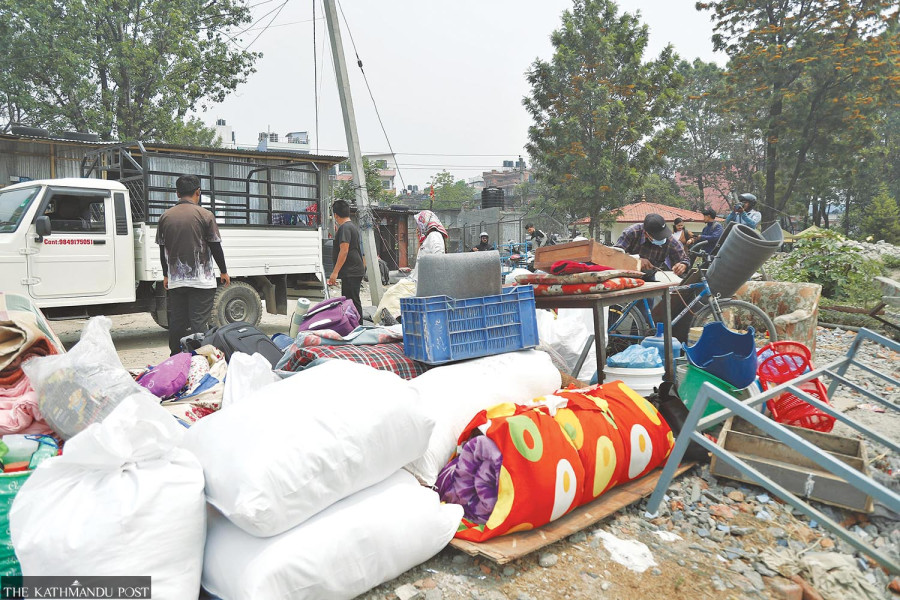
Authorities say structures on encroached land will be demolished and displaced families relocated. Critics argue the plan lacks adequate resettlement guarantees.Squatters living along the Bagmati riverside in Thapathali, Kathmandu bundle their bedding and belongings on Friday as they prepare to leave following government eviction orders. Deepak KC/TKP
The government is preparing to deploy security forces to clear squatter settlements along the riverbanks in Thapathali, Gairigaun and Manohara of Kathmandu, with demolition of houses and temporary shelters set to begin at 6am Saturday.
A meeting of relevant agencies at the Ministry of Urban Development on Friday decided to proceed with the eviction drive.
Kathmandu Assistant Chief District Officer Muktiram Rijal said any obstruction to the operation will face strict legal action. He said all structures built on encroached public land will be demolished, and affected families relocated.
“The houses and structures will be removed, and encroached land fully cleared. Those displaced will be relocated to designated areas arranged by the government,” Rijal said.
The administration issued a public notice warning that any obstruction to the operation will trigger action by the local administration, police and the Kathmandu Metropolitan City. The notice further warned that individuals would be held responsible for any damage to property during demolition if they fail to comply.
The decision has triggered strong opposition from human rights organisations, civil society groups and political parties, who say the eviction is being planned without adequate consultation or guaranteed relocation.
The United National Squatter Front Nepal has warned that the use of security forces for forced eviction without alternative arrangements would amount to a violation of human rights. It has urged the government to halt the operation and instead expedite processes through the Land Problem Settlement Commission to resolve the issue.
Meanwhile, Nepal Police arrested Narayan Pariyar alias Parishrami, acting chair of the Squatter Front and a CPN-UML leader. Police said he was arrested on charges of a banking offence and clarified that the arrest is not related to the government’s eviction drive or other ongoing actions in the area.
Various human rights bodies have cautioned the government against evictions without ensuring adequate alternatives. The National Human Rights Commission reminded the government of its recommendation to identify genuine squatters and arrange alternative housing for them.
“The commission today [Friday] wrote to the government seeking an update on the progress of its implementation,” said commission spokesperson Shyam Babu Kafle. Likewise, Amnesty International said forced eviction without prior consultation, verification or resettlement measures reflects a dangerous erosion of the rule of law and signals an increasingly authoritarian approach.
“The recommendation decision had already been sent to the government for implementation. Today, we have again written to the government seeking an update on the progress of its implementation,” said Commission spokesperson Shyam Babu Kafle.
“In the current situation, the Commission has directed the government to implement its recommendations and the orders issued by the Supreme Court, identify genuine squatters, make necessary arrangements for their shelter, and refrain from using excessive force in the course of clearing houses and huts built on encroached land, while maintaining restraint.”
“The move signals an increasingly authoritarian approach. The government’s roadmap had promised to resolve the issues of landless squatters within a fixed timeframe,” the statement said. “Evicting families without prior verification, meaningful consultation or assurance of alternative housing undermines that commitment and risks turning a governance challenge into a preventable human rights crisis.”
The main opposition Nepali Congress said the issue should be resolved through dialogue rather than confrontation.
According to a report by the High Powered Committee for Integrated Development of the Bagmati Civilisation, the Kathmandu Metropolitan City alone has 2,245 landless squatters.
Project director Machakaji Maharjan said repeated efforts to remove settlements in the Kathmandu valley over a long period ended in failure. “Because they live in high-risk areas, there has always been a fear of floods every monsoon, so we have been trying to relocate them,” he said. “We had even built houses in Nagarjun Municipality for their management,” Maharjan said.
The space is available only for 45 people in the housing, while other structures are being used by an ashram and could be used for relocation if needed.
However, senior advocate Raju Chapagain said the government was geared for forced eviction, bypassing legal procedures. He said an agreement had been reached during Balendra Shah’s tenure as mayor with the Land Problem Settlement Commission to first verify squatters, but it was never implemented. “Instead, bulldozers were sent into their settlements. A case was also filed at the High Court Patan against that move,” he said.
Chapagain, who argued in the case against the eviction, said the court had directed the authorities not to remove settlements without verification.
“The court had given six months for verification, but two years have passed, and nothing has been done,” he said. “Laws on housing rights, land management, the Constitution and international obligations all require proper identification and management. The correct process is study and verification.”
Chapagain said the state must first determine who the genuine squatters are and who are not, and then decide on rehabilitation or eviction based on evidence. “What is being proposed now is eviction first and verification later. That is not a legal approach,” he said.
Gen Z activists have also opposed the government’s move. They referred to past remarks by Rastriya Swatantra Party (RSP) chair Rabi Lamichhane, who had said he would “stand in front of bulldozers” to prevent demolition.
Ten people, including lawyers and Gen Z activists Tanuja Pandey and Majid Ansari, filed a petition at the Supreme Court on Friday challenging the government’s decision.
“We filed the petition arguing that the eviction decision is unlawful as it was taken without consulting with affected families and without ensuring their safe relocation,” Pandey said.
During his tenure as Kathmandu mayor, Balendra Shah had attempted to remove squatter settlements but had not received federal support. On November 28, 2022, when the Kathmandu Metropolitan City tried to clear the Thapathali settlement, clashes broke out, leaving 36 people injured, including then municipal police chief Raju Pandey.
The eviction attempt failed.
Shah later sought support from multiple home ministers, including Narayankaji Shrestha and Rabi Lamichhane, for clearing the settlements.
However, when Lamichhane was home minister, the ministry had instructed the authorities to follow legal procedures, consult stakeholders and ensure proper preparation before any eviction.
After becoming prime minister, Shah started pursuing the same agenda he could not complete as mayor. In a 100-point roadmap, the government announced a nationwide digital survey and verification of landless squatters within 60 days, and a resolution of the issue within 1,000 days through relocation and land allocation.
The plan also includes building a Geographic Information System-based database, identifying genuine beneficiaries, updating records of public and guthi land, and providing land or integrated housing for relocation in urban areas.
However, within a month of forming the government, Shah, who also oversees the home ministry, directed security chiefs on Wednesday to prepare for clearing squatter settlements.
Shah has said the relocation will be carried out without applying force, with attention to humanitarian concerns. “We have not forgotten our commitments made during elections, in the party manifesto, and in the 100-point government plan,” he wrote on social media. “We are preparing internally to fulfil those promises.”
He added that the situation of riverbank settlers in Kathmandu is different from those of the landless populations elsewhere in the country, and said the government will distinguish between encroachers and genuine squatters.
Despite the government’s push, coordination with the Kathmandu metropolis remains limited. Kathmandu Metropolitan City spokesperson Nabin Manandhar said the federal government has informed them, but details on implementation and relocation plans remain unclear.




 12.97°C Kathmandu