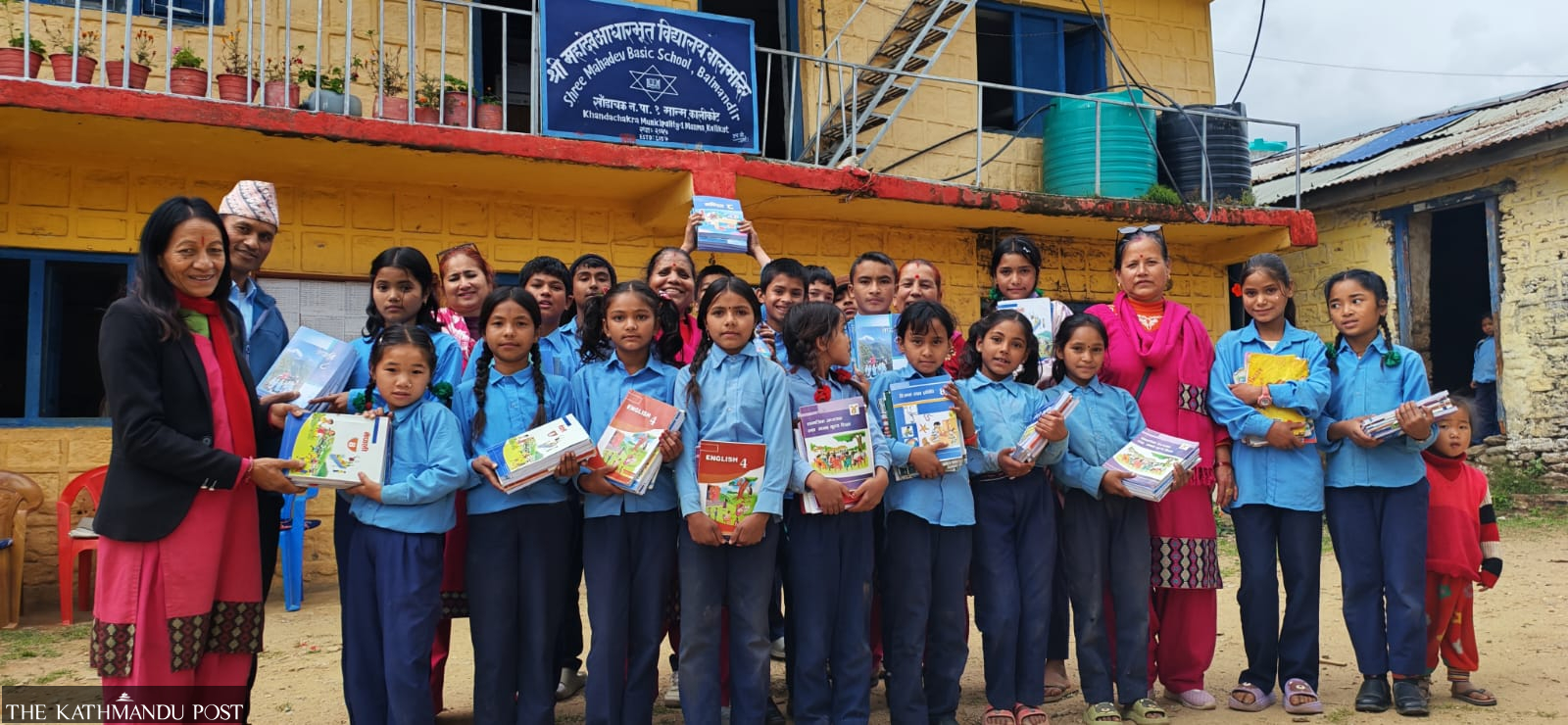
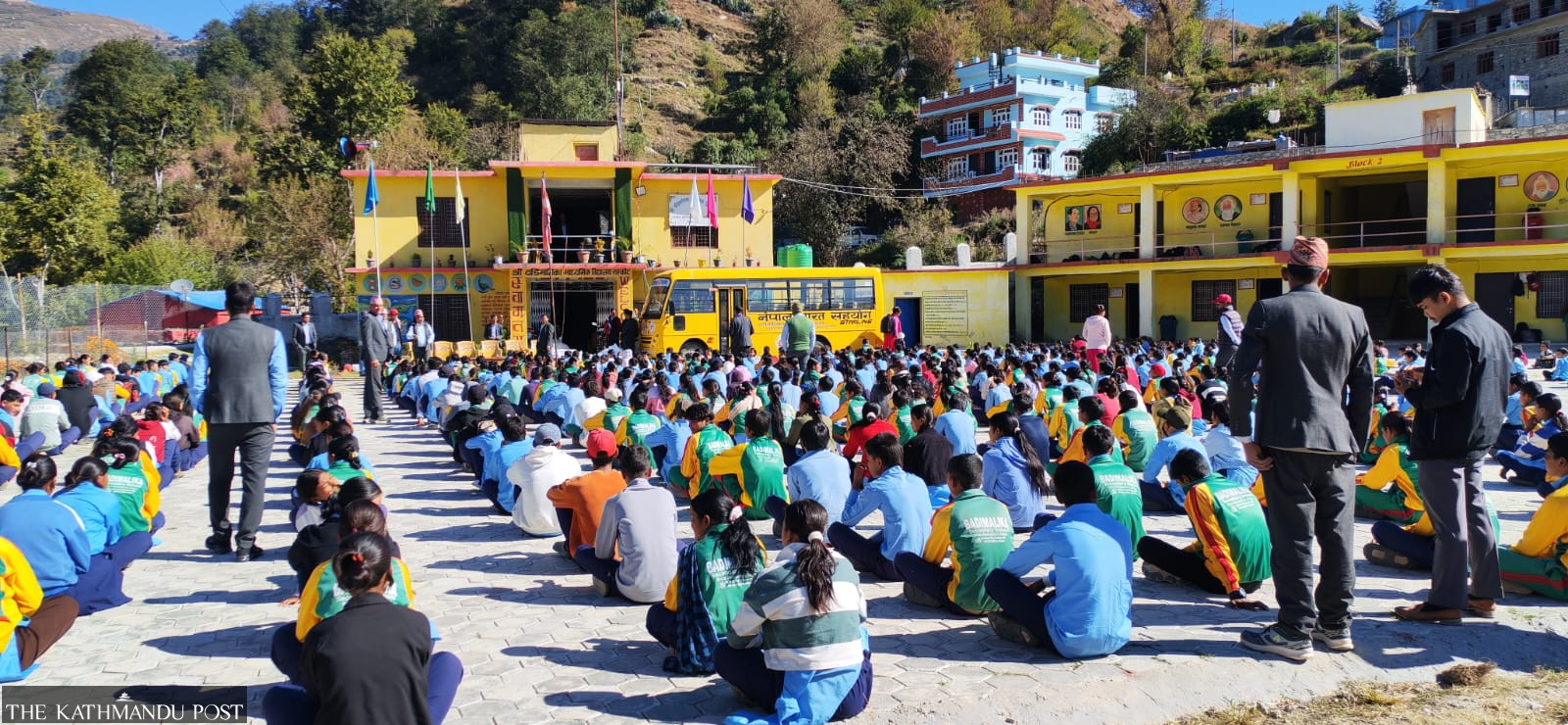
Poverty, migration, child labour, teacher shortages and long school closures are pushing thousands of children out of classrooms across the province. A teacher with his students at Malika Secondary School in Sinja, Jumla. Tularam Pandey/TKP
Fifteen-year-old Nabin Sarki of Gairigaun in ward 6 of Sanni Triveni Rural Municipality, Kalikot, enrolled in Grade 8 at Badrukh Basic School in 2025. He attended classes for nearly five months, from April to August. But in the last week of August, he dropped out and left for Shimla, India, to work after his family’s financial condition worsened.
After spending six months in manual labour in India, he returned home in February. Since then, however, he has not gone back to school.
“My father died. I have to look after my two younger brothers and a sister,” said Nabin, who now works as a daily wage earner in the village. “How can a poor person dream of education? Even after working every day, it is difficult to manage household expenses.”
Yashoda Sarki, a teacher at the school, said Nabin’s case is far from unusual. Of the 219 students enrolled at the school last year, 26 dropped out. According to school records, six children left from the early childhood development (ECD) class, three from Grade 1, two from Grade 2, three from Grade 6, five from Grade 7 and seven from Grade 8.
“Most children say they leave school because of poverty,” she said. “We visited their homes three or four times to convince them to return, but we could not bring them back to the classroom.”
In Tadi of ward 4 of Khandachakra Municipality in the same district, nine-year-old Nishan BK enrolled in Grade 3 at Navajyoti Basic School last April. He attended classes for around two and a half months before leaving school in August after his parents decided to send him to a monastery in Kathmandu.
“Even though enrollment is said to be free, schools collect Rs5,000 to Rs10,000 a year under different pretexts,” claimed his father, Banche BK. “At the monastery, education is good, food and lodging are provided, and even travel expenses are covered.”
Harilal BK, a teacher at the same school, said 17 children from the ward have been sent to monasteries in Kathmandu. Seven other students from the school migrated to India with their parents last year.
Another teacher, Hasta BK, said schools with a high Dalit population face serious challenges in ensuring regular attendance. “Many students enrol here and then leave for India. They return only two or three months before annual exams to attend the tests,” he said.
According to him, many such students fail their exams and eventually quit studies altogether.
The government provides midday meals, scholarships, free textbooks and sanitary pads for girls to encourage school attendance. But rights activist Dan Bahadur BK said the results remain poor despite state investment in public education.
“The government talks about bringing children to school, retaining them and improving learning outcomes,” he said. “But in Kalikot, only around 30 percent of enrolled students complete basic education, and less than 20 percent pass the secondary level.”
Seven percent of children out of school
According to the 2021 national census, Karnali has a population of 1,688,412, including 677,048 children. Of them, 345,492 are boys and 331,556 are girls.
Data from the Ministry of Social Development of the province show that 48,071 children, or 7.1 percent, remain outside the school system.
The ministry’s data show Jumla and Dolpa have the highest proportion of out-of-school children at around 13.6 percent, while Surkhet has the lowest at 6.1 percent.
Balbir Sunar, senior education officer at the ministry, attributed the situation to poverty, parental neglect, the death of parents at an early age, long distances to schools and migration to India for work.
The 2021 census also shows that 18,543 children aged between five and 12 in Karnali are deprived of schooling, including 9,606 boys and 8,939 girls.
A study conducted by the ministry in 100 schools across Karnali during the 2022 academic year found that out of every 100 students who enter Grade 1, only 80 remain in school by Grade 5.
Sunar said the dropout rate increases by around 20 percent at each level.
Community schools losing students
The growing dropout rate has left many community schools across Karnali with too few students.
Bal Mandir Primary School in Birendranagar, Surkhet, which had nearly 400 students eight years ago, enrolled only 40 students this year. Last year, 90 students enrolled, and only 45 appeared in the annual examinations.
“Private schools nearby have many students,” said teacher Shanta Khatri. “But for us, it has become difficult even to find students for new enrolment.”
Similarly, Nepal Rastriya Basic School in Simta, Surkhet, enrolled only 13 students this year. Teacher Narendra BK said 35 students enrolled last year, but only 20 appeared in the annual examinations.
“There was a time when this school had up to 500 students,” he said. “Now even those who enrol do not attend classes regularly.”
The government provides midday meals, scholarships, free textbooks and sanitary pads for girls to encourage school attendance. Tularam Pandey/TKP
He blamed a lack of awareness among parents, migration for work and the growing attraction of private schools for the decline in student numbers.
Min Bahadur Pun, former headmaster of Tribhuvan Janata Secondary School in Rukum West, said migration to urban areas, preference for private schools, ineffective teaching caused by teacher shortages and parental neglect are driving the crisis in community schools.
According to ministry data, 860 basic schools in Karnali have fewer than 30 students. The ministry says around 515,000 students study in 3,026 early childhood centres, basic schools and secondary community schools across the province. Of these schools, 1,152 have fewer than 45 students.
Govinda Koirala, provincial president of the Federation of School Management Committees, said teacher shortages are another major reason children are leaving school.
“There is a shortage of subject teachers in schools. Without teachers, effective classes are not possible,” he said. “This is contributing to the increasing dropout rate.”
Across Karnali, 18,946 teachers are currently working while 5,540 teaching positions remain vacant. According to Sunar, there are 24,486 approved teaching positions across the province.
“At the secondary level, it is difficult to find teachers for English, Maths and Science,” he said. “Without enough teachers, the quality of education suffers and students leave school.”
Child marriage and child labour are also contributing to dropouts.
According to the National Child Welfare Council, nearly 41,000 children became brides or grooms last year, while 137,000 children were engaged in different forms of child labour.
Manbir Oli, child rights officer at Sanibheri Rural Municipality in Rukum West, said poverty, geography and lack of awareness among parents push children into labour.
“Child marriage remains common in rural areas. Many children marry while studying in Grade 7 or 8,” he said. “After marriage, they have to take household responsibilities, and their education stops midway.”
Laxman Sunar, a teacher at Simta Basic School, regards child marriage as the main obstacle to children’s education in the province.
Council data also show that 25,363 children in Karnali are living away from their parents.
“Some children lose their parents at a young age and have no close relatives to care for them,” Oli said. “Without guardians, some never attend school while others drop out halfway.”
According to “Shaikshik Jhalak”, published by the ministry last year, the net enrollment rate at the basic level in Karnali stands at 93.4 percent. But the figure drops sharply to 46.4 percent at the secondary level.
Last year, 58,158 students were enrolled in early childhood centres, 311,000 in Grades 1-5, 144,000 in Grades 6-8 and 126,000 in Grades 9-12.
The ministry said 71,246 students enrolled in Grade 1 in the 2015 academic year, but only 38,379 students sat for the Secondary Education Examination (SEE) last year.
“The dropout trend becomes clear when we compare the number of children enrolled in Grade 1 with those appearing in the SEE,” said Sunar. “Even with scholarships, free textbooks, free enrollment and midday meals, it has been difficult to keep children in school.”
The ministry says around 515,000 students study in 3,026 early childhood centres, basic schools and secondary community schools across the Karnali province. Tularam Pandey/TKP
Ministry records show that in 2014, altogether 72,304 students enrolled in Grade 1, but only 37,911 appeared in the SEE in 2024. Likewise, of the 67,898 students enrolled in 2013, only 35,808 sat for the SEE in 2023.
The SEE pass rate stood at 59.6 percent in 2025, compared to 61.81 percent in 2024 and 65 percent in 2023.
Snowfall and yarsagumba season affect studies
In several local units of Humla, Mugu and Dolpa, education is regularly disturbed by heavy snowfall and seasonal migration.
Villages in Namkha of Humla, Mugum Karmarong of Mugu, and Chharka Tangsong, Shey Phoksundo and Dolpo Buddha of Dolpa remain largely deserted from the third week of October until mid-March because of extreme cold.
“When families move to valleys and Tarai districts to escape the cold, children go with them,” said Chhiring Kyapne Lama, chair of Mugum Karmarong Rural Municipality. “For at least four months, there is almost no development work or schooling in these villages.”
He added that during the Yarsagumba collection season in May and June, children also accompany their parents to highland pastures for around a month, further affecting studies.
Kamal Lamsal, assistant professor at Mid-Western University and a long-time education researcher, said schools in Karnali’s mountain and hill districts effectively remain closed for nearly two months each year because of long summer and winter holidays.
Most local levels provide a one-month summer break between late June and late July and a one-month winter break from late December to late January.
Schools also remain closed for around a month during Dashain and Tihar, about 15 days for enrollment campaigns and another 15 days after annual examinations. Local governments can additionally grant five days of leave, while the provincial government provides roughly a week-long holiday.
“Both the teachers and students are absent for a week before and after long holidays,” said civil society leader Bijay Lama. “Teachers whose homes are far away sometimes take an extra week or two to return.”
According to him, schools in many mountain settlements effectively conduct teaching for only four to five months a year.
Education regulations require schools to remain open for 220 days annually, with teaching conducted for at least 180 days.
But a 2022 study by the Education Development Directorate in 100 schools across Karnali found that schools in mountain districts remained open for only 180 to 200 days on average, while actual teaching took place for just 140 to 160 days.
“When schools remain open for fewer days, completing the course becomes impossible and students’ learning quality declines,” said Sunar of the ministry’s planning and research division. “Although official holidays account for nearly three months, local holidays and other disruptions create another three months of irregularity for both teachers and students.”




 18.61°C Kathmandu