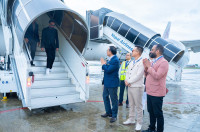
Samir Paul Kapur, the US Assistant Secretary of State for South and Central Asian Affairs, arrived in Nepal on Monday for a three-day visit and started meetings with party leaders and government officials. He is the highest-ranking foreign diplomat to visit Kathmandu since Rastriya Swatantra Party (RSP) leader Balendra Shah became prime minister on March 27.
Soon after landing in Kathmandu, Kapur visited the US Embassy in Kathmandu and was briefed by embassy officials before meeting the RSP chief Rabi Lamichhane.
Interestingly, Washington has not made public Kapur’s visit, meetings and engagements, although the US embassy in Kathmandu acknowledged the visit on X.
The assistant secretary is engaging with senior government officials, business leaders, and cultural experts to further strengthen the US-Nepal partnership, said the US Embassy in Kathmandu.
After meeting Lamichhane, Kapur took to X and said: “Great to meet Rastriya Swatantra Party Chair Lamichhane here in Kathmandu to learn about RSP’s priorities in the new government and discuss areas for US-Nepal.”
This marks the first standalone visit to Nepal by a US assistant secretary of state. Previous senior US officials typically combined Nepal visits with trips to other South Asian countries.
After meeting office bearers and officials of the American Chamber of Commerce in Nepal, Kapur wrote on X: “important discussion with industry leaders about expanding US business opportunities in Nepal’s ICT sector. Also discussed ways to bolster digital infrastructure, AI adoption, cybersecurity, and sharing US technology prowess.”
Unlike his predecessors, Kapur is not meeting with Prime Minister Shah. His predecessors, during visits to Kathmandu, used to meet the prime minister. “But there was no such request from the American side to meet the prime minister so there is no meeting with the PM,” a foreign ministry official told the Post. “And the US side has also not shared the agendas of the visit with the foreign ministry.”
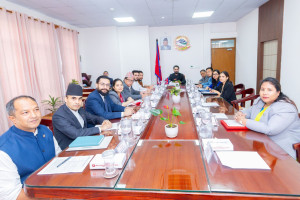
On Tuesday, according to a government official, Kapur is scheduled to meet Finance Minister Swarnim Wagle, Foreign Minister Shishir Khanal, and officials of the Nepal-US Chamber of Commerce and Industry.
“They (Americans) have not shared any agendas with us,” the official said, adding, “we are just anticipating the visit as introductory where we will communicate our priorities, and what we are doing and they will share the priorities of the Trump administration.”
Kapur will hear the government’s priorities and convey how Washington intends to support them, according to officials.
He will also visit the Patan Durbar Square.
Ahead of Nepal’s March elections, Kapur had expressed confidence that the vote would be peaceful and said the US was prepared to work with the incoming government.
Briefing the House Foreign Affairs Committee in February, he said, “With Nepal, we also trust that we’ll have a secure and peaceful electoral process, and we’re prepared to work with whoever wins.”
In his testimony, Kapur outlined US positions on South Asia, including Nepal and Bangladesh, where recent political developments have drawn international attention. He visited Dhaka in early March following the formation of a new government there. US lawmakers have underscored Nepal’s strategic location between India and China, with Kapur noting that preventing dominance by any single power in South Asia remains a key US objective. “A hostile power dominating South Asia could exert coercive leverage over the world economy,” he told the US House committee.
His visit to Kathmandu is being followed keenly in New Delhi as well. Commenting on his visit, Professor S D Muni, Professor Emeritus at the School of International Studies, Jawaharlal Nehru University (JNU), wrote on X that Kapur's statement in Kathmandu must be understood carefully in New Delhi. “He said the US does not want China or any other country to dominate Nepal. The US also tried to contain India in Nepal during early years of the Cold War,” Muni wrote.
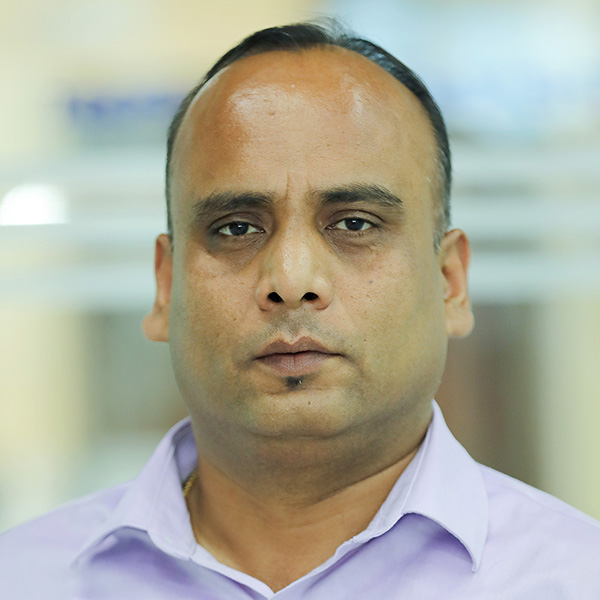
Anil Giri is a Chief Sub Editor covering diplomacy, international relations and national politics for The Kathmandu Post. Giri has been working as a journalist for more than two decades, contributing to numerous national and international media outlets.




 18.03°C Kathmandu