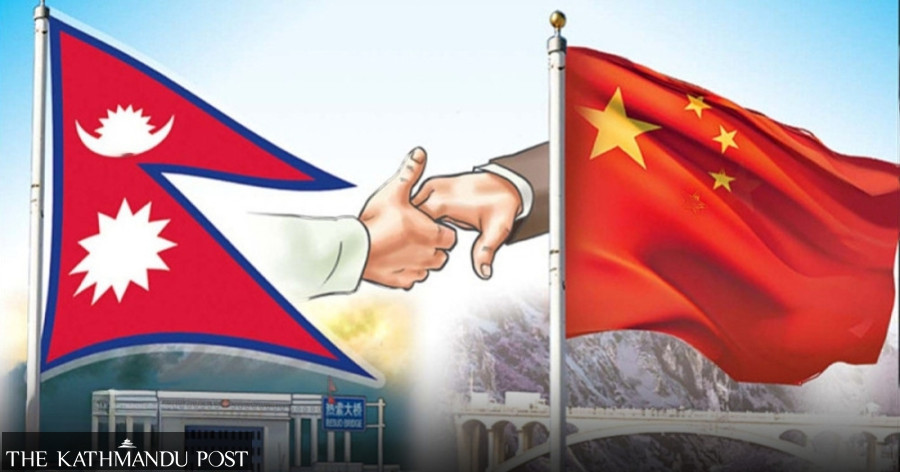
Tuesday marks the ninth anniversary of Nepal and China signing a memorandum of understanding on cooperation under the Belt and Road Initiative (BRI), Beijing’s flagship connectivity and infrastructure initiative launched by Chinese President Xi Jinping.
The two countries signed the MoU on May 12, 2017, although Nepal's engagement with the ambitious Chinese initiative had begun much earlier, soon after Beijing unveiled the strategy in 2013. The initiative later evolved from the “Silk Road Economic Belt”, to “One Belt, One Road” and finally, the BRI.
The overarching goal of the BRI, as mentioned in the MoU, largely focus on policy coordination, facilities connectivity, unimpeded trade, financial integration and promotion of people-to-people bonds.
After Nepal officially joined the BRI in 2017, Kathmandu and Beijing made several efforts to push it forward. But despite interest from both sides, the BRI largely remained confined to seminars and high-level meetings and visits.
Over the past nine years, Nepal and China have negotiated and discussed the ideology of the BRI, projects to be pursued under it, and its execution and financing modalities.
Besides China’s unilateral announcement that Pokhara Regional International Airport was built under the BRI framework, no other tangible progress has been made in these nine years to show that Nepal has implemented the initiative. Even under governments considered close to Beijing, Kathmandu failed to make any tangible progress.
But China’s unilateral decision to put Pokhara Airport under the framework of BRI was opposed by Nepal and the project was later embroiled in a multi-billion-rupee corruption scandal.
Now, with the formation of a strong government in Kathmandu under the leadership of Balendra Shah, there are renewed concerns over how new administration views the BRI, the deals signed in the past, and, if it decides to move ahead, under what terms and conditions it wants to negotiate the initiative with China.
From lending modalities to the investment framework, the two sides in the past failed to fully negotiate projects under the BRI, which was once considered a tool to transform Nepal from a “landlocked” to a “land-linked” country.
Some observers say that the new administration in Kathmandu might review the projects under the BRI and herald a new beginning.
A senior foreign ministry official told the Post that the two sides were yet to have a major discussion on BRI implementation.
“Once high-level visits start, some conversations might begin,” said the official, who did not want to be named. The Chinese side also has not raised anything substantive during meetings with Foreign Minister Shisir Khanal, Finance Minister Swarnim Wagle, and other ministers on how to push the BRI in the changed political context in Kathmandu.
During a meeting between Khanal and Chinese ambassador Zhang Maoming, while dispelling the notion that the present government in Kathmandu tilts towards the West, Khanal made it clear that Nepal government’s policy towards China remains unchanged, though he did not explicitly mention the BRI.
Besides Wagle and Khanal, ambassador Zhang held multiple meetings, including with Speaker Dol Prasad Aryal and several other ministers, over the past month. But the ambassador rarely raised issues related to Beijing’s strategic interests such as the BRI, connectivity and infrastructure projects under the Trans Himalayan Multi Dimensional Connectivity Network (THMDCN), or the proposed Chinese railway connecting Kathmandu with Kerung, according to multiple officials present in those meetings.
But the Chinese envoy appeared sensitive about the Tibetan refugee issue and whether growing American influence could undermine China’s core strategic and security interests in Kathmandu, including delays in Chinese-funded projects in Nepal, the officials told the Post.
“The Chinese ambassador in most of his meetings urged Nepal not to issue identity cards to Tibetan refugees, refrain from signing the US State Partnership Program, and avoid adopting Starlink internet service, as Chinese companies like Huawei are keen to provide high-tech and affordable internet services in Nepal,” said an official who attended those meetings with ministers.
“The Chinese envoy also advised Nepal not to depend too much on support from the US Millennium Challenge Corporation. He stressed that the optical fiber network coming from China should not be monitored by other countries, and expressed concerns over foreign activities in Mustang,” another official who attended meetings between the Chinese envoy and ministers told the Post.
After the signing of the MoU in 2017, the Nepali side proposed 35 projects to China during then prime minister KP Oli’s visit to Beijing. The list was later trimmed to nine at China’s request. Besides conducting the feasibility study of Kerung-Kathmandu railway, no progress was made on the remaining eight projects.
Later, Chinese leaders also launched the “Silk Roadster”—an initiative involving small cooperation projects, training, cultural exchange under the broader BRI umbrella—in Kathmandu in July 2023. A comprehensive agreement was signed between Nepal and China in December 2024 in Beijing that outlined a detailed framework of the BRI between Nepal and China, and to renegotiate 10 different projects. No government agency has a definite response on the status of those ten projects.
In the third week of April, Deputy Director General at the Department of Asian Affairs at China’s Ministry of Foreign Affairs Cao Jing held talks with Foreign Secretary Amrit Bahadur Rai and Joint Secretary at the North East Asia Division at the Foreign Ministry Bhrigu Dhungana, where she discussed the possible ramifications of the MCC Compact, urged Nepal not to join the US State Partnership Program (SPP) and not to be part of Elon Musk’s Starlink satellite network, an official told the Post.
But according to the officials she did not push for the implementation of the BRI or other agreements reached between Nepal and China.
Former Nepali ambassador to China, Krishna Prasad Oli, said there is no way Nepal can skip the BRI, and must implement mega projects under it.
“The BRI can only move forward through partnership between both sides, so no single party can implement it. Nepal and China should quickly take decisions to extend China’s railway to Kathmandu, expand energy connectivity, and build some roads. That would also show our strategic autonomy,” said Oli, talking to the Post.
He added that projects such as the construction of dry ports, increasing Chinese investment in Nepal, and exporting Nepali goods to the Chinese market could also be included.
According to a briefing published by the Centre for Social Innovation and Foreign Policy, a Kathmandu-based think tank, Nepal’s navigation of the geopolitical landscape surrounding the BRI is heavily influenced by perceptions of its key partners—India, its close neighbour, and the US, the global superpower.
India views the BRI as a strategic initiative challenging its status and leverage within South Asia, while the US sees it as an effort to expand China’s sphere of influence, the think tank states.
If BRI projects materialise and its provisions are implemented, it could be difficult for Nepal to tread the thin line of geopolitical balance, the think tank says.
The question now is how the new government in Kathmandu will approach the BRI with Beijing.
“The current government may not actively push the BRI for three main reasons,” said Pramod Jaiswal, research director at Nepal Institute for International Cooperation and Engagement (NIICE), another think tank.
“First, there is still no clear national consensus on the BRI within Nepal. Second, at the regional level, the BRI has become associated with controversies, including the Hambantota port case in Sri Lanka and concerns over CPEC [China-Pakistan Economic Corridor] in Pakistan. Third, the BRI faces broader headwinds in South Asia, as several countries are wary of transparency and strategic implications.”
However, he added that Nepal may be more receptive if China offers projects as grants rather than loans.
Chinese observers, however, see great scope of cooperation under the BRI framework.
“The political developments in Kathmandu have ushered in prospects of policy continuity, political stability and pragmatic diplomacy, which represent positive momentum,” said Gao Liang, vice director of the Nepal Study Centre at the Institute of South Asian Studies, Sichuan University. China expects Nepal to engage in pragmatic communication on implementing relevant agreements and push forward for their early delivery, he told the Post.
The sub-headline of the story has been updated for clarity.
Anil Giri is a Chief Sub Editor covering diplomacy, international relations and national politics for The Kathmandu Post. Giri has been working as a journalist for more than two decades, contributing to numerous national and international media outlets.




 18.18°C Kathmandu