Lapchi herders cling to traditional grazing route in Tibet, but returns are shrinking
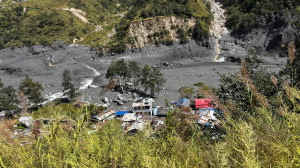
Grazing taxes are still paid in ghee under an old barter arrangement. The villagers in Lapchi rear yaks and produce yak milk products to sell in the Tibetan markets across the border. Photo: Courtesy of Lapchi Chonzom
With the start of spring and snowmelt along the Nepal-China border, herders from Lapchi in Dolakha set off on their seasonal journey that has continued for generations. Driving long lines of yaks, chauris, horses and mules across the high Himalayan terrain, they head towards the grassy meadows of Ramdung in Tibet, carrying food supplies, tents and sacks of flour for months of isolation in the mountains.
By the second week of May, seven yak sheds from Lapchi, which lies in ward 1 of Bigu Rural Municipality near the Nepal-China border, had already crossed into the Chinese grazing fields. The movement continues until late mid-June. Each year, around 400 yaks and chauris and more than 40 horses of around 13 sheds from Lapchi spend four months grazing in Chinese pastures.
The herders from Nepal, however, must carry border passes issued for seasonal movement. Without the documents, they are barred from entering the grazing areas.
For the people of Lapchi, the journey is not simply about pasture. It is tied to survival, memory and an old cross-border relationship that predates modern border controls. In return for using the grasslands, herders pay a traditional grazing tax to Chinese local authorities—not in money, but in ghee.
“We have been taking our yaks and chauris to the large pastures across the border after the snow melts,” said Kunjok Sherpa, a local herder from Lapchi. “We stay there from April until August. Officials there count our animals and we return after paying the ghee as tax.”
According to local practice, herders must pay 750 grams of ghee per head of yak or chauri grazing in Tibetan fields. Horses taken for grazing are also taxed in ghee, although calves are exempt.
Kunjok recalls that the trade once supported a thriving pastoral economy in Lapchi. “Until 10 years ago, more than 2,000 yaks and chauris of around 60-70 sheds used to reach those pastures,” he said. “There would be dozens of sheds and even temporary markets in the grazing grounds. Chinese traders came there to buy ghee and calves.”
According to Kunjok, Chinese officials themselves travelled to the highlands to collect the butter tax. “This has been our tradition since long,” he said. “We also had relatives across the border. Our salt, clothes and food all came from Tibetan markets.” Cross-border marriages, however, have been restricted by Chinese authorities for more than a decade, according to locals.
Tenzing Sherpa, another local from Lapchi, said he grew up watching his father hand over ghee to Chinese officials in the grazing fields. “I used to accompany my father to the pastures when I was a child. At that time too, he paid the tax in ghee. The practice still continues,” he said.
But while the tradition survives, the livelihood behind it is weakening. The locals say yak and chauri herding no longer generates enough income to sustain families as it once did. Demand for ghee and calves in Tibetan markets has declined sharply in recent years, forcing many households to abandon the occupation.
“Earlier, we earned well by selling calves and ghee across the border and buying food supplies there,” said Tenzing. “Now the business barely covers the grazing costs.”
Lapchi, which has 48 households and a population of around 130, depends heavily on yak and chauri herding. According to the locals, the Chinese market remains their primary trading point because the nearest Nepali market is several days away on foot.
According to Karma Waisar Sherpa, the locals have repeatedly urged the government to ease grazing arrangements and negotiate relief on the butter tax during bilateral border meetings. He said the local government had raised the village’s problems and the issue of grazing tax during border meetings, but no action had been taken. “For four months of grazing, we have to provide ghee worth around Rs1,200 for each animal. The trade is weak now, so the tax feels too high,” he said.
The prolonged border restrictions,wildlife attacks and declining trade have deepened hardship in Lapchi, where families rely heavily on yak products and seasonal cross-border exchanges for survival.
Lapchi is a remote village that borders Tibet in China. The locals have to walk for nearly two days to reach Lamabagar, the nearest market in Nepal, to buy daily essentials. They are dependent on the Tibetan market to sell the local products and buy the essentials.
The villagers in Lapchi rear yaks and produce yak milk products to sell in the Tibetan markets across the border. They had been unable to sell their goods in the Tibetan market as the border had remained closed since 2019 due to Covid pandemic and reopened only in 2024.




 13.86°C Kathmandu