Mother secures justice for son’s murder after 11-year fight
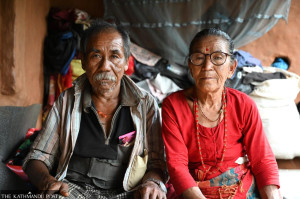
Supreme Court upholds 12-year sentence for main convict and convicts two men previously acquitted in the 2015 killing of Surya Bahadur Pandey. Bishnu Kumari Pandey reviews court documents after the Supreme Court ruled in her favour. Gaurav Pokharel/TKP
After more than a decade of court appearances and repeated delays, a 76-year-old mother has finally secured a verdict in the murder case of her son, who was killed in Kaski district 11 years ago.
Bishnu Kumari Pandey attended at least 15 hearings at the Supreme Court, often travelling from Pokhara to Kathmandu, as she pursued justice for her 25-year-old son, Surya Bahadur Pandey.
At one point, she said she was prepared to sell her remaining belongings, including a small earring she still owns, if that was what it took to continue the legal fight.
On Wednesday, the Supreme Court delivered its long-awaited ruling.
A division bench of justices Tek Prasad Dhungana and Meghraj Pokharel upheld a 12-year prison sentence against Ram Chandra Manandhar, who had been convicted by the Pokhara High Court. The bench also overturned the acquittals of Buddha Shrestha, 26, and Dhruba Manandhar, 41.
The court found Buddha and Dhruba guilty under Section 17(3) of the homicide chapter of the then Muluki Ain (General Code). The provision allows for a prison term of between six months and three years for a person present at the scene of a crime without direct involvement. The court handed both men the minimum six-month sentence.
Supreme Court spokesperson Arjun Koirala said the court upheld the 12-year sentence against Ram Chandra.
The case dates back to February 17, 2015. Surya Bahadur had left home with friends to attend a Shivaratri fair in Pokhara. The following morning, his bloodied body was found near Ram Temple at Tulsighat.
Advocate Mohana Ansari, who represented the victim’s family, told the court that the post-mortem report documented injuries, including blood in the hair and wounds to the temple area.
She also referred to the testimony of a witness identified as “Bauhni Aunty”, who said the victim and the accused had spent the evening together and consumed alcohol in their room.
According to the statement, Surya Bahadur left the room at around 1:30 am while speaking on a mobile phone. Ram Chandra followed a few minutes later. About an hour afterwards, Ram Chandra returned in a distressed condition, washed his hands and feet at an outdoor tap and went to bed without explanation.
Government lawyers had sought a life sentence, citing previous Supreme Court precedents. However, the bench upheld the High Court’s ruling on Ram Chandra’s sentence.
Bishnu Kumari had initially filed complaints against all three men, but the police delayed registering the case for years. Ansari said the case was not formally registered for around five years before a supplementary investigation report was eventually filed.
The case saw conflicting rulings in lower courts. Following a preliminary hearing, the Kaski District Court ordered the accused to remain in judicial custody. The accused challenged the order, and in June 2019, the Pokhara High Court released them on bail of Rs100,000 each.
The Kaski District Court later convicted Ram Chandra but acquitted Buddha and Dhruba, saying the evidence against them was insufficient. The government appealed, but in March 2022, a joint bench of judges Shridhar Kumari Pudasaini and Pramod Kumar Shrestha Baidya upheld the district court’s verdict.
The case then reached the Supreme Court, where hearings were repeatedly postponed.
For Bishnu Kumari, the case became a years-long struggle marked by uncertainty and delay. The Supreme Court hearing alone was deferred 15 times. On several occasions, she travelled from Pokhara to Kathmandu without knowing whether the case would be heard.
On Wednesday, she again arrived at the court early and tried to follow proceedings closely. When the verdict was finally announced, she broke down in tears.
“Officials said, ‘Mother, you have won the case.’ I am happy,” she told Kantipur after the verdict. “Now the remaining two should also be arrested and sent to jail soon.”
According to the complaint filed by Bishnu Kumari, the killing stemmed from a dispute that arose during a local fair and escalated over disagreements involving a woman named Amrita Lama.
Statements by the accused offered differing accounts of the incident, including claims that a physical confrontation had taken place and that the victim was later pushed into a gorge near the Seti river.
Throughout the legal battle, Bishnu Kumari maintained that those named in her complaint were responsible for her son’s death and repeatedly voiced frustration over delays in the investigation and prosecution.
After years of conflicting rulings and prolonged legal proceedings, the Supreme Court’s decision has finally brought an end to a case that defined more than a decade of her life.




 22.14°C Kathmandu