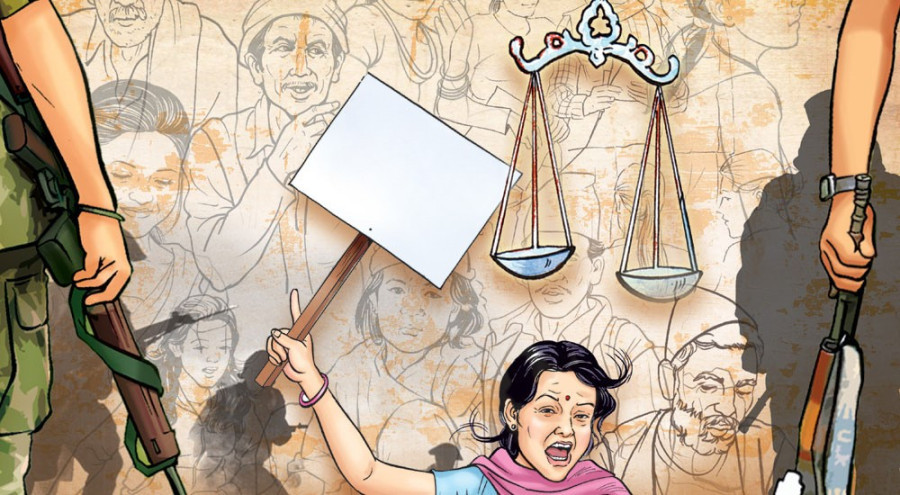
Civil society has long been a driving force in Nepal’s political evolution, stepping in at critical moments to push for democratic reforms and safeguard human rights, press freedom and government accountability. It often acted as a vital link between citizens and the state.
However, of late, the civil society voice has shrunk more than ever, raising concerns about its implications for Nepali society and democracy. Analysts say that when the opposition in Nepal’s Parliament is itself weak, the shrinkage of civil society could have long-term consequences for the country.
“Civil society works as a moral and democratic pressure on political actors,” said Bhim Bhurtel, political analyst and an active civil society participant during the 2006 people’s movement. “If that pressure fades, political institutions face fewer checks, and governance can become less responsive to the people.”
Bhurtel also notes that civil society voices on major national debates appear to be less audible today than they were earlier.
He points to several recent developments that make one suspect the intent of the new government. These include the decision to withhold state welfare advertisements from private media outlets, the growing practice of arresting citizens on urgent arrest warrants without a court order, and incidents where individuals have been detained for insulting the prime minister.
According to him, such trends create space for concern, and in the days ahead, there may be a need for a strong and active civil society to hold the government to account.
Recently, civil society has become comparatively weak, acknowledges former chief election commissioner Bhojraj Pokharel, who is also a strong civic voice. But he adds that, “civil movement is not always active. It becomes active when needed and goes into hibernation,” Pokharel said.
During the political transitions of the 1990s and the 2006 people’s movement, civil society helped shape the national discourse. It organised public forums, challenged political decisions, and mobilised citizens around constitutional and democratic issues.
According to Bhurtel, during the 2006 movement, when the public had largely lost faith in political parties, it was civil society that acted as a bridge between the parties and the people. It was largely because of that coordinating role that people were encouraged to take to the streets to ask for their rights.
Last year, on February 18, 2025, professor of political science Krishna Khanal, left-leaning political analyst Khagendra Sangraula, and writer and activist Sanjeev Upreti, among others, announced a citizens’ movement. At the time, they said the movement was being launched in protest against political parties that, instead of delivering results and ensuring good governance after the 2022 elections, had already begun preparing for the next polls under what they called “Mission 2027”.
However, the initiative largely remained limited to the announcement.
Why has the effectiveness of civil society declined?
Giving the example of the 2010 Arab Spring, political science professor Sucheta Pyakuryal says that widespread accessibility of the internet has changed the nature of movements, and this shift has also affected civil society. According to Pyakuryal, social media has increasingly taken over the space occupied by civil society.
Former chief election commissioner Pokharel says the culture of lynch-mobbing on social media has also weakened civil society and the movements it leads.
“In the past, society would readily trust individuals who were well-established and widely respected, and such figures could lead civil society and its movements,” Pokharel said. “Today, there is a lack of widely accepted figures, and those who are identified as leaders of civil society often become targets of digital mobs should they come out to champion any agenda.”
According to him, this environment has also contributed to civic movements becoming comparatively subdued. Pokharel says that although it would not be entirely accurate to describe the Gen Z protest as a civil society movement, it did, in one way or another, attempt to represent citizens’ voices.
Civil society traditionally served as watchdogs, questioning those in power. They help bring public concerns into the policy arena and ensure that governments remain accountable to citizens. When this role diminishes, experts say, the balance between power and public scrutiny shifts.
One reason civil society in Nepal has weakened is the frequent accusation that they are engaged in what critics call “dollar farming”, implying that they work primarily to secure foreign funding rather than to address genuine social concerns.
The concept of civil society was developed by the French political scientist Alexis de Tocqueville. Observing that France continued to struggle with political instability despite repeated political movements, while the United States moved towards stability after its own upheavals, Tocqueville travelled to America to understand the difference, something which Pierre Manent has mentioned in his book ‘Tocqueville and the Nature of Democracy’.
During his visit, Tocqueville concluded that a strong civil society existed there, acting as a watchdog over the government, and that this played an important role in maintaining political stability. He recorded these observations in his book ‘Democracy in America’, published in 1835. According to his understanding, civil society is a loose association of individuals from different professions who come together to question and challenge the wrongdoings of the government.
Critics also acknowledge that, in recent years, questions have been raised about civic movements in Nepal as development partners began investing in and institutionalising them into formal organisations. As a result, the watchdog role they play has increasingly come under scrutiny.
However, the weakening of civil society could have direct consequences for democratic accountability.
Civic groups often play a crucial role in monitoring government actions, exposing corruption, and advocating transparency. Without strong civic oversight, critics warn that institutions responsible for governance may face less pressure to explain or justify their decisions.
“Democracy does not rely only on elections,” Bhurtel noted. “It also depends on active citizens and independent organisations that constantly question power.”




 22.68°C Kathmandu