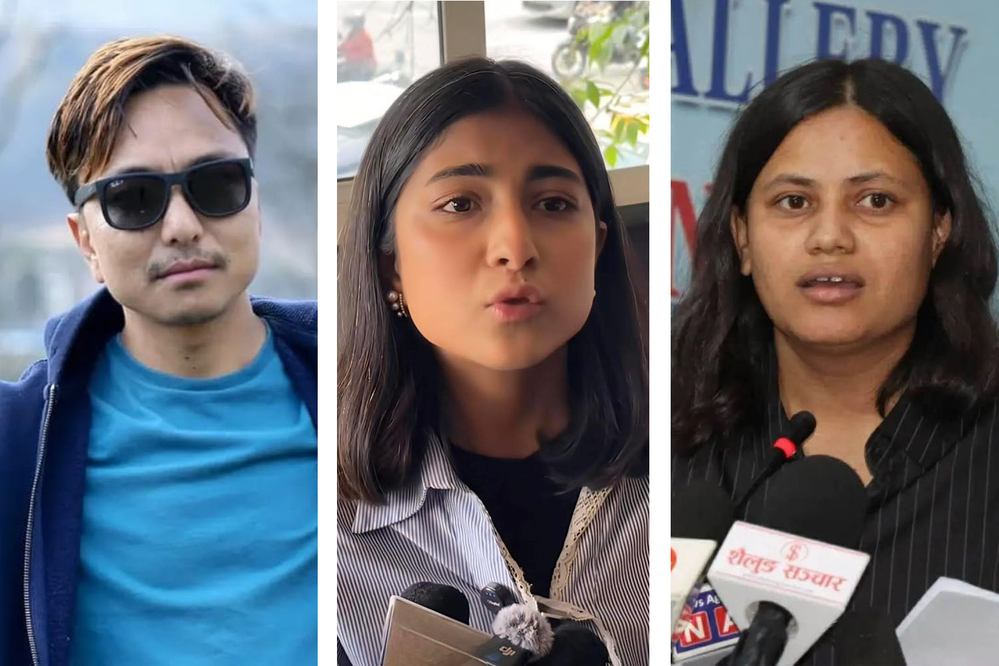
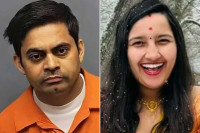
On March 28, the government led by Balendra Shah ordered the arrest of former Prime Minister KP Sharma Oli from his residence, prompting UML cadres to take to the streets. Among them was Amisa Parajuli, who defended Oli, saying, “Arresting Oli is unlawful, and no one is above the law.” Her remarks quickly spread across social media.
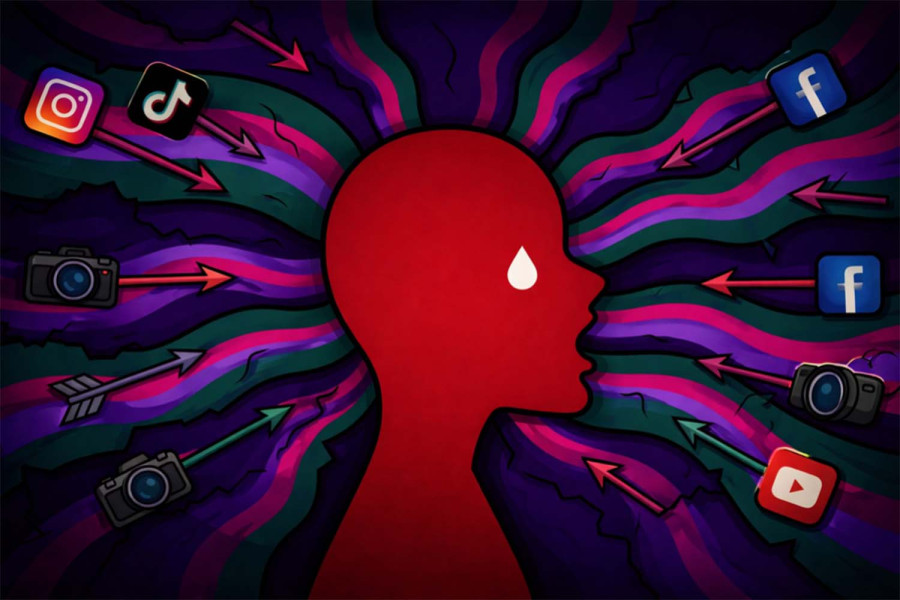
Social media saw immediate reactions, but alongside differing views, she also faced hatred, threats and abusive language. The comment section of her viral video included violent and obscene responses. Memes with sexually suggestive interpretations were also created based on her remarks.
“The comments were extremely frightening and unbearable. Instead of differing opinions, I had to face obscene abuse, character assassination and even rape threats,” Amisa told the Post. “Those were not just criticisms but digital violence.”
She was also targeted with AI-generated images showing a figure resembling UML chair Oli applying sindoor (vermilion) to her, implying marriage.Some users even sent personal threats such as, “If you keep speaking like this, you will be raped and thrown.” The abuse against Amisa was not limited to social media. She began receiving such threatening messages personally. Reactions to her opinion were aimed at causing personal harm.
“This deeply affected me. It is not possible to ignore such violent threats after reading them. It made me feel unsafe not just online but in real life. When people openly talk about sexual violence, it is no longer just a ‘normal comment.’ It turns into a heavy mental and emotional burden,” she said. “This has also exposed how unsafe it is in our society to express differing opinions.”
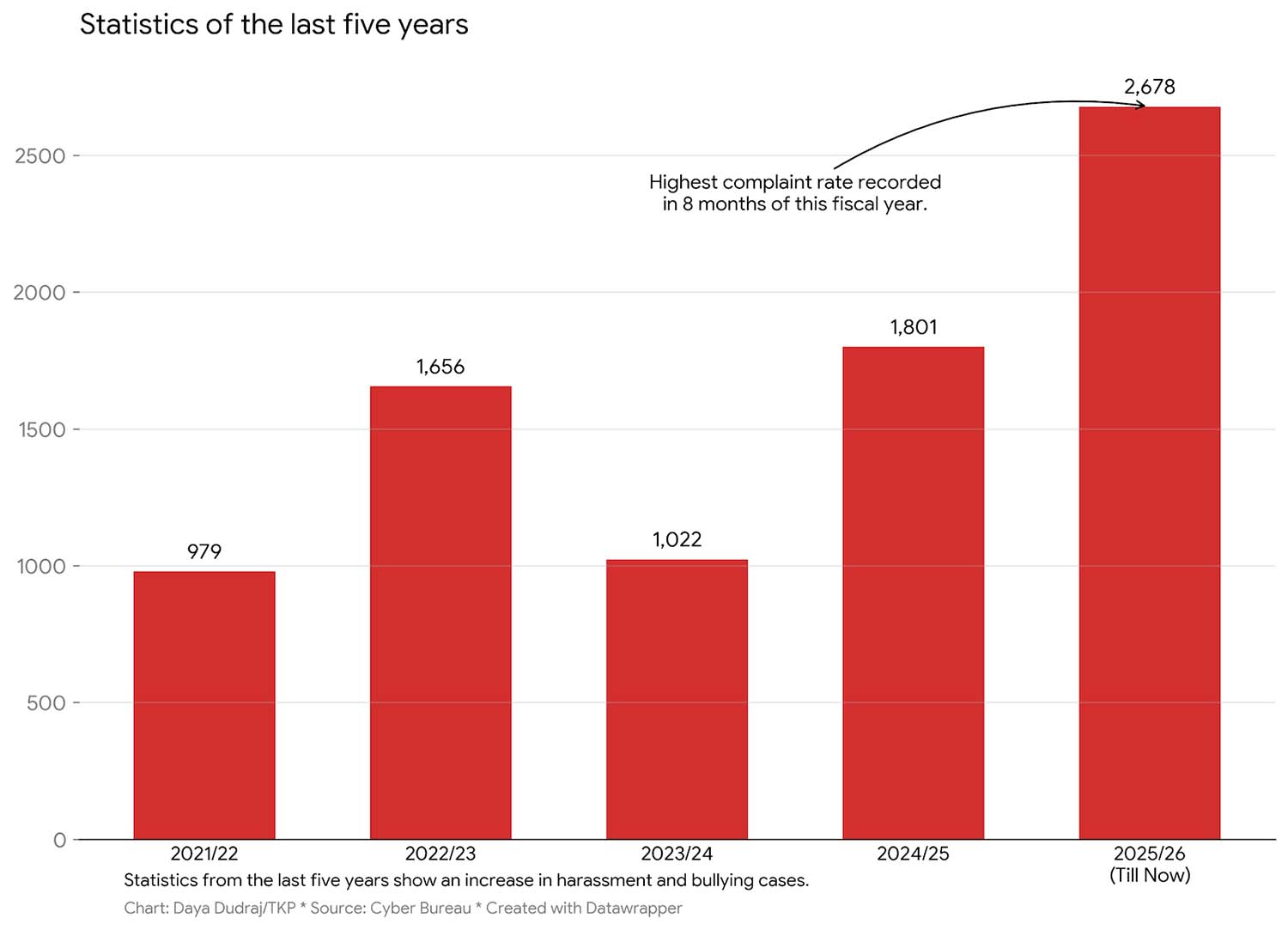
Amisa is not an isolated case. Data from the Nepal Police Cyber Bureau shows that incidents of harassment and bullying via social media have risen over the past five years. According to Superintendent of Police Dilip Kumar Giri, in the fiscal year 2024/25, 1,801 complaints related to harassment and bullying were recorded, while the figures increased to 2,678 in the current fiscal year, 2025/26.
According to sociologists, such rising cyber attacks are creating a chilling effect in society, leading people to increasingly resort to self-censorship. Sociologist Samjhana Wagle Bhattarai argues that the trend of “digital lynching” against those expressing dissent has been on the rise. “The practice of targeting those who express differing opinions or criticise the government on social media has increased,” she said. “This has created a situation where people hesitate to express their views freely.”
AI expert Dovan Rai believes that fear of digital lynching and abusive backlash is leading many to self-censor their public expression. “The narrative has been constructed in such a way that criticising the government or leadership is seen as insulting the aspirations and votes of the people,” she said. “Today’s society shows a clear divide between ‘good’ and ‘bad.’ Those supporting a new party are labelled ‘good,’ while those opposing are immediately judged as ‘bad’ or ‘agents of old parties.’”
Amid the current landscape of Nepal’s social media, it is clear that political intolerance has reached an extreme level. Organised “troll armies” are often mobilised immediately when someone supports or criticises a political party. Once trolling begins, the individual is systematically targeted, harassed or even subjected to attempts to “cancel” them, with the intent of damaging their reputation, career or mental health. In Western countries, this phenomenon has recently been termed “digital lynching.”
Previously, journalist Bishwo Limbu also faced digital mob lynching for expressing his opinion on social media. He had criticised the five-star hotel orientation programme organised for newly elected members of the House of Representatives from the Rastriya Swatantra Party (RSP). He also questioned the venue of the programme while appreciating the orientation itself.
In a two-minute and 10-second video posted from the Facebook account “Bishwo Limbu Podcast,” he faced abusive comments. Allegations were made against him with phrases like “Harka’s follower,” “Harke’s labourer,” “Harka’s journalist,” “Is this journalist controlled by Harka?” and “Eat Harka’s excrement.” (Harka refers to newly elected House of Representatives member and chair of Shram Sanskriti Party, Harka Sampang, who frequently comments on social issues on social media.) Comments targeting his personal life and identity were also made. “The comment section is normal, but now I even receive personal messages with threats involving my parents,” Limbu said.
Smriti Timsina also shared a bitter experience of facing abuse online after criticising the government. She said that although she spoke while being affiliated with a political party, she faced a flood of abusive and threatening comments for expressing a differing opinion. “Not only obscene comments in the comment section, but I also received very hateful messages in my inbox. They are so disgusting that they are unbearable to read,” Timsina said.
She even faced police interrogation for uploading a video on social media. “I had uploaded a video related to the Home Minister. Because of that video, I was arrested,” she said. “I was interrogated for three hours to find out who directed the making of that video.”
Earlier, the director of “Comedy Champion”, a reality show, Bishal Bhandari, also experienced similar abuse on social media. He had to deal with harsh criticism after inviting CPN-UML Secretary Mahesh Basnet as a guest on his show, “Comedy Champion”.
As soon as Basnet appeared on the programme, Bhandari was subjected to abusive language. Comments such as “Rest in peace, brother Bishal Bhandari” and “Jholey (cadre of a particular political party)” began circulating.
Some even posted violent remarks such as “It’s time to skin Bishal Bhandari and spread it on the road.” He was also subjected to obscene abuse. Even users with the Nepali flag as their profile picture used abusive language involving their parents, children and siblings.
Another artist targeted for political commentary is Nabina Silwal. Popularly known as “Khuili,” she had spoken about Rastriya Swatantra Party chair Rabi Lamichhane being linked to a cooperative scam that defrauded ordinary people. After she spoke on the issue, content attempting to defame her character began appearing widely on social media. Images combining her with UML chair Oli were made viral with offensive messages. She began receiving threats ranging from rape to death. “There are many who use obscene words and give rape threats, even directly through private messages,” she said.
Content creator Suruchi Budhathoki shared her experience of intolerance on social media. During the Gen Z movement, after Lamichhane was released from Nakkhu prison, she posted a video saying, “Go back, Rabi Lamichhane.” In the video, she stated that they were not protesting for the release of any individual and that releasing someone under the guise of the Gen Z movement was wrong.
After the video was published, abuse began on Facebook, Reddit and other platforms. The attacks were not limited to her. Images of her family members were also circulated online. A page called “Troll Tollywood” created a collage of her family’s photos under the label “nepo kid,” which was later made viral by pages including “NEB Nepal.”
Artists have not been spared, facing boycott campaigns for expressing their opinions publicly. When singer Prakash Saput praised KP Sharma Oli during the launch of the book “KP Sharma Oli: Dream, Struggle and Resolve” on March 3, 2025, he was not only abused with caste-based insults but also faced a boycott campaign against his film “Basant”. Under pressure, he eventually had to publicly say, “I made a mistake.” Similarly, model Smarika Dhakal was forced to apologise with folded hands before her video was even released after acting in a song for a political party during the recently concluded March 5 elections.
“Self-censorship”: A new era of silence
According to Santosh Sigdel, executive director of Digital Rights Nepal, this trend poses a serious threat to democracy. “If political parties do not come forward and show willingness to hear questions and differing opinions, open society and democracy cannot thrive,” he said. “Such practices risk eliminating dialogue and questioning from society and fostering a leader-centric system.”
Rajib Subba, a former Deputy Inspector General of Nepal Police who holds a PhD in social media, believes that freedom of expression in digital spaces is weakening. Referring to John Suler’s “Online Disinhibition Effect,” he said, “In the digital world, people feel anonymous. The belief that no one knows them and nothing will happen to them leads to extreme behaviour, which is called the ‘disinhibition effect’ in social science. This leads people to express hateful views against others.”
Algorithms on platforms such as Facebook, TikTok and X (formerly Twitter) promote provocative, negative and hate-driven content, which further fuels organised attacks against dissenting voices, according to AI expert Rai. “Users are trapped in echo chambers where only their own views seem correct. Political 'bot armies’ and coordinated campaigns exploit these algorithms to attack those with differing opinions,” she said. “This creates a situation of digital lynching instead of healthy political debate.”
Those who experience digital lynching are increasingly unable to speak openly. “I no longer express my views as openly as before. I think multiple times before posting anything,” said journalist Limbu. “A sense of fear has developed in me, wondering if I will be abused for speaking.”
Timsina, who was interrogated by police for uploading a video, also now feels afraid to express her opinions. “I have started feeling afraid to speak freely. I feel our leaders were unafraid, even when bounties were on their heads. Why should we be afraid?” she said. “But the fact that we cannot speak freely anymore is worrying.”
Content creator Budhathoki has also decided not to express her views on social media anymore. After posting a “Go back” video when Rabi Lamichhane was released from prison, not only her but also her parents’ photos were used in troll posts. After such attacks on her family, she said, “After seeing the hate directed at my family and me, I am no longer able to speak on social media.”
Women are the most affected in digital lynching. “The impact of abusive behaviour on social media is more severe and disturbing for women than for men,” said sociologist Bhattarai. “The use of abusive language that goes beyond social norms is weakening women’s courage to express themselves.”
Lack of law
The rise in such abusive behaviour and trolling is linked to the growing digital culture and the influence of algorithms. “Algorithms on platforms like Facebook, TikTok and X promote provocative and hate-filled content. Users are trapped in echo chambers,” AI expert Rai said. “Bot armies and coordinated campaigns exploit these algorithms to attack dissenting voices, resulting in digital lynching instead of healthy political debate.”
However, Nepal still lacks a clear and strong legal framework to address organised digital lynching. In Nepal, cyber-related incidents fall under Section 47 of the Electronic Transactions Act, 2063. The section states that anyone who publishes or displays materials through electronic means that are prohibited by law, against public morality or decency, incite hatred, harass women, insult, or disrupt social harmony between communities, shall be liable to a fine of up to Rs 100,000, imprisonment of up to five years, or both.
In Nepal, cyber-related incidents fall under Section 47 of the Electronic Transactions Act, 2063. The section states that anyone who publishes or displays materials through electronic means that are prohibited by law, against public morality or decency, incite hatred, harass women, insult, or disrupt social harmony between communities, shall be liable to a fine of up to Rs 100,000, imprisonment of up to five years, or both.
However, the enforcement of this law is so slow and cumbersome that victims do not receive immediate justice and relief. Even after filing complaints, the police face technical difficulties in tracing perpetrators who use fake identities. Amisa filed a complaint under this provision at the Cyber Bureau on April 1, but only one person has been arrested so far. “Since anyone can easily create fake accounts using others’ photos and names, it is difficult to identify the real perpetrator. Unless platforms like Facebook provide ID, URL and IP address details, it is difficult to identify individuals,” said Bureau spokesperson Giri. “Social media platforms like Facebook, X and Instagram do not have regional offices in Nepal. We have to write to them from abroad, but they do not respond quickly. Sometimes there is no response at all, which creates difficulties for us.”
Former Superintendent of Police Pashupati Raya, who worked at the Cyber Bureau, sees a lack of legal clarity and procedural delays as the main challenges. Rai said, “Under the current legal framework, defamation cases fall under Schedule 4, which requires victims to go to court themselves, preventing police from directly investigating. If the police are to be empowered to investigate such cases, Sections 306 and 307 of the National Penal (Code) Act should be included in Schedule 1.”
According to him, Section 47 of the Electronic Transactions Act, 2063 alone cannot address all aspects of cybercrime, so existing laws need to be clarified and made more comprehensive.




 21.66°C Kathmandu