Costly cultural weddings drive some couples to tie the knot in court
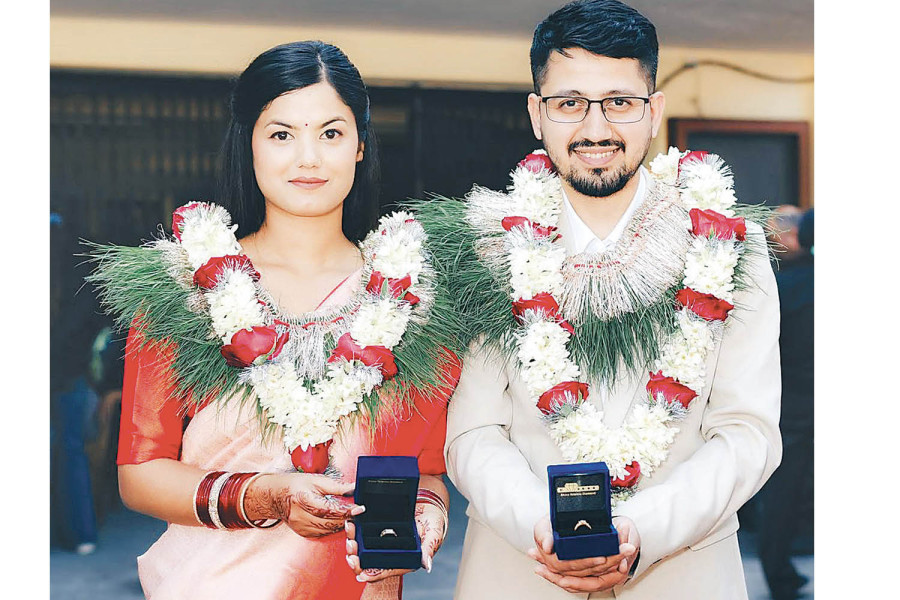
Once seen as a quiet alternative, court marriages are becoming first choice—driven by cost, convenience and changing ideas about what marriage should be. A couple poses for photo after registering their marriage at Kathmandu District Court in 2025. Photo: Courtesy of Seema Adhikari
On a weekday afternoon at the Bhaktapur District Court, couples queue quietly outside the civil registration desk. They arrive with documents: citizenship certificates, letters issued by the local ward office confirming single status, and two witnesses in tow. Within an hour, most walk out legally married. There are no wedding processions, no music, and no elaborate rituals—just signatures and a brief exchange.
What was once considered an alternative is increasingly becoming a preferred option. Data from Lalitpur and Bhaktapur district courts show a steady rise in the number of court marriages in the current fiscal year. According to Hirakumari Bhandari, spokesperson for the Bhaktapur District Court, 668 marriages have been registered in the current fiscal year, up from 353 in the previous year. Lalitpur District Court recorded 331 registrations, compared to 263 last fiscal year. Officials in both courts also reported consistent registrations even during months not traditionally considered auspicious for weddings.
Behind the numbers are couples with varied reasons; some ideological, some practical, and others who simply stumbled into it.
Mahima Tiwari and Shashwat Upreti, both in their mid-thirties, were not among those who had originally planned a court marriage. The couple, who now live in Maryland, had envisioned a traditional ceremony. “At first, we had planned a traditional wedding. But then Covid happened,” Tiwari said.
Upreti said the couple first opted for a court marriage in 2019 only for paperwork, intending to organise a religious ceremony later. “Eventually, the whole idea of a wedding began to lose its value for us,” he said.
For Tiwari, the experience reinforced her belief that rituals were not necessary. “It actually made me more convinced that I don’t need a cultural wedding,” she said. Marriage for her is simply about companionship. “Even if we hadn’t legally married, I would still love him the same.”
She had never been particularly religious, and the more she reflected on what a traditional Nepali wedding would have required of her—bowing to the groom, wearing sindoor and potay (vermillion and glass bead garland, traditional Hindu marriage essentials)—the less she wanted any part of it. ‘‘These symbols often demean women,’’she said. ‘‘I just can’t agree with that.’’
Upreti’s hesitation was simpler. He was not attached to the rituals himself but had wanted the gathering of both families in one place, celebrating. The court marriage, completed without ceremony in Maryland, did not give him that. Over time, he said, it did not feel like a loss.
The family took some time to come around. Relatives back in Nepal continued to ask about a proper wedding for a while. Eventually, Tiwari and Upreti staged a symbolic moment at home, wearing traditional clothes while their mothers applied tika, to signal a closure for the family.
‘‘It was simple, and it was enough,’’ Tiwari said, adding that their form of marriage helped them with financial security. “We were able to use the money we had saved for the wedding to buy a house.”
Their experience reflects a broader shift among couples who increasingly prioritise simplicity and personal choice over elaborate ceremonies.
For Dixit Awasthi, a 31-year-old teacher, the decision to have a court marriage was both ideological and practical from the start.“When it comes to traditional weddings, the process carries a lot of issues… there is a power imbalance embedded within rituals,” he said. Financial considerations also played a role. “It [a court marriage] is much more cost-effective.”
His wedding at the district court was, in his own description, unremarkable. When he and his partner arrived, a criminal hearing was still underway in the same room. When it concluded, it was their turn.
‘‘It didn’t feel solemn or romantic as weddings are supposed to be,’’ he said.
That evening, both families gathered for a dinner where rings were exchanged. The following day, a reception which, as tends to happen in Nepali households, grew larger than anyone had planned. There were no ritual fires, no traditional rites. That was, by his account, enough.
Some in his circle were surprised. Others were quietly envious. “Some of my friends who were already married joked that if they had known this was an option, they would have chosen it too,” he said, adding that a few later followed suit.
Seema Adhikari, a family law expert at Moksha Legal Group, noted that inter-caste couples are among those most drawn to court marriage. ‘‘Those couples whose families don’t give permission to marry opt for court marriage,’’ she said—a point that resonates with Awasthi’s observation on the power dynamics that exist in traditional ceremonies.
Adhikari, who has observed a steady rise in court marriages over the past seven to eight years, said the reasons couples give are consistent. “It is cheaper,’’ she said. Minimalism among younger generations is also influencing decisions. “The youths know where to spend and how to spend, and many would rather invest in a car or business than in a big wedding.”
Across the Valley, the process has become routine, with around 14 to 15 court marriages taking place on an average day and up to 27 during peak wedding periods. “The judges here are now well-versed in the process, allowing court marriages to be handled faster and more smoothly, which has increased the numbers” she said.
She also noted that many couples planning to move abroad opt for court marriage first, intending to organise a ceremony after they return. In some cases, as with Tiwari and Upreti, the ceremony never materialises and for many, that turns out to be perfectly fine.
The trend, she added, is no longer limited to Nepali couples. Foreign nationals, particularly from Bangladesh, China and India, are increasingly coming to Nepal to marry, drawn by the country’s comparatively simple legal procedure and lower costs. ‘‘It might open the door for another kind of tourism,’’ she said.
The growing numbers, however, do not mean the social ground has fully shifted.
Sociologist Rameshwari Pant said the trend reflects a shift from marriage as a social spectacle to marriage as a personal commitment. “The current trend shows that weddings are becoming less about community pressure and more about individual choice,’’ noting that many couples see it as a practical necessity, especially when planning to go abroad.
However, she added that legal recognition does not always translate into social acceptance. “A court marriage provides legal validity, but whether the family provides that same validity is another matter,” Pant said. She noted that traditional expectations still remain strong.
Pant also highlights the role of court marriage in facilitating inter-caste unions. “Such marriages aren’t usually supported culturally or traditionally, so the law makes their relationship stronger. However, social acceptance… is still difficult when it comes to blending into the family,” she said.
For couples like Tiwari and Upreti, the absence of a traditional ceremony has not diminished the importance of their relationship. “It’s just the two of us being together and loving each other,” Upreti said. “A ceremony doesn’t make it more real.”
Aarya Chand is a reporter at The Kathmandu Post covering social issues. Before moving to the social beat, Chand was an intern covering culture and lifestyle for the Post.




 14.81°C Kathmandu