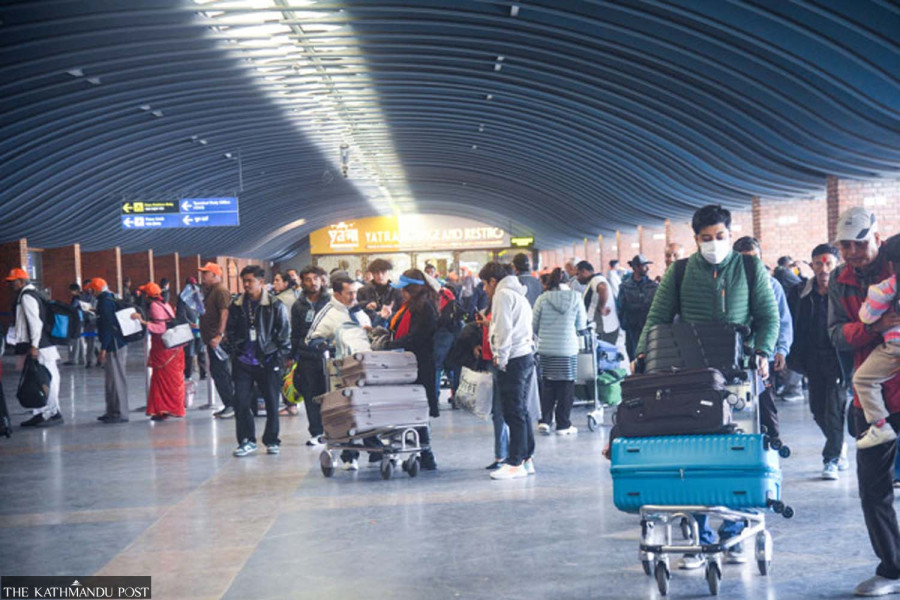
The ongoing war in the Persian Gulf region has caused difficulties in bringing back the bodies of 38 Nepali nationals, the Ministry of Foreign Affairs said on Friday.
“Due to flight disruptions, we are facing difficulties in repatriating the bodies of 38 Nepali nationals,” said Foreign Ministry spokesperson Lok Bahadur Chettri during a press conference in Kathmandu.
The Nepalis died from various causes unrelated to war. So far, the ministry has confirmed that only one Nepali in the UAE has died due to the conflict, while 21 others sustained minor injuries and have returned home after treatment.
The US-Israeli war on Iran, launched on February 28, and Iranian counterattacks across the Gulf show no signs of abating anytime soon.
The ministry is seriously concerned about the delay in repatriating the bodies of Nepalis who died from various causes, as flights have been affected, he said.
According to him, 15 dead bodies were in Dubai (UAE), 17 in Riyadh (Saudi Arabia), 1 in Oman, 4 in Abu Dhabi (UAE), 5 in Jeddah (Saudi Arabia), 3 in Tel Aviv (Israel), 2 in Qatar, and 1 in Bahrain. Out of these, nine were brought back via Kuwait Airways on Wednesday, and efforts are on to repatriate the remaining bodies, he added.
On Friday, the government sent a nonscheduled flight to Dubai to bring back some of the bodies. Another Nepal Airlines flight scheduled for Sunday will also transport the bodies of the Nepali migrant workers who died due to various circumstances.
Since the war broke out 35 days ago, the ministry has set up an online platform asking the Nepali diaspora in Gulf nations to register their names, addresses and other details for evacuation purposes. According to Chhetri, around 86,420 Nepalis have registered so far. But the number of people currently considering themselves unsafe is gradually decreasing, according to Chhetri.
Nepalis have been following instructions not to post misleading or rumour-spreading content on social media during the conflict. However, 11 Nepalis who violated these rules have been detained in various Gulf states.
Chhetri also added that 11 Nepalis currently in Iran are safe and in contact with the Nepali mission in Doha. He urged Nepalis in serious difficulties and wishing to return home to contact relevant embassies, stating that facilitation efforts are underway.
He also said that the situation does not indicate large-scale job losses among Nepalis in the region.
“However, there is a possibility of some impact in sectors such as hospitality and construction, and we are continuing necessary initiatives and coordination in this regard,” he said.
Regarding the arrest of Amit Jha in Iran, the foreign ministry said the arrest occurred before the current tensions began, and a court decision is pending.
He said efforts are ongoing to obtain detailed information [about Jha’s arrest] and provide legal assistance through the Nepali mission in Doha and the Nepali consulate in Iran. “A lawyer has met him, and he is reported to be safe,” said Chettri.
MoFA unveils 10-point agenda of reforms
Following the announcement last week of a 100-point roadmap for good governance and reform by the Rastriya Swatantra Party government, the Ministry of Foreign Affairs has come up with a 10-point agenda for reform and efficient service delivery.
As per the ministry, it will register a bill to amend the Passport Act, 2076, which will be completed within a month. “Second, the Department of Passports will effectively implement the appointment system currently in place for passport applications. Preparations are underway to complete this within 15 days,” said Chettri.
The third task is to make document authentication services more effective, organised, technology-friendly, and service-oriented. This is related to expanding the online system of consular services, with a target to complete it within 45 days.
The fourth task includes launching an AI-based virtual assistance system to make service delivery by the ministry and its agencies simpler, more accessible, user-friendly, and technology-driven. The ministry plans to complete this within 90 days. The passport department and Nepali missions abroad have been receiving over 8,000 inquiries, calls and other grievances on a daily basis.
“Fifth, there is a plan to repatriate Nepalis affected by the ongoing conflict in West Asia as soon as possible, in coordination with the Nepal Airlines Corporation and the Himalayan Airlines, with the travellers bearing the airfare. This is to be completed within 15 days,” he added.
The sixth task involves developing a mobile app for the Department of Consular Services and diplomatic missions to easily receive and address service-related requests and complaints. This work has already started and is expected to be completed within 30 days, according to Chhetri.
The seventh task is to expand online payment services for passport-related revenue fees. Work has started with a target to complete this within 45 days.
The eighth task involves establishing a Rescue and Relief Fund within 60 days to support Nepali citizens abroad—for purposes such as rescue, body management, legal aid, and defence—especially those travelling for foreign employment, study, tourism, or other purposes.
The ninth task focuses on locating and rescuing Nepalis abroad who are in trouble, stranded, or in prison. It also includes expanding the online system for insurance claims and compensation for injured or deceased Nepalis and their families to all districts and 753 local units. This system will allow individuals and their family members to easily submit applications and access necessary information. This is planned to be completed within 90 days.
The tenth task aims to further organise and improve the front desks and help desks at the department to make them more service-friendly. This is expected to be completed within 15 days, according to Chhetri.
Anil Giri is a Chief Sub Editor covering diplomacy, international relations and national politics for The Kathmandu Post. Giri has been working as a journalist for more than two decades, contributing to numerous national and international media outlets.




 23.32°C Kathmandu