Government sets 180-day deadline to clear stalled power deals, eyes export push
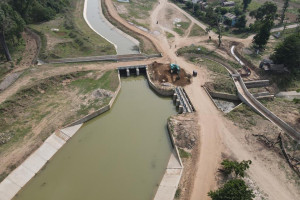
The plan prioritises clearing pending PPAs, boosting energy exports and reforming the power sector, but draws criticism for lacking focus on domestic electricity consumption. Post File Photo
The government has set a 180-day deadline to decide on power purchase agreements (PPAs) and licensing for energy projects.
In its 100-point work plan, the government has prioritised electricity production, transmission, distribution, and export, but has not emphasised growth in domestic consumption.
Aiming to make the energy sector a key driver of economic transformation, the government has said it will clear all pending PPAs and licensing decisions within 180 days by removing existing bottlenecks in production, transmission, distribution and export.
Energy entrepreneurs are confident that all projects pending since 2018 will receive PPAs. Ganesh Karki, chair of the Independent Power Producers’ Association Nepal (IPPAN), said PPAs will be completed within at least six months for projects totalling around 13,000 megawatts that have already applied to the Nepal Electricity Authority. He added that this could pave the way for opening up PPAs for the remaining projects.
Energy Secretary Chiranjeewee Chataut said discussions are ongoing with the Nepal Electricity Authority and the Department of Electricity Development to resolve issues related to PPAs and permits. “We are in talks and will find a solution and move towards implementation,” he said.
Former secretary Dwarika Nath Dhungel said the government must avoid pressure-driven PPAs that could lead to excess electricity going to waste in the future. He urged the government to align its decisions with India’s energy policy.
IPPAN has long demanded private sector participation not only in generation but also in transmission, distribution and export, arguing that this would help address delays in infrastructure development and issues in electricity trading.
The government has pledged to prepare an energy export strategy within one month. Secretary Chataut said discussions are ongoing to form a separate committee for this purpose. IPPAN expects the strategy to allow private sector participation in trade and transmission infrastructure.
The government has also announced a roadmap to restructure the Nepal Electricity Authority and move towards immediate implementation.
To improve industrial and business security, the government plans to establish necessary structures and a rapid response mechanism within 30 days. This is expected to ensure a stable environment for investors, free from past disruptions such as strikes and vandalism, according to Karki.
The plan also includes a streamlined and time-bound environmental approval process for national pride projects, using a fast-track, automated system. This is expected to speed up environmental impact assessments and tree-cutting permits for hydropower projects in protected areas, helping projects move forward on time.
Meanwhile, the Rastriya Swatantra Party (RSP) manifesto includes provisions to expand domestic electricity consumption by providing land for infrastructure and extending transmission lines to industrial zones. It proposes attracting energy-intensive industries such as steel, cement, herbal processing, data centres and fertiliser plants, along with tariff restructuring to boost household consumption.
The manifesto also targets increasing per capita electricity consumption to 1,500 kilowatt-hours annually by 2035 through a comprehensive energy strategy. However, the government’s 100-day agenda does not include measures to boost domestic electricity use.
Former secretary Dhungel said the government should not operate under the illusion that it can become wealthy by exporting electricity alone. He stressed that electricity and water resources should be used to create jobs and improve living standards within the country. He also emphasised balancing production with national planning and expanding the domestic market, while seeking export opportunities, particularly with India.
Dhungel suggested promoting reservoir-based projects to manage seasonal fluctuations, as Nepal imports electricity in the dry season but produces surplus during the monsoon.
The Federation of Nepalese Chambers of Commerce and Industry (FNCCI) welcomed the focus on energy production and exports. FNCCI president Chandra Dhakal said electricity should be treated as a raw material and supplied at concessional rates to industries, which would create a dual benefit for the economy.
The government’s plan also includes prioritising electricity exports to high-value markets, especially during peak evening hours. Nepal currently exports surplus electricity to India year-round and to Bangladesh between June 15 and November 15. The country will increase exports to Bangladesh from 40 megawatts to 60 megawatts starting June 15.




 24.95°C Kathmandu