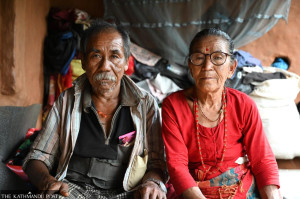
A 76-year-old mother travels every month between Pokhara and Kathmandu as hearings in son’s murder case are repeatedly delayed. Bishnu Kumari Pandey has been seeking justice for the past 12 years. Post photo
Every month, 76-year-old Bishnu Kumari Pandey boards a bus from Pokhara to Kathmandu clutching a bundle of court papers, borrowed money and fading hope.
Her son Surya Bahadur Pandey was killed during Mahashivaratri celebrations in Pokhara 12 years ago. Since then, she has spent years moving between police offices and courts demanding punishment for those accused of his murder. Yet, every trip to the Supreme Court ends the same way.
On Monday, Bishnu Kumari reached the court expecting a hearing in the long-running case. Instead, court officials informed her that the hearing had once again been deferred and rescheduled for June 3.
“I have no money left, but still there is no justice,” she lamented, breaking into tears outside the court premises. “If I still do not get justice, I will die at the gates of the court or outside the Office of the Attorney General.”
Bishnu Kumari cannot read or write. Her hearing has deteriorated with age, making communication difficult. Yet she continues to narrate her ordeal to anyone willing to listen.
“My son was beaten to death, and the court has failed to give justice,” she said.
According to Bishnu Kumari, she has already spent all her savings travelling repeatedly between Pokhara and Kathmandu, around 200 kilometres. She said she had borrowed money for transport and hotel expenses and now owns little beyond the earrings and nose ring she is wearing. “If selling them will help me get justice, I will sell them too,” she said.
The Supreme Court has already deferred the hearing 15 times. Frustrated, Bishnu Kumari now carries a handwritten list containing the names of judges involved in the case, including acting Chief Justice Sapana Pradhan Malla and Chief Justice nominee Manoj Kumar Sharma.
“Where can I meet the judges? Will they give justice to my son?” Bishnu Kumari told Kantipur this week. At one point, she even tried to meet Prime Minister Balendra Shah at Singha Durbar, hoping he might help draw attention to her struggle. Officials at Singha Durbar told her he was in Baluwatar, while staff there directed her back to Singha Durbar.
“Where does Balen really stay?” she asked in confusion.
The incident dates back to February 17, 2015. Surya Bahadur, then aged 25, had left home with friends to attend a Shivaratri fair in Pokhara. The next morning, his bloodied body was found near Ram Temple at Tulsighat.
According to the complaint filed by Bishnu Kumari, Surya Bahadur had disputes with Ramchandra Manandhar, Buddha Shrestha and Dhruba Manandhar over a woman named Amrita Lama. She claimed that her son was beaten to death and thrown off a cliff.
Police statements submitted during the investigation showed contradictory accounts. Buddha Shrestha told investigation officers that the dispute began after sugarcane waste accidentally struck Lama. He claimed Surya Bahadur suddenly arrived and assaulted him before Dhruba intervened.
Ramchandra, however, admitted during police questioning that he had fought with Surya Bahadur after the latter allegedly used offensive language towards his girlfriend while they were drinking together. He further stated that Surya Bahadur left the room after receiving a phone call around 1:30am and that he followed him to the Tulsighat bridge area. According to the police statement, Ramchandra admitted pushing Surya Bahadur into the Seti river gorge after a physical fight.
However, all three accused later changed their statements in court. Following a preliminary hearing, the Kaski District Court ordered the accused to remain in judicial custody. The defendants challenged the order at the High Court, which overturned the district court’s decision in June, 2019 and released them on bail of Rs100,000 each. Later, the Kaski District Court convicted Ramchandra Manandhar but acquitted Buddha Shrestha and Dhruba Manandhar, stating that the charges against them were not sufficiently proven.
The government appealed against that verdict at the Pokhara High Court. In March 2022, a joint bench of judges Shridhar Kumari Pudasaini and Pramod Kumar Shrestha Baidya upheld the district court ruling. The case then reached the Supreme Court, where hearings have repeatedly stalled.
Advocate Mohna Ansari, a former member of the National Human Rights Commission, said Bishnu Kumari’s struggle for justice reflects the suffering faced by many ordinary citizens trapped in Nepal’s overloaded judicial system. “She had come to Kathmandu in the same way last year and cried inside the court after the hearing did not proceed. The court employees then convinced her and sent her home,” said Ansari. “This case shows how much hardship citizens face because cases remain pending for years.”
After the hearing was deferred for the 15th time, Bishnu Kumari returned to her home district in despair. Still, she says she will not stop raising her voice until she gets justice. “At first, they refused to even register the complaint, and the police did not conduct a proper investigation either. No matter what anyone says, I will not stop speaking out,” she said.
At one point during her campaign for justice for her son, she also lost her documents, cash and other belongings. “Everything was stolen. People tell me not to keep going to the courts and the police. But how can I stay silent against those who beat my son to death?” she said.
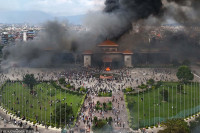
According to Supreme Court officials, the case file related to Surya Bahadur’s murder was also destroyed during the Gen Z protest in September last year. Officials said the recovered documents later allowed proceedings to resume.
Supreme Court spokesperson Arjun Prasad Koirala said delays were common because of the growing backlog of cases and shortage of justices. “It is impossible to hear every case on schedule. Some hearings are postponed because of technical reasons, while others are deferred due to the heavy workload,” said Koirala.




 18.61°C Kathmandu