Speakers stress innovation, policy stability and productive investment
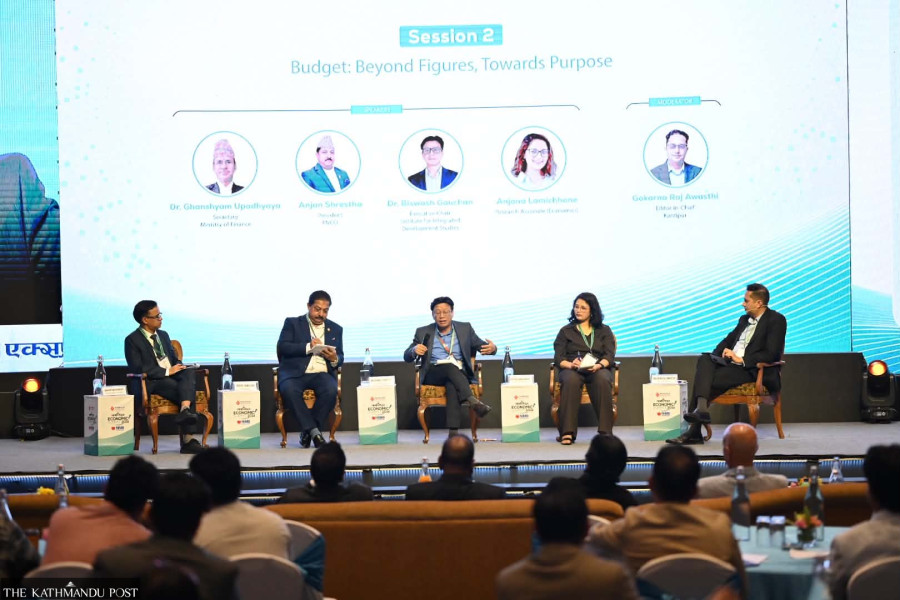
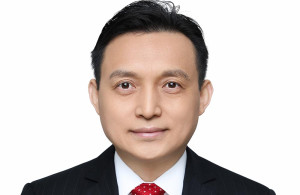
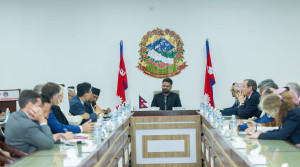
Finance Secretary Ghanshyam Upadhyaya says the upcoming budget will prioritise governance, economic reform and infrastructure, while business leaders call for investor confidence. Angad Dhakal/TKP
Finance Secretary Ghanshyam Upadhyaya said on Wednesday that the government’s priorities for the upcoming fiscal year had already been outlined in the policy and programme document, with good governance remaining the top focus.
Speaking at the second session of the Kantipur Economic Summit 2026 titled “Budget: Beyond figures, towards purpose,” Upadhyaya said economic reform and infrastructure development would follow as the government’s key priorities.
“The pillars of these priorities are investment and facilitation,” Upadhyaya said.
He said government policies over the past decade had helped Nepal become self-sufficient in cement production and transformed the country from enduring 18 hours of daily load-shedding to exporting electricity.
“This became possible because of supportive government policies,” he said. “The government has worked to reduce import dependency and facilitate growth in productive sectors through policy measures.”
Upadhyaya said restoring private sector confidence has become essential.
“The private sector seeks guarantees of security, including protection of property and personal safety,” he said.
He also said the government plans to involve the private sector more actively in public infrastructure development and profit-oriented projects. According to him, the upcoming budget will place special emphasis on completing unfinished projects.
Other speakers at the summit said Nepal’s economy cannot achieve long-term growth targets without policy stability, stronger industrial productivity and greater focus on innovation.
President of the Federation of Nepalese Chambers of Commerce and Industry Anjan Shrestha said the private sector has long suffered from policy instability and unpredictable government decisions.
“We keep jailing businesspeople and then expect them to think freely and innovate. If businesses do not have the freedom to operate with an open mind, how can innovation and research flourish?” Shrestha said.
He said government policies often change with political leadership, creating uncertainty for investors.
“One minister introduces a policy. Two years later, a new minister arrives and reverses the same policy,” he said.
Executive Chair and Director at the Centre for Economic Policy at the Institute for Integrated Development Studies Bishwash Gauchan said Nepal’s economy is unlikely to reach the 100-billion-dollar mark within the next five to seven years under the current pace of economic growth.
Speaking at the summit, Gauchan said Nepal would require much stronger and sustained growth to meet the government’s targets. The government’s policy and programme have projected an average economic growth rate of 7 percent over the next decade and aim to upgrade Nepal to a middle-income country within that period.
Gauchan also said Nepal’s economy has struggled to generate jobs because both the state and private sector have failed to prioritise innovation.
“While we continue discussing second-generation reforms, we should be building an economy capable of competing globally,” he said.
“The state and private sector both need to focus on innovation. But neither appears to have seriously invested in it,” he added.
Gauchan also said he had not seen any public-private partnership project in Nepal that could be considered fully successful, adding that the private sector has not been encouraged to pursue new investment opportunities.
Economist Anjana Lamichhane said Nepal’s industrial and production sectors remain weak, while private investment is still low despite excess liquidity in banks.
“Our production and industrial sectors are weak, and private investment remains limited,” she said. “Even though banks have liquidity, investors lack confidence, which has prevented investment from increasing.”
Lamichhane said the government should avoid scattering budget allocations across numerous small projects and instead prioritise spending that delivers effective and measurable results.
Gokarna Raj Awasthi, editor-in-chief of Kantipur Daily, moderated the session.




 25.83°C Kathmandu