Gen Z activists continue protest as government withholds probe report
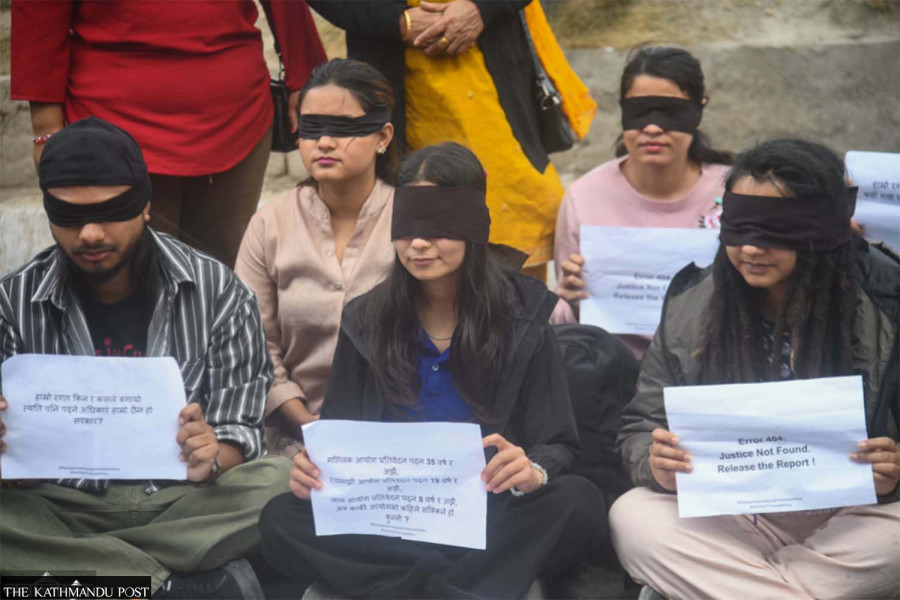
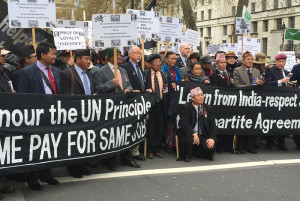
Government spokesperson Aryal did not show up for an expected regular press briefing on Monday, when the details of the report were supposed to be made public. Activists stage a sit-in at Maitighar, Kathmandu on Monday, demanding the release of the probe report. Deepak KC/TKP
Gen Z activists continued their protests on Monday, demanding the report submitted by the commission investigating the September uprising be made public.
Activists under the banners of Gen Z Movement Alliance Nepal, the Nepal Gen Z Front, and the Gen-Z Civic Forum have been staging protests at Maitighar Mandala since Sunday to build pressure on the government.
The government has so far appeared reluctant to release the report submitted by the commission led by former Special Court judge Gauri Bahadur Karki.
The commission was formed on September 21 to probe the killings and destruction of private and public properties during the uprising. The commission submitted the report to the government on March 8.
The Sushila Karki administration has vowed to release the synopsis of the report, but has not lived up to the commitment yet. The agitating youths want the entire report to be made public.
Monika Niraula, a representative of the Gen Z Alliance who participated in the protest, says they will continue their protest to exert pressure on the government until the report is made public.
She argues that the government had earlier stated that the commission's report would be accepted after the election and then be made public. Now the government’s failure to disclose the report has created further suspicion, she said.
“The government’s refusal to make the report public is suspicious,” she said. “We will therefore continue to apply pressure on the government through both physical protests and social media until it comes to the public domain.”
Another Gen Z activist Rakshya Bam said they are building pressure to make the government accountable for its commitment.
The Cabinet meeting on Sunday decided to accept the report.
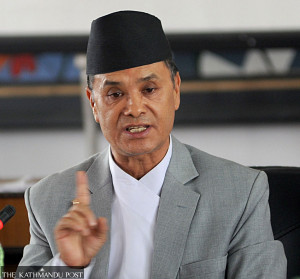
Government spokesperson Om Prakash Aryal, who also oversees the home ministry, had said that the Cabinet had decided to accept the report and was studying it.
While speaking to the media, Aryal had said that detailed information about the Cabinet meeting would be made public on Monday during the regular media briefing.
“The details will be known tomorrow [Monday],” Aryal had said.
However, according to Rabindra Prasad Poudyal, the information officer at the Ministry of Information and Communications, the regular media briefing, usually held on Mondays, did not take place.
“I am not aware of the reason why the media briefing could not be held,” Poudyal said.
The commission's report reportedly recommends criminal investigations against former Prime Minister KP Sharma Oli, former Home Minister Ramesh Lekhak, and former Police Chief Chandra Kuber Khapung, among others.
Senior advocate Bipin Adhikari says that anyone can be investigated for a criminal offence, but a person is considered guilty only when the investigation establishes the charges against them.
Adhikari says a criminal offence must be proven beyond reasonable doubt. In the context of the incidents that occurred on September 8 and 9, whether these political figures are connected to the events depends on what the investigation report has actually found, he said.
Only on the basis of those findings can any conclusion be drawn. Political and moral responsibility differ from criminal liability, said Adhikari, who is also a professor at Kathmandu University School of Law.
Adhikari also explains that even when orders are issued (from the higher authorities), the mobilisation of force follows the chain of command. “The decision on whether to use bullets is typically not taken directly by the high command but by the police personnel deployed on the spot,” Adhikari told the Post.
However, advocate Bishweshwar Bhandari, a member of the commission, says that the report has only provided recommendations to the government for further investigation.
According to him, the suggestions are intended to assist government agencies in conducting further investigations. “It is totally up to the government whether or not to adopt the recommendations,” Bhandari said.
After receiving the report, Prime Minister Karki said the government would first study the document and then proceed with implementation.
During the investigation, the commission recorded statements from over 150 individuals, including government officials and eyewitnesses, regarding the incidents during the Gen Z protests that resulted in a total of 77 deaths, including dozens of unarmed youths shot by police.
Besides Gauri Bahadur Karki as its head, the panel included former additional inspector general of police Bigyan Raj Sharma and legal practitioner Bhandari as members.




 15.76°C Kathmandu