Politically correct? Concern grows over what MPs can utter in Parliament
From Panchayat-era controversies to today’s disputes, Nepal’s Parliament still wrestles with what counts as ‘unparliamentary’. Opposition party lawmakers protest as Speaker Dol Prasad Aryal (not pictured) attempts to proceed with the House of Representatives meeting. Post File Photo
Author Tanka Chaulagain, in his novel Rudane, based on the life of Rupchandra Bista, paints a vivid picture of a moment in Parliament during the Panchayat days.
It's the early 1980s. During a National Panchayat session, Chaulagain writes, Bista, also known as Rudane, rose to speak and said: “Those who have ‘king, country and system’ written on their faces, but behave like dogs that bark and bite at people’s rights, are our main political problems.”
The chamber erupted. Hiralal Bishwakarma objected immediately. Chair Kamal Shah instructed Bista to withdraw his remark.
“Hey, my words. Your job is done," Bista responded with sarcasm. "Now come back!”
The remark was withdrawn, but the words had already echoed through the hall and were etched in everyone's mind. Author Chaulagain says the episode is drawn from a real incident, later woven into fiction.
The objection to Bista's words was that they were "unparliamentary".
More than four decades on, Nepal’s political system has changed, the constitution has changed, and Parliament itself has changed. Yet what remains the same is the question of which words are deemed parliamentary and which ones unparliamentary. And it has rather become more complicated.
That question returned sharply on May 12, during a debate at the House of Representatives on the government’s policies and programmes.
CPN-UML parliamentary party leader Ram Bahadur Thapa questioned the political rise of the Rastriya Swatantra Party, the Gen Z movement, and the role of the Nepali Army, from the rostrum. “Why did the Nepali Army remain a silent spectator when the country was burning and even the headquarters of its own supreme commander, the President’s Office, came under attack?” he asked.
The reaction was immediate. The RSP lawmaker Manish Khanal objected. Speaker Dol Prasad Aryal indicated that a point of order would be taken after the speech. Once Thapa finished, Khanal demanded the remark be removed from the record, calling it “unparliamentary”. Rastriya Prajatantra Party lawmaker Khusbu Oli also backed the demand, focusing on the reference to the army.
The next day, RSP lawmakers pressed the issue again.
Speaker Aryal then ordered three bits from Thapa’s speech to be expunged: “mob of anarchists”, “those who burned the country wearing the national flag”, and “Nepali Army remained a silent spectator”.
Matter closed?
No, it widened instead.
The next day, UML chief whip Ain Mahar raised a counter-question: why were similar expressions used by RSP lawmakers Ganesh Parajuli and Ramesh Prasain, including “henchmen”, “sycophants”, and “genocide” left untouched?
On May 14, the Speaker ordered those too to be removed from official records.
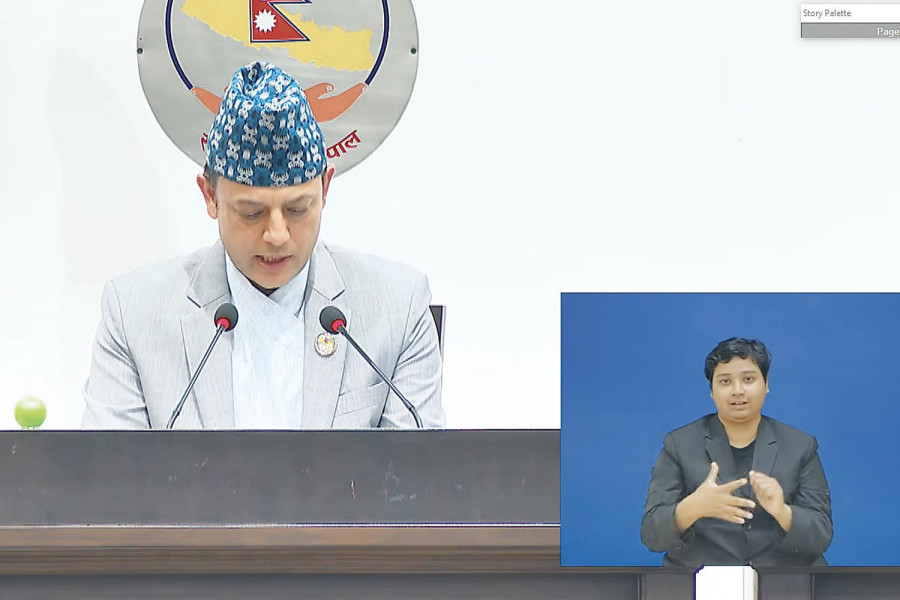
Speaker Dol Prasad Aryal and a sign language interpreter (right) in a recent House session. Screengrab Via YouTube
In a democracy, Parliament is considered the most hallowed place, yet it's where lawmakers spar, engage in the exchange of words, and trade barbs. In doing so, in the heat of emotion, they often tend to toss a phrase or two that stokes a debate of what's parliamentary—and what is not.
Inside the House, every spoken word is recorded in audio, video, and written form, forming a verbatim record. The Speaker has the authority to remove parts of that record if they are judged to violate parliamentary decorum. In some cases, recordings are muted or edited.
The constitution protects lawmakers’ freedom of speech inside Parliament, granting them immunity for statements made in the House. But that freedom is not without limits.
The House Rules prohibit indecent, obscene, insulting, or identity-based derogatory language. The problem is that there is no fixed list of banned words. Much depends on interpretation.
What exactly, then, counts as parliamentary language?
Rajendra Phuyal, a former secretary at the federal parliament, says, “It cannot be said in absolute terms which word is parliamentary and which is not. Context, timing, and intent matter.”
That ambiguity is where disputes begin.
What one side sees as a legitimate political question, another sees as an insult to national institutions. A remark about the Nepali Army, for instance, may be read as accountability by some, and as overreach by others.
Saugat Gautam, a political scientist, warns that expanding the scope of “unparliamentary” too far risks shrinking debate itself. “The core function of Parliament is scrutiny. The opposition exists to question power,” he said. “The parliament loses its critical edge if questioning institutions or the government is treated as unparliamentary.”
The issue has become more crucial now, as the ruling party has close to a two-thirds majority—182 seats—with the opposition altogether numerically weak. The Speaker, as the presiding officer of the House of Representatives, must act prudently, judiciously, and impartially, observers say.
Shiva Gaunle, a journalist with long experience covering parliamentary affairs, says the issue ultimately rests on the Speaker’s discretion, but that discretion must be exercised carefully.
“The practice of expunging words started to remove genuinely offensive or degrading language,” he said. “But increasingly, strongly-worded political criticism began to be pulled into that category.”
He adds that a balance is essential.
“Genuine abuse cannot be protected in the name of free speech, but political dissent should not be swiftly categorised as unparliamentary,” he said.
Hari Bahadur Thapa, also a journalist who has extensively covered parliamentary affairs, sheds light on how the practice of deeming words unparliamentary began.
According to him, initially, this had more to do with abusive language or expressions that demeaned marginalised communities.
“In the House of Representatives meeting on September 14, 1959, Mrigendra Shumsher Rana, elected from the Gorkha Parishad, used the word ‘incompetent’. Then Speaker Krishna Prasad Bhattarai ruled it unparliamentary and instructed that it not be used,” Thapa said.
According to Thapa, for a long time, “unparliamentary words” mainly referred to expressions that insulted women, Dalits, marginalised groups, or individuals.
“But in recent times, there is a growing tendency to also remove remarks made while questioning state institutions by labelling them unparliamentary,” he said. “If there are political questions raised against an institution, they should instead be subject to parliamentary scrutiny. They should not be erased from the record.”
Striking off “unparliamentary” words is not uncommon
In the 2008 Constituent Assembly, the then Maoist leader Gopal Kirati’s remark that opponents of constitution drafting would be “turned into ashes” was removed from the record. Rastriya Janamorcha leader Chitra Bahadur KC’s reference to Parliament as a “sheep pen” was similarly struck off the records.
In 2016, Amaresh Kumar Singh’s comment questioning then-prime minister KP Sharma Oli’s mental state was erased.
It was during the 2019–20 policy and programme debate in Parliament. Oli attended the House on May 7, 2019, to respond to questions raised by lawmakers.
At the beginning of his remarks, Oli said: “Thank you for the questions and observations. I will respond to them without being influenced by anger, frustration, or what I consider disparaging comments (nimchharo remarks).”
His use of the word “nimchharo” immediately triggered controversy in the House. The Nepali Congress protested, and then Speaker Krishna Bahadur Mahara directed that the word ‘nimchargo’ be removed from the record.
Such parliamentary records show that the practice of expunging words is not new. But the current concern is not just about practice; it is also about credibility.
Journalist Gaunle says the authority to remove words from the record lies with the Speaker, but it must be exercised with care.
“Since expunging from the record is a matter of the Speaker’s privilege, the Speaker must exercise prudence while making such decisions,” he said.
International practice also feeds into this debate.
In the British Parliament, words such as “liar” and “blackguard” are considered unparliamentary. If an MP directly calls another MP a liar, the Speaker immediately asks for the remark to be withdrawn.
In India’s Lok Sabha, there is a practice of regularly updating a list of ‘unparliamentary’ words each year. In recent years, terms such as “Covid spreader”, “sycophant”, and “dictator” have been included. This sparked criticism that even words used to question those in power were being classified as unparliamentary, raising concerns that criticism of authority itself was being curtailed.
Nepal, too, has experimented with standardising parliamentary language, according to Phuyal. He says that in 1991, the Parliament Secretariat published a compilation of “unparliamentary” words. A book titled Sansad Bhitra, written by then-general secretary Jeevan Lal Satyal, was distributed to lawmakers.
Phuyal says, however, that meaning and interpretation change with time and context. The political language of earlier decades is different from the language used in the era of social media.
“Words used earlier and words today carry different weight. Terms once labelled unparliamentary may become acceptable over time,” he said, “while expressions once considered normal may now be seen as unparliamentary.”




 23.73°C Kathmandu