No immediate need to evacuate Nepalis from Gulf region, says MoFA
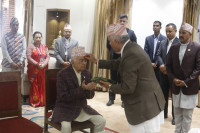
Out of 15 Nepalis injured in Iran attack in the Gulf and Israel, 14 have returned to work after treatment. Foreign Minister Balananda Sharma (centre) and other officials of the Ministry of Foreign Affairs at the press conference organised in Kathmandu.
The Ministry of Foreign Affairs (MoFA) has said there is no immediate need to evacuate Nepali workers from the Gulf region on security grounds.
“Our analysis so far suggests that there is no need to rescue and bring them back immediately due to risks to their lives,” Amrit Kumar Rai, the foreign secretary, said at a press conference organised in Kathmandu on Wednesday. “No one should worry or panic. This message should also reach their families in Nepal and Nepalis living in West Asia.”
Rai noted that although some western countries have been evacuating their citizens, countries that send migrant workers to the Gulf have not initiated evacuation efforts.
“We have not seen rescue efforts from labour-sending countries such as Bangladesh, India, Pakistan and Sri Lanka,” he said. “If a situation arises where evacuation becomes necessary, the government is capable of doing so and will act at any cost.”
Meanwhile, the ministry said 15 Nepali nationals were injured in the missile and drone attacks carried out by Iran. Six were reportedly injured in Israel.
Ramkaji Khadka, joint secretary at the ministry, said 14 of the injured have already returned to work after receiving treatment, while one person is still undergoing treatment and is in stable condition.
The attacks came amid escalating hostilities between Iran and Israel and the United States, with Iran launching drone and missile strikes targeting US military bases in the Gulf and other parts of West Asia and Israel.
Earlier, Dibas Shrestha of Gorkha died in the UAE during a drone attack. His body has been repatriated to Nepal and cremated.
According to the ministry, the Nepali Embassy in the UAE is working to secure compensation for the deceased through diplomatic channels.
MoFA said Nepalis living in other parts of the region are safe and that the government is closely monitoring the situation.
The ongoing war in the Persian Gulf has unsettled the overall security situation in the region, and its repercussions are expected to affect Nepal as well.
With the escalation of hostilities, air services operating through Gulf countries have been disrupted and employment prospects in the region are likely to suffer.
Data shows that around 1.9 million Nepali workers are currently employed across the Gulf. Of the approximately 700,000 Nepalis who leave the country each year for foreign employment, nearly 65 percent—around 450,000—head to Gulf countries.
Migrant workers in the region also contribute a significant share of Nepal’s remittance inflows. In the fiscal year 2024-25, Nepal received Rs1.702 trillion in remittances, of which Rs673 billion came from Gulf countries.
In the first six months of the current fiscal year 2025-26, Nepal received Rs1.03 trillion in remittances, with Rs422 billion—around 41 percent—originating from the Gulf region.
Analysts say any prolonged conflict could therefore affect Nepal’s tourism, remittance inflows, foreign trade and labour migration.




 18.41°C Kathmandu