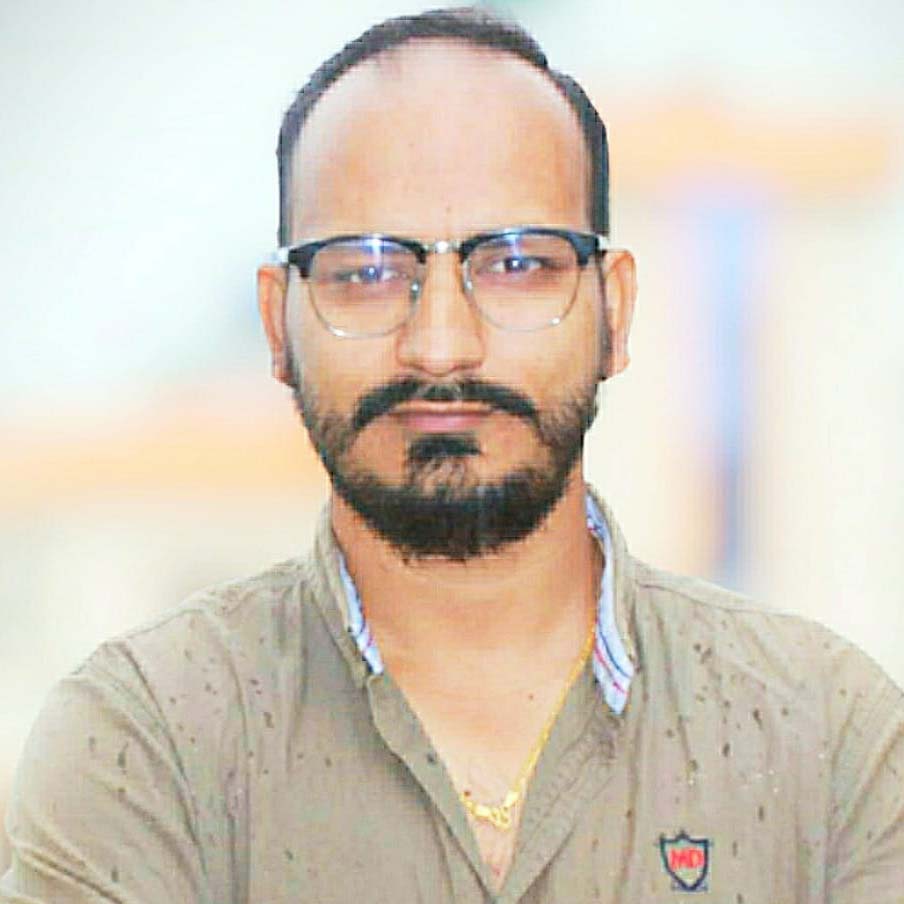
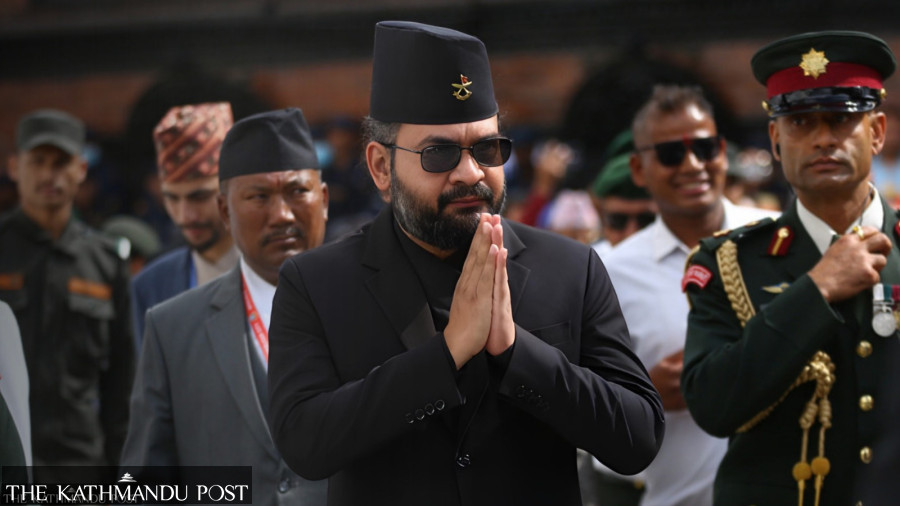
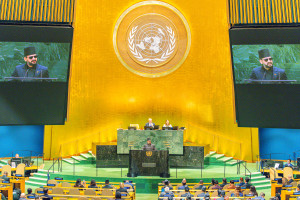
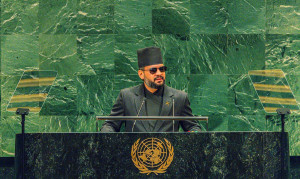
While Lamichhane and Aryal’s remarks raise questions, lower-rung leaders say there is no question of deviating from the previous agreement. Balendra Shah trounced former prime minister KP Sharma Oli in the March 5 election.p POST PHOTO
As the vote count for the parliamentary elections nears completion, and the Rastriya Swatantra Party (RSP) in line to bag close to a two-thirds majority, statements made by some party leaders have raised questions over the party’s prime ministerial candidate.
The seven-point agreement between the RSP and Balendra (Balen) Shah envisions the former Kathmandu Metropolitan City mayor as the party’s prime ministerial candidate. Clause 4 of the agreement states that Rabi Lamichhane would remain the party chair, while Shah would be made the parliamentary party leader and the party’s candidate for prime minister.
However, after the election victory, non-committal comments made by party chair Lamichhane and vice-chair DP Aryal in response to media queries have triggered public debate. Aryal, who was elected from Kathmandu constituency–9, has faced criticism on social media over his remarks on the implementation of the agreement.
When asked whether the seven-point agreement that envisages Balen as prime minister would be implemented, Aryal had said, “I may need to look at the agreement myself again. I don’t remember every detail. If what you are saying is indeed written there, then that will be followed.”
When pressed further, Aryal said he did not see the need to make any such commitment to the media.
The same question was also put to party chair Lamichhane. However, his rather evasive response only fuelled further speculation. When asked whether Balen would be made prime minister for the full five-year term, he seemed to be trying to avoid the question.
Lamichhane, who won a landslide victory from Chitwan–2, is unlikely to be prime minister immediately, as cases against him related to cooperative fraud, organised crime, and money laundering are currently under consideration in various courts.
But lower rung leaders say Balen will not be betrayed.
Shishir Khanal, a leader of the RSP, said that Balen will indeed become prime minister. Khanal argues that since the party had already declared Balen as its prime ministerial candidate before the election and sought votes from the public on that basis, there is no room for the party to backtrack on that commitment.
“The party will not demur from implementing the seven-point agreement,” Khanal, who was also one of the negotiators from the RSP during the unity talks with Balen, told the Post.
Along with Khanal, one other negotiator from Balen’s side who too was involved in drafting the seven-point agreement, also expressed confidence that the agreement will be honoured.
Days after the seven-point agreement, the RSP organised its first public gathering in Janakpur, the capital city of Madhesh province. The public gathering featured Shah, who just a day earlier had resigned as mayor.
Balen, who hails from Mahattori, a district in Madhesh province, rarely gave public speeches, but on this occasion, he said, “A son of Madhesh will be the prime minister of the country.”
Before that, on December 28 last year, he had decided to join the RSP, a party that emerged as the fourth largest force from the 2022 election. The party had pledged to appoint Balen as the prime minister should the party get enough seats in the March 5 election.
The RSP surpassed expectations, securing 125 seats out of 165 direct seats , and bagging around 50 percent of the proportional representation (PR) votes, which are still being counted after the election on March 5. In the 275-strong parliament, there are 110 PR seats.
Meanwhile, the Election Commission, which has already completed the vote count under the FPTP system, has said it will also complete the PR vote count and submit the final report to President Ramchandra Paudel by March 19. Upon receiving the report, the President will convene the meeting of the newly elected Parliament, which will then proceed to elect a new prime minister.
Experts believe that Balen successfully harnessed the wave of support unleashed by the September uprising to give the party the top position in the election.
The new RSP could be stronger than even the 2017 alliance of CPN-UML and then CPN (Maoist Centre). The two parties, which later merged to form the Nepal Communist Party, had a total of 174 seats in Parliament.
Some RSP leaders argue that the party already had strong goodwill before the election, as was evident during the signature campaign last year against the then government’s decision to detain party chairman Rabi Lamichhane in connection with cooperative fraud cases. Based on this, those leaders claim that the party’s current electoral performance cannot solely be attributed to Balen.
“The party did not become popular overnight. The enthusiastic public participation in the signature campaign we launched also showed that there was already considerable public goodwill towards the party even before a particular individual joined it,” said a leader close to party chair Lamichhane, speaking on condition of anonymity.
The party had claimed that over four million people had participated in the signature campaign.
Political analyst Chandra Dev Bhatta said that despite the claims of some party leaders, Balen played a pivotal role in getting out votes for the RSP.
“This result can be attributed more to Balen as a person than the RSP as a party. Not making him prime minister would be to deceive the electorate," Bhatta argues.
However, Bhatta also notes that RSP’s statute might make it tricky for Shah to become prime minister.
Article 66, Sub-clause 8 of the Constitution provides for the selection of the leader of the parliamentary party in the House of Representatives. It states that the leader should be chosen through a contest among interested candidates from among those already selected as candidates—either under the PR or FPTP systems—before the federal election.
“The leader of the parliamentary party in the House of Representatives shall be elected through a vote among interested candidates from among those selected by the party as candidates under the PR and FPTP systems for the federal election,” the statute states.
Sub-clause (b) further provides that all ordinary members of the party will be eligible to vote in the election mentioned in Sub-clause (a). A candidate who secures at least 50 percent plus one of the total valid votes cast will become the parliamentary party leader from the party. If no candidate gets the required majority, the Constitution provides for a second round of voting between the two candidates who received the highest number of votes.
“If no candidate secures 50 percent plus 1 of the total valid votes, a run-off election will be held between the two candidates receiving the highest number of votes, and the winner will become the parliamentary party leader of the party,” the provision reads.
Under Article 76(1) of the Constitution, the President is also required to appoint as prime minister only the ‘leader of the parliamentary party’ that has a clear majority in the House of Representatives.
However, party leader Khanal said that the RSP has in the past picked its parliamentary party leader based on the votes of elected lawmakers rather than strictly in accordance with the party statute. Therefore, he argues, the statute would not pose an obstacle for Balen’s election as prime minister.
“The party will not even need to amend its statute to make Balen the prime minister,” Khanal said.




 15.26°C Kathmandu