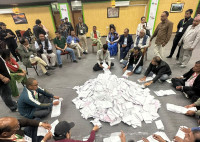
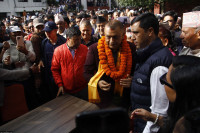
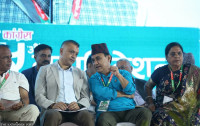
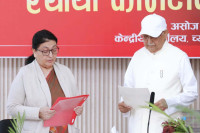
Interim government overcomes scepticism and political opposition as she oversees Thursday’s elections with strong public support. Sushila Karki votes in a Dhapasi polling centre in Kathmandu on Thursday. Post photo
Against widespread doubts, the interim non-partisan government led by Prime Minister Sushila Karki successfully conducted snap parliamentary elections on Thursday, called in the wake of last September’s Gen Z uprising. Experts and political observers had initially questioned whether Karki’s caretaker government could manage elections amid public scepticism and security concerns.
Political analyst Jhalak Subedi says that although there were doubts about the government from the day it was formed, the Karki administration has provoked the doubters wrong by successfully completing its primary duty.
With the end of elections, Subedi also believes the country has started returning to a constitutional track.
Although Nepal’s second Constituent Assembly elections in 2013 was also conducted by a non-partisan government led by former chief justice Khil Raj Regmi, Subedi says there were significant differences between that administration and the current Karki-led government.
The earlier government had been formed on the recommendation of political parties and received their cooperation in conducting the election.
“By contrast, the government led by Karki did not enjoy the same level of backing from political parties. Despite such challenging and adverse circumstances, the Karki-led administration ensured the election process went ahead smoothly,” says Subedi.
During the Gen Z movement, 77 people lost their lives, many of them unarmed young students shot dead by police. The unrest also shook the country’s police administration and wider state machinery. With morale of key state institutions weakened, political parties—especialy those ousted by the uprising, including the CPN-UML and Nepali Congress—as well as some monarchist groups, repeatedly accused the Karki government of failing to create a conducive environment for holding elections.
During the September unrest, thousands of prisoners serving sentences for various crimes managed to escape prisons across the country, and many police weapons were also looted. Under these circumstances, many people had serious doubts about whether a free and fear-free elections would be possible.
There were also legal questions around the formation of the Karki government. Article 76 of the Constitution of Nepal outlines three specific circumstances under which a prime minister can be appointed. However, Karki’s appointment as prime minister met none of the three criteria.
Citing Article 132 of the constitution, the CPN-UML, whose prime minister KP Sharma Oli was ousted by the uprising, had repeatedly argued that Karki’s appointment as prime minister was unconstitutional. According to the provision, the chief justice and justice of the Supreme Court cannot hold any office other than that of the National Human Rights Commission. UML consistently maintained that, as a result, any election conducted by the Karki government would lack legal validity.
Amid such circumstances, there were widespread fears that the election might not take place at all. Despite these challenging conditions, Nepal went on to successfully conduct its ninth parliamentary elections on Thursday.
According to former deputy inspector general of Nepal Police Hemanta Malla, there are two main reasons why the government was able to conduct the elections despite the difficulties.
First, following the Gen Z uprising, a large section of the Nepali public stood in favour of change. “As elections are the most legitimate means of bringing about such change, people were keen to take part in the electoral process, which made it easier for the government to conduct the polls,” Malla says.
He points out that those opposed to change had comparatively weaker public support, and as a result, were unable to disrupt the electoral process.
Malla adds that while Prime Minister Karki played a crucial role in ensuring timely election, the contribution of Home Minister Om Prakash Aryal should not be overlooked. According to him, Aryal appeared somewhat inexperienced during the early days of his tenure, but gradually matured in the role.
“From a security standpoint, he convened not only central-level security coordination meetings but also meetings at the district levels and this helped ensure that there were no major security challenges during the election period,” Malla states.
Former permanent representative of Nepal to the UN, Shumbhu Ram Simkhada, says the government led by Karki was able to conduct the election successfully not only because of domestic support but also due to the goodwill of Nepal’s two neighbours—India and China—as well as other friendly nations.
According to Simkhada, diplomatic missions in Nepal appeared ambivalent in the aftermath of the Gen Z uprising, but in recent months they seemed increasingly in favour of political stability in the country.
“Particularly for India and China, it is far more convenient to have a stable Nepal than an unstable one. That is why they wanted a timely election,” Simkhada says.
He added that while some friendly countries may have privately preferred certain political parties, there was a broader understanding among them that their interests would be best served through the prompt restoration of the democratic process in Nepal.
A total of 18.9 million voters were registered for Thursday’s elections for the 275-seat House of Representatives, up by over 915,000 since the last elections held in 2022. Around 52 percent of them fell in the 18-40 age group.
A total of 6,541 candidates contested the election — 3,406 for first-past-the-post seats and the rest under proportional representation. Under FPTP, 65 parties fielded 2,263 candidates, alongside 1,143 independents.




 24.79°C Kathmandu