Why can’t consumers exchange other brands’ LPG cylinders amid the shortage
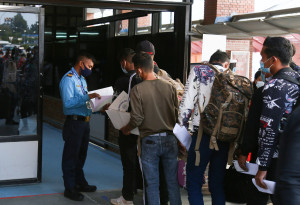
A government directive allowing consumers to exchange cylinders across brands has failed to take effect, with gas companies citing legal, technical and insurance complications. Nepal currently has 58 LPG bottling plants, and each company distributes gas in its own cylinders. Photo: Nepal News Bank
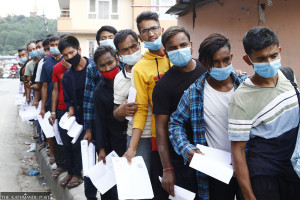
There was a long queue outside the Salt Trading Corporation’s office in Koteshwar on Friday as consumers waited to get cooking gas. Many had brought cylinders belonging to different LPG companies, hoping to exchange them for filled ones.
But some had to return empty-handed because the cylinders they carried did not belong to the company whose gas was being distributed.
One consumer arrived with a Himal Gas cylinder, only to be told at the gate that he would not be given a filled cylinder in exchange. A security guard told him that only Salt Trading Company (STC) cylinders could be exchanged.
When the consumer asked what he could do to buy or exchange a cylinder, the guard replied: “Nothing can be done.”
Consumers carrying Everest and Himal Gas cylinders also said they were unable to get gas from Salt Trading. They complained that being allowed to exchange only their own company’s cylinders had added to their difficulties amid the shortage.
The shortage has hit consumers in Kathmandu harder because they cannot exchange a cylinder from one company for a cylinder from another. They are therefore forced to find cylinders belonging to the particular company they use.
Nepal currently has 58 LPG bottling plants, and each company distributes gas in its own cylinders.
Former industry, commerce and supplies minister Gauri Kumari Yadav had directed gas companies to provide LPG by allowing consumers to exchange cylinders regardless of the brand. Under the directive, consumers were supposed to be able to exchange cylinders at the same price.
But the directive has not been implemented.
Salt Trading Corporation and gas entrepreneurs say the arrangement is difficult to implement because of legal and technical complications.
Kumar Rajbhandari, information officer at Salt Trading, said the government had not clearly defined the procedure for exchanging cylinders across companies, particularly because the production capacities of LPG companies vary.
“Every company has its own capacity. Some companies have five or seven plants, while others have fewer,” he said. “A procedure needs to be developed on how the cylinders will be exchanged and how the ratio will be maintained. That procedure has not been developed yet.”
Salt Trading itself supplies only a limited share of the gas sold in the market. Since the private sector meets most of the demand, exchanging cylinders from other companies would also create difficulties in managing supply, Rajbhandari said.
Gas entrepreneur Shiv Prasad Ghimire said allowing consumers to exchange cylinders across brands would raise legal, technical and insurance-related issues.
“If a company fills another company’s cylinder and an unfortunate incident occurs, the question is who will be responsible,” he said. “There are also issues related to cylinder maintenance, hydro-testing, valves and replacement of other parts, which cannot be handled easily when cylinders are exchanged.”
According to Ghimire, cylinders found to be unfit for reuse during hydro-testing must be discarded. But when a company uses another company’s cylinder, it is unclear who would be responsible for such decisions and liabilities.
Although the former minister had directed companies to allow cross-brand cylinder exchanges, the legal and technical issues were not discussed beforehand, Ghimire said.
He said LPG cylinders are insured for around Rs10 million. Consumers can claim compensation from the concerned company if their property is damaged or they suffer other losses because of an LPG-related incident.
But, according to Ghimire, consumers could face difficulties in obtaining compensation if cylinders are exchanged between companies.
“My company has insurance for its own cylinders. But if I fill another company’s cylinder and it causes damage, how can I take responsibility for it?” he said. “I cannot pay compensation for another company’s cylinder. Consumers could be further affected in such a situation.”
Ghimire said LPG cylinders are considered the property of the respective gas companies. He said the Supreme Court has also ruled on cylinder ownership, while the Nepal Oil Corporation’s regulations governing the sale and distribution of LPG and existing insurance provisions make it difficult for one company to use another company’s cylinders.
“The cylinders belong to the respective gas companies. The Supreme Court has also made a decision regarding cylinder ownership,” he said. “The Nepal Oil Corporation’s regulations on the sale and distribution of LPG, as well as insurance provisions, also make it difficult for one company to use another company’s cylinders.”
Ghimire said the immediate cause of the LPG shortage in Kathmandu Valley was disruption to imports and supply.
Floods and landslides in the Krishnabhir section had disrupted the movement of vehicles carrying LPG, making supplies difficult for several days, he said.
“Supply will improve only when sufficient gas starts arriving,” he said. “If imports become as regular as they were last month and the Krishnabhir road section becomes accessible, the situation could return to normal within a few days.”




 24.48°C Kathmandu