Bhotekoshi floods halt Nepal’s electricity exports to Bangladesh
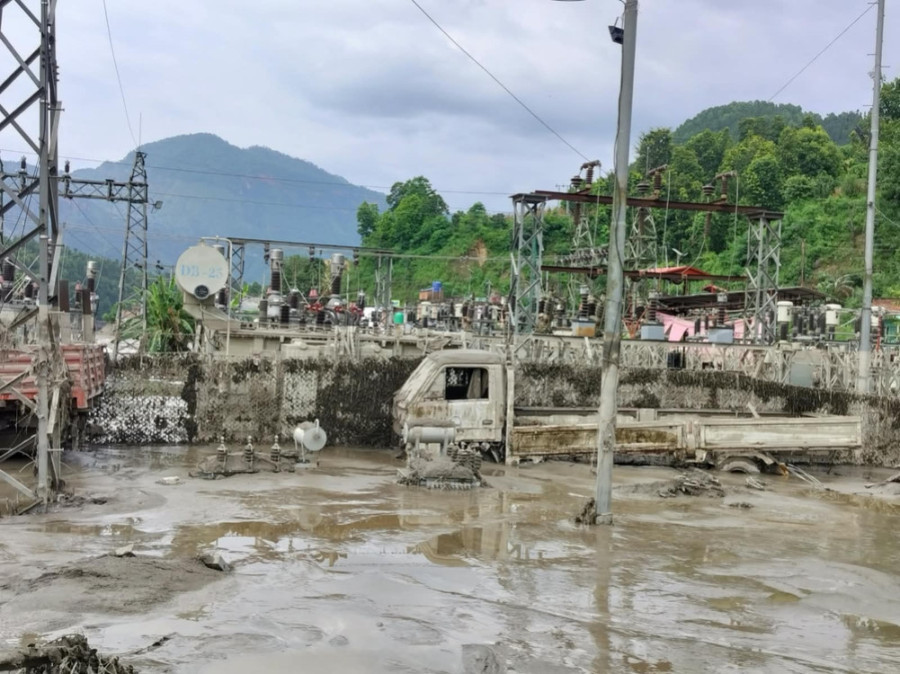
Nepal had been exporting an average of about 1,000 MW of electricity during the wet season. That has now fallen to around 650 MW. An electrical substation and transport vehicles are inundated with thick mud, silt, and debris following the Bhotekoshi flash flood on August 26. Photo: Courtesy of Ministry of Energy, Water Resources and Irrigation
For Nepal, the monsoon is normally the season of abundant electricity.
Heavy rains swell the rivers that power its run-of-river hydropower plants, allowing the country to generate more electricity than it can consume and sell the surplus to its neighbours. But this year, the same rivers have become a source of disruption.
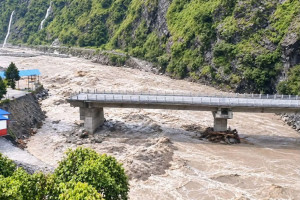
The devastating flood that swept through the Bhotekoshi river system on August 26 has shut down hydropower projects and sharply reduced Nepal’s electricity exports. Bangladesh, which only recently began receiving Nepali electricity through the Indian grid, has been hit particularly hard: exports to the country have effectively stopped.
Nepal had been exporting an average of about 1,000 megawatts of electricity during the wet season. That has now fallen to around 650 MW.
The disruption comes as Nepal attempts to establish itself as a regional power exporter after years of relying on electricity imports, particularly during the dry winter months.
Two hydropower projects authorised to supply to Bangladesh, the 22.1 MW Chilime Hydropower Project and the 24 MW Trishuli Hydropower Project, have been damaged. Both have stopped generating electricity since last week.
Chilime had approval to sell 21.4 MW to India, while Trishuli had approval for 18.6 MW. The two projects were also authorised to supply power to Bangladesh through India. Nepal receives payment in US dollars for electricity sold to Bangladesh.
“Both projects supplying electricity to Bangladesh have been damaged, so we have asked India to allow electricity from another project to be sent as an alternative,” said Dirghayu Kumar Shrestha, acting managing director of the Nepal Electricity Authority. “At present, electricity exports to Bangladesh are effectively at zero.”
The damage has extended beyond the two projects. Since the flood, generation has stopped at 12 hydropower projects.
The Nepal Electricity Authority has kept the Sanjen, Upper Sanjen and Salasungi projects in “isolated mode” because their transmission lines were damaged. That means the plants are operating outside the national grid and generating electricity only to meet demand in nearby areas.
The disruption to exports, however, is not solely the result of the floods.
At a time when Nepal would normally be sending its largest volumes of electricity to India, the country is also unable to export 73.75 MW from three hydropower projects because India has yet to renew their export approvals.
The export approval for the 38.8 MW Upper Chameliya Hydropower Project expired on June 31 but has not yet been renewed. Approvals for the 24.25 MW Seti River and 10.70 MW Upper Tadi Khola projects expired on July 31.
Unti the approvals are renewed, the Nepal Electricity Authority cannot sell their combined 73.75 MW to India. These approvals have to be renewed every year.
India’s Central Electricity Authority is the designated agency responsible for approving electricity imports and exports. Nepal must obtain or renew that approval before electricity from individual projects can be exported.
The problem illustrates the constraints Nepal faces even as it seeks to expand its power trade.
Nepal has so far received Indian approval to export electricity from 37 hydropower projects, with a combined capacity of about 1,200 MW. Chilime and Trishuli were among them.
Nepal sells surplus electricity to India through the Indian Energy Exchange’s day-ahead and real-time markets, as well as under bilateral medium-term power sales agreements with the Indian states of Haryana and Bihar.
The two countries conduct electricity trade through several transmission links, including the 400-kV Dhalkebar-Muzaffarpur line and the 132-kV Tanakpur-Mahendranagar, Kataiya-Kushaha, Raxaul-Parwanipur, Gandak-Ramnagar and Mainahiya-Sampatiya lines.
The Bangladesh market adds another layer of complexity.
At a Nepal-Bangladesh energy secretary-level Joint Steering Committee meeting in Dhaka in November 2025, the two countries agreed to increase Nepal’s electricity exports to Bangladesh by another 20 MW under their existing 40 MW arrangement.
They also agreed to begin the necessary procedures. But India subsequently said the additional 20 MW could not be exported because of a lack of transmission capacity.
Nepal again asked India to approve the additional 20 MW at a Nepal-India energy secretary-level Joint Steering Committee meeting in June.
The Nepal Electricity Authority has also sought approval to export electricity from other projects, including the 456 MW Upper Tamakoshi Hydropower Project. But Indian approval has not been forthcoming for projects involving Chinese investment, Chinese contractors or, in some cases, Chinese equipment.
Upper Tamakoshi is a prominent example. Although Indian companies were awarded the contracts for its hydromechanical, electromechanical and transmission-line works, a Chinese company carried out the civil works. India has so far not approved the project’s electricity for export.
Nepal has repeatedly raised the issue at bilateral energy meetings.
The formal restriction applies to electricity generated by projects involving investment from third countries that share a land border with India but do not have a bilateral power-sector cooperation agreement with India. In practice, however, Nepalese officials and energy-sector stakeholders say India has also been reluctant to approve exports from projects involving Chinese contractors or Chinese equipment, even where the projects are not Chinese-invested.
They argue that diplomatic engagement will be necessary if Nepal is to expand its electricity exports.
“Renewing or obtaining approval for electricity exports requires negotiations at different levels,” said former energy minister Kulman Ghising. “Sometimes it is with officials, sometimes with the executive director and sometimes through the foreign ministry and embassy. Depending on the situation, we need to negotiate and focus on securing and renewing approvals for power trade.”
Ghising said he had negotiated an agreement to sell 650 MW to India at 5.45 Indian rupees per unit, but Nepal had been unable to increase that volume since then.
The current disruption comes after Nepal began exporting electricity in 2021, marking a major shift for a country that had previously depended heavily on imports.
In the 2025-26 fiscal year, Nepal exported electricity worth Rs29.32 billion to India and Bangladesh. It imported electricity worth Rs10.23 billion from India during the dry season, leaving it with a net power-trade surplus of Rs19.09 billion.
The model depends on Nepal’s seasonal rivers.
During the monsoon, abundant water allows hydropower plants to produce a surplus that can be exported. During the dry season, when river flows decline and domestic demand remains high, Nepal imports electricity from India.
The Bhotekoshi floods have disrupted that model at precisely the time when Nepal would normally be maximising its export earnings.
For now, the Nepal Electricity Authority is trying to restore damaged generation and transmission infrastructure while seeking Indian approval to redirect electricity from other operational projects to Bangladesh.




 15.71°C Kathmandu