Their flood videos went viral. They are still haunted by what they saw
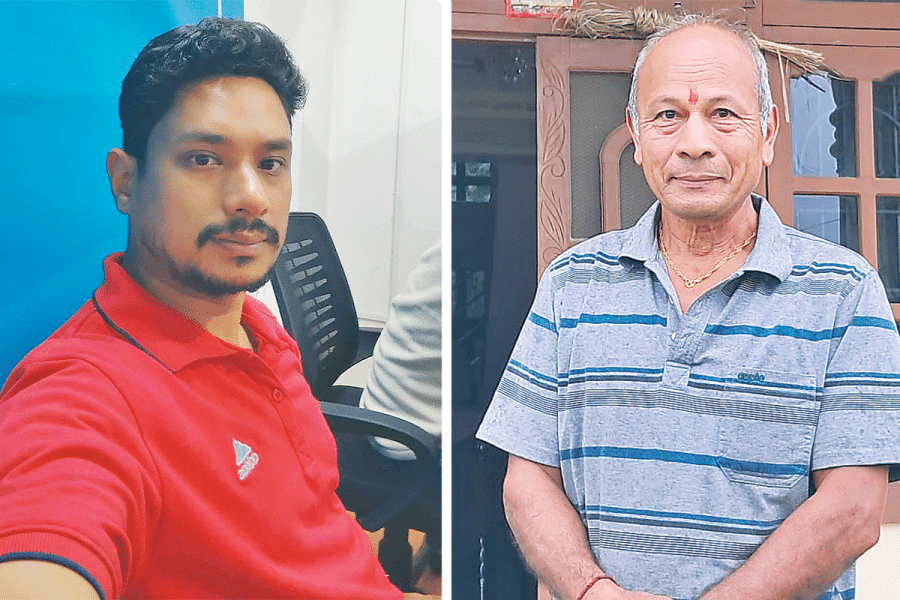
Millions watched videos of the August 26 flood that devastated entire towns. The men behind two of the clips survived, but one lost his home and farmland, the other his mother.This combo photo shows Nabayug Shrestha (left), who survived the August 26 flood that destroyed Trishuli Bazar; and Bhimsen Thapa outside his home in Bogatigaun in Nuwakot. This is the only home Thapa has left after the Trishuli flood took his house at Dhunge Bazar. Post Photos
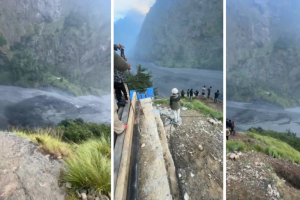
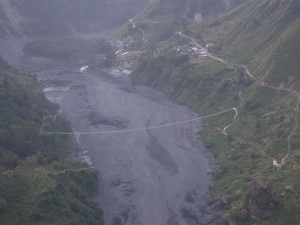
Until the first glimpse of the rising waters, it was just an ordinary Wednesday morning at a bridge over the Bhotekoshi river at Trishuli Bazar in Nuwakot. Motorcycles honked and crisscrossed, and people stood by the roadside. Beyond them, however, the river had already swollen, rushing beneath the bridge, with houses lining the bank and green hills rising in the background. Then, almost suddenly, the furious waters burst through the river channel, sending up a towering plume of spray. The torrent of muddy water and debris crashed against the banks and swept beneath the bridge with terrifying force, transforming the familiar landscape into a scene of devastation. Captured on August 26, as catastrophic floods battered the Bhotekoshi corridor, the footage offers a chilling glimpse of how quickly the river turned lethal.
When Nabayug Shrestha, 34, posted the video on his Facebook on September 5, the magnitude of the disaster’s loss had become clear. When he checked back a couple of days later, as the country was reeling under tragedy and grief, the video had crossed a million views. Shrestha says he has not watched it since. “If I watch it, it will just give me trauma,” he told the Post recently. “It will remind me of how we were running that day, how people and houses were being swept away. It also reminds me of my mother.”
Millions of people have watched the videos of the August 26 flood and many have wondered what became of the people who stood in its path with their phones raised. There is no count of how many of them perished, but two men who filmed it and survived—Shrestha and Bhimsen Thapa—are still struggling to live with what they witnessed. One lost his home and farmland; the other lost his mother. The bridge where both of them stood is gone too: the Department of Roads said 35 of the 41 bridges between the Miteri Bridge in Rasuwa and Malekhu in Dhading were damaged by the flood, 32 of them completely destroyed.
For both, the footage that brought the disaster to the world is now almost too painful to watch.
Thapa, a resident of Bogati village, took a similar video. It is still in his mobile phone. In the weeks after the Bhotekoshi floods, he watched it two or three times. But these days, he said he can’t. “My heart just can’t take it,” said Thapa, 62, a retired inspector with the Armed Police Force. “Seeing the places you saw with your own eyes, remembering your friends and brothers, and watching it turn into a barren desert…”
The video shot by Thapa stretches across those minutes. Early clips show the bridge about 10 minutes before the flood reached it with Thapa on his bike and people behind him shouting, “Run! Run!” Later clips show the wave itself. Thapa said rivers here usually swell slowly and touch the banks. This one arrived all at once, with a roar. His hands shake in the footage. He kept recording anyway.
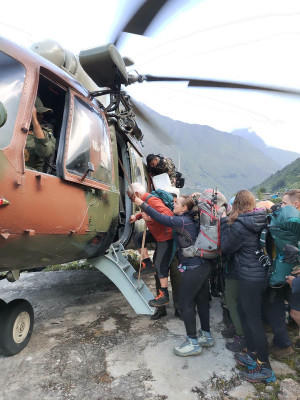
That Wednesday, a massive glacial collapse in the Lhende valley, near the Nepal-China border, sent rock, ice, and debris down the Bhotekoshi river, unleashing the unprecedented disaster. By early October, police had recovered more than 1,450 bodies in eight districts, and a government assessment counted 5,285 people as still missing. In a disaster this large, a face in a video is a rare piece of proof that someone made it out.
Thapa left his home in Bogati village around 9am to pick up a few missing ingredients for the Janai Purnima festival. At the new bridge over the Trishuli, police were announcing through a loudspeaker that a flood was coming. He filmed the announcement and crossed anyway. “For me, it was just a normal trip like any other day,” he said.
When he returned, Armed Police Force and Nepal Police personnel, and schoolchildren were streaming past after an early dismissal. He parked and began filming. Passengers in a microbus asked what was happening. “The dam has broken, and the water level is rising,” he told them. “A flood is coming from Syaprubesi [an upstream town].” Thapa tried calling his family, but the call would not connect. He had seen many floods, he said, so he decided to watch this one.
Then he changed his mind. He decided to deliver the groceries and come back. He had gone barely a minute when he heard it: “A roaring wave with a massive sound.” He stopped and recorded as the water took his fields, then houses, one after another. A fallen pole, held up by its wires, missed him but blocked his motorcycle. A man nearby shouted, “Hurry up, run, run!” His nephew was already riding uphill, ahead of him. Thapa got moving too. Years of morning runs and drills in the force may have kept him quick, he said.
Thapa counts the flood as his third life. The second came years ago, during an APF posting in Lebanon, when he went under the sea, and his team pulled him out. He has feared water since. “Looking at it makes me angry,” he said. “It makes me scared.”
Above the town, his wife, Ishwari, watched the river from the house. “It came jumping and surging,” she said, moving her hand up and down. “We were pacing back and forth, frantically.” When her husband walked in, she was relieved. By evening, the whole family had been found. The Thapas lost a house in Dhunge Bazaar and 15 ropanis of banana farm shared with his brothers.
“May such a disaster never happen to anyone, in any place, any nation, or any district,” Ishwari said.
Shrestha knows what the other side of that wish looks like.
He was at his stationery shop, across from Tribhuwan Trishuli Secondary School, when a school accountant ran up around 9:15 am shouting that a flood had come. Like Thapa, he did not think it would reach him. The shop stood 300 to 400 metres above the river. At worst, he thought, the water would touch the bridge. He went home to eat.
Then the house shook as if in an earthquake, and there was a sound like a bomb. He threw down his plate and ran to the shop to pull down the shutter. Outside, he watched the entire 76-year-old institution being swept away. The water had nearly reached his feet.
He ran uphill, taking with him the wife and children of a school peon who later went missing, and a neighbour. People he knew, he said, would not leave. Neighbours who climbed onto a roof were carried off with their house.
Before leaving for his shop, Shrestha had made tea for his 67-year-old mother. He had also left his laundry outside, ready to wash when he returned. By the time he came back to eat, she had already washed the clothes and hung them out to dry, without being asked. “I think of that every morning now that my mother is no longer here,” he said. He remembered, too, how she raised chickens and ducks and sold their eggs, but never ate them herself.
For two or three days, people told him she had gone uphill. When he finally learned otherwise, he told his brothers abroad and about nine or ten days later, they performed her final rites at Pashupati. Her body has not been found.
Neither Shrestha nor Thapa has left Nuwakot. Shrestha could have returned to Kathmandu, where his family lives. Instead, he walks through his ward, helping neighbours clear houses, trying to find bulldozers and talking to donors. “Maybe it will be a support to someone, or give them courage,” he said. He worries about the months ahead, when the aid trucks leave, and people sit alone with their memories. He counts himself among them.
Thapa, for his part, has helped guide Armed Police Force teams to places worth searching. He has introduced aid groups to families in need. The relief operation now runs from what was Thapa’s banana farm.
Shrestha said he is still struggling to come to terms with the shock and tragedy. Above all, however, he considers himself lucky to have survived. “I survived because of just one minute,” he said. “If I had stayed to record another video, I probably would have been gone too.”
Aarya Chand is a reporter at The Kathmandu Post covering social issues. Before moving to the social beat, Chand was an intern covering culture and lifestyle for the Post.




 15.38°C Kathmandu