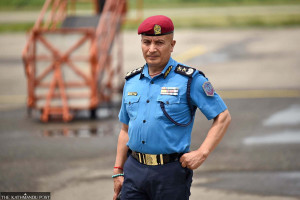
Transfers of Nepal Police officers with ranks from inspector to superintendent have remained stalled since August, prompting concerns within the force over morale, performance and the development of future leaders.
Police Headquarters in Naxal prepared a transfer proposal under Inspector General of Police Dan Bahadur Karki, but it has not secured political approval. Some officers have spent 12 to 15 months in the same assignment, although the usual practice is an annual transfer.
“Officers ask every day when they will be transferred, but we have no answer to give them,” a senior superintendent of police told Kantipur, asking not to be named. Those waiting to move to another posting are reluctant to take risks or show the same energy in their current jobs, he said, affecting performance. He warned that prolonged postings could affect work performance.
A superintendent waiting for a transfer in the Kathmandu Valley said chiefs in Jhapa, Morang, Rupandehi, Kaski, Dang, Kailali, Kanchanpur, Siraha and Rautahat had served more than a year. Proposed changes also cover district police offices in Sankhuwasabha, Parbat, Khotang, area police office in Butwal, and police circles in Durbar Marg and Sohrakhutte.
The proposal was sent to Home Minister Sudan Gurung and the Prime Minister’s Office, but it drew no positive response.
Police inspectors, too, have been waiting for transfers for a long time while remaining at the same offices. “We have waited long enough,” an inspector in Kathmandu said on condition of anonymity. “If there are objections to particular names, those could be left out and the others transferred. We do not know the problem at the higher level, but we are bearing the consequences.”
Some deputy inspector generals are due for transfers. Around 35 inspector and 25 deputy superintendent posts are vacant, although promotions are not yet due.
The Police Regulations 2014 authorise the IGP to transfer inspectors, deputy superintendents and superintendents. Deputy inspector generals can also transfer inspectors within their areas. In practice, however, the police chief cannot exercise these powers without political approval, said a former officer working in the police administration branch. Officers transferred against political leaders’ wishes had previously been brought back immediately, the official said.
According to the regulations, the home minister transfers senior superintendents and deputy inspector generals, while the Cabinet decides transfers of additional inspector generals. According to police officers, successive governments led by KP Sharma Oli, Sher Bahadur Deuba and Pushpa Kamal Dahal restricted the inspector general’s authority. They had expected improvement under the Balendra Shah-led government, but the issue remains the same.
“In the past, officers recommended by powerful ruling party leaders had to be sent to their home districts,” an officer said. “We thought things would improve, but now the process has stopped.” Political leaders appeared to be delaying decisions in the name of screening candidates, he added.
Rabindra Regmi, a former superintendent of police working in the administration unit, recalled that the force’s budget was once cut after a traffic inspector was transferred without consulting the Home Ministry when Bamdev Gautam was home minister.
“The police budget was cut as punishment because the inspector general had not consulted the minister,” Regmi told Kantipur. “Since then, no inspector general has been able to exercise the authority granted by the regulations. The situation has reached a point where even transfers below inspector rank cannot be made without consulting political leaders.”
Regmi said annual transfers could give one in five inspectors a chance to lead a unit, while deputy superintendents and superintendents could each receive up to two assignments. Prolonged postings deny others experience.
“When one officer stays in the same unit for a year and a half, others lose opportunities to lead,” he said. “This affects leadership development, exposure and the transfer of institutional knowledge, and can ultimately undermine the quality of policing.” Long-serving officers may also become too close to local people.
Retired Deputy Inspector General Hemanta Malla Thakuri said the Home Ministry or Prime Minister’s Office might lack confidence in replacing officers amid uncertainty.
“There may be rumours of protests, and the leadership may not want to take the risk of sending a new officer,” he said. If particular names were disputed, others could still be transferred, he added.
“Either the Home Minister has not had the time to look into these matters—he has hardly been seen in connection with the arrest of journalists and various other controversies—or there must be some other reason for keeping the transfer process on hold,” Thakuri.
A source at the police’s Human Resources Department said political leaders were using the need to screen officers as a reason to put off the transfers.
Nepal Police spokesperson Abi Narayan Kafle, however, said transfers would take place soon. “The Bhotekoshi floods came in between, followed by Dashain, and Tihar is approaching. That has also caused delays,” Kafle told Kantipur. “Police Headquarters is preparing the transfers. Senior officers who have completed one year in their current postings will be transferred in phases.”




 14.87°C Kathmandu