Land subdivision halted in 333 local units as federal government plans another rule change
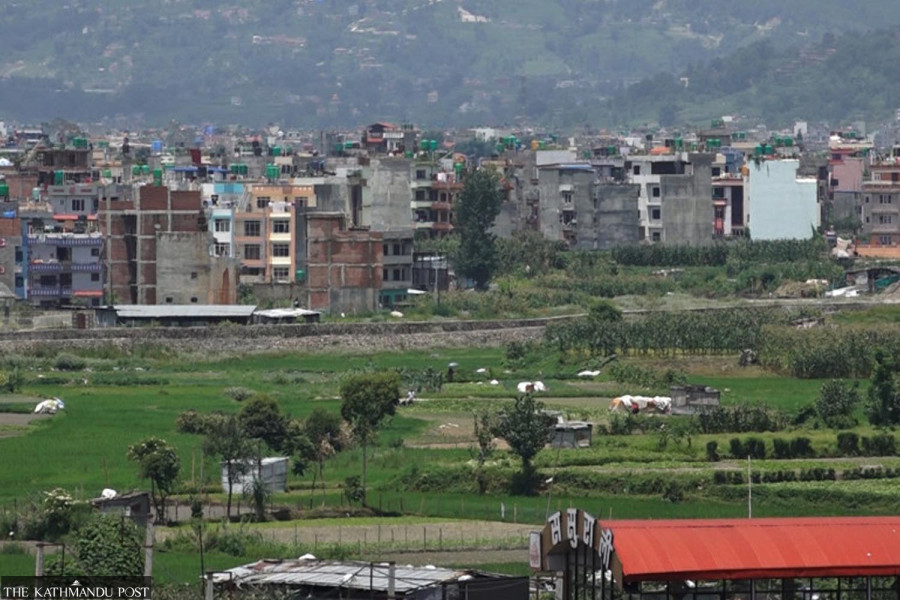
Only 420 local units have classified land under the 2019 law, prompting a fourth amendment to the land-use rules. Only 420 out of 753 local governments have completed land classification across 10 designated categories since the 2022 regulations came into force. Post File Photo
The subdivision of land into smaller plots has been suspended in 333 local units because they have failed to classify land according to its designated use. The federal government is preparing yet another amendment to the rules in an attempt to ease the restrictions.
The Ministry of Land Management, Co-operatives, Federal Affairs and General Administration has drafted a fourth amendment to the Land Use Regulations, 2022. The draft has been sent to the Ministry of Finance for approval, said Ganesh Prasad Bhatta, spokesperson for the land management ministry.
“Once we receive the finance ministry’s approval, we will send the proposal to the Ministry of Law. It will come into force after the Cabinet endorses it,” he said.
The government has repeatedly amended the regulations to temporarily allow plot subdivision in local units that have not completed land classification. But restrictions have been reinstated whenever those local units have failed to meet the deadlines set by the government.
So far, only 420 local units have classified land. They have designated land for ten categories of use, including agriculture, industry and housing.
Under the Land Use Act, 2019, local land-use councils are responsible for classifying land and enforcing land-use policies based on maps and data provided by the government. The regulations require land to be classified into ten categories, including agricultural, residential, industrial, forest, mining and mineral, and commercial areas.
Since the act and regulations came into force, the subdivision of unclassified land for sale has been restricted. However, transactions involving an entire plot, property partition among family members, transfers under court orders and corrections to land records are still permitted, Bhatta said.
The latest suspension follows several rounds of restrictions. In August 2026, plot subdivision was halted in 390 local units. In 2025, it had been suspended from July after 500 local units failed to complete land classification. At the time, only 253 had fully classified their land.
Earlier, in September 2024, land administration services, including plot subdivision, had been halted in 620 local units because they had not completed classification. Only 133 had done so.
When the regulations were introduced in June 2022, local units were given six months to identify agricultural land by specifying its boundaries. By December that year, however, only a few had designated agricultural areas. The rules required land to be classified into all ten categories, but most local units failed to complete the task.
The government amended the regulations in August 2023, giving local units another year to identify agricultural areas and define their boundaries.
The first amendment also eased minimum plot-size requirements. It allowed residential and commercial land to be subdivided into plots as small as 80 square metres and agricultural land into plots of one ropani (about 509 square metres). Previously, residential plots could not be smaller than 130 square metres. For agricultural land, the minimum was 500 square metres in the Kathmandu Valley and 675 square metres in the Tarai and Inner Tarai.
Different standards apply to agricultural, residential and commercial land once it has been classified. The regulations also require land intended for residential and commercial development to meet local road-access standards.
Even after the government extended the deadline by another year through the first amendment, many local units failed to classify their land. The ministry therefore revised the regulations for a second time in September 2024.
A third amendment set the latest deadline at the end of June 2026 for local units to identify agricultural land and specify its boundaries.
Ministry figures show that 176 local units have prepared parcel-level land details. Another 130 have set the required criteria and updated their maps, while 61 have prepared the criteria and standards. Eight have identified only agricultural land, and 38 have yet to begin the process.
The Ministry of Law had advised against a second amendment when the land ministry proposed it, according to officials. The ministry is now preparing a fourth amendment, largely to reopen plot subdivision in areas where classification remains incomplete.
Bhim Prasad Dhungana, president of the Municipal Association of Nepal, said many local units lacked the funds and technical staff needed to classify land. The task costs at least Rs1.5 million to Rs2 million, but neither the federal nor provincial governments have provided adequate funding, he said.
The restrictions have also affected property transactions and the real estate market, said Bishnu Ghimire, president of the Nepal Land and Housing Developers Federation.
“The restrictions have caused more problems for ordinary people than for us. We can move our business to places where plot subdivision is allowed,” he said. “But someone who needs to sell a piece of land to pay for medical treatment or send a child abroad cannot do that. They are the ones suffering.”
The government began classifying land after issuing the Land Use Regulations on June 6, 2022, three years after the Land Use Act was enacted.
The Office of the Auditor General’s 62nd annual report has also called for a more practical approach to regulating plot subdivision. It said the government should provide local units with adequate resources and coordinate with the Department of Survey to classify land using the land-use map data transferred to them.
“All local units should be equipped with the necessary resources, and coordination should be made to classify land on the basis of land-use map data handed over by the Department of Survey,” the report said.




 18.85°C Kathmandu