Onion prices jump 140 percent in a year as India supply tightens
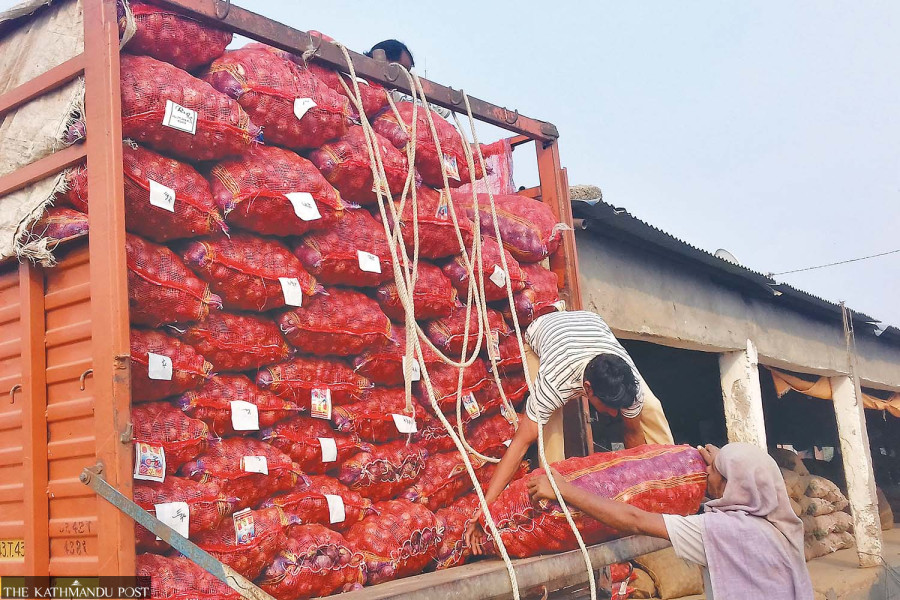
Retail prices have climbed to Rs110-140 per kilo. Nepal gets almost all its onions from India. Onions imported from India being unloaded at Taulihawa in Kapilvastu in this undated photo. Post file photo
For Lalit Chand, buying onions has become an exercise in cutting back.
On Sunday, Chand bought a kilogram of onions for Rs140 in retail and immediately told his wife, Sushma, to use them sparingly.
“Last week, I bought a kilogram of onions for Rs100 from a local grocery store. Now it has reached Rs140. Every time I go to buy onions, the price has increased,” said Chand, a resident of Mulpani, Kathmandu. “The shopkeeper says the wholesale price has increased, so the retail price has also gone up.”
The price of onions has risen sharply in Nepal, with both tighter supplies from India and disruptions along the country’s main supply route adding pressure to the market.
According to the Kalimati Fruits and Vegetable Market Development Board, the wholesale price of onions rose 20.77 percent in a week, 68.65 percent in a month and 140 percent in a year. On Sunday, onions were being traded at Rs93.6 per kg in the Kalimati wholesale market.
The price of the pungent bulb, a staple in many Nepali kitchens, has risen to between Rs110 and Rs140 per kg in retail markets.
Nepal meets almost all of its onion demand through imports from India, making the domestic market highly vulnerable to price and supply fluctuations across the southern border.
Onion prices have also risen sharply across India. In the capital New Delhi, the retail price has reached around INR65 per kg, or about Rs104, compared with INR35 per kg, or around Rs56, a year ago.
Indian media reports say the country relies heavily on its rabi onion crop, harvested around March and April, to meet demand in the following months. The crop is stored and generally continues to supply markets until around October.
This year, however, stored stocks are depleting faster. Unseasonal rain and hailstorms in Maharashtra during March and April damaged the late-season rabi crop and affected the quality of stored onions. Maharashtra is India’s largest onion-producing state.
At the same time, the next kharif onion crop has been delayed. Kharif onion sowing in Maharashtra was pushed back after the monsoon arrived late.
Indian Union Consumer Affairs Secretary Nidhi Khare has attributed the recent rise in onion prices to black marketing, hoarding and profiteering. She said there was adequate supply to meet demand during the festive season and that the government was not considering an export ban because there was no shortage of onions.
The developments in India are quickly reflected in Nepal, where domestic onion production is negligible.
“Onion price fluctuations depend on the Indian market price, and this time the price has risen in India,” said Binay Shrestha, information officer at the Kalimati Fruits and Vegetable Market Development Board. “The majority of onions are imported through the Bhairahawa trade point from Nashik, India, and then supplied through the Prithvi Highway. The highway has not been fully functional for the past five days, which ultimately affects prices.”
The disruption on the Prithvi Highway has added further pressure on onion supplies.
Last Wednesday’s flash flood halted the Thankot-Chitwan section of the highway for three days before traffic resumed on Friday evening. The highway was again closed on Sunday after the road caved in at the Krishnabhir section.
Under normal circumstances, the Kalimati market receives between 70 and 100 tonnes of onions a day, according to Shrestha.
Importers, meanwhile, say their costs have doubled in just two weeks.
“We were importing onions at INR20 per kg two weeks ago, but the price has now reached INR40,” said Mohan Baniya, president of the Potato-Onion Import-Export and Wholesaler Association.
He attributed the increase to reduced onion production and declining stocks in India.
“For now, the supply is normal. We are receiving around 30-32 tonnes of onions daily,” Baniya said. “But as the festive season approaches, prices of consumable goods such as onions increase in India, which ultimately affects prices here.”
Nepal imported 194,905 tonnes of onions worth Rs7.98 billion from India in the last fiscal year, underscoring the country’s dependence on its southern neighbour for the staple vegetable.
The latest price rise comes as overall consumer inflation is also picking up. Nepal’s consumer price index-based inflation stood at 5.14 percent in mid-July 2026, compared with 3.08 percent in the previous fiscal year, according to Nepal Rastra Bank.
The Department of Commerce, Supplies and Consumer Protection has stepped up commodity-focused market inspections, particularly of sugar, onions and cooking gas, since last week to curb black marketing, hoarding and artificial price hikes.
Krishana Prasain is a business reporter for The Kathmandu Post covering markets. Before joining The Kathmandu Post in 2018, she spent 3 years in New Business Age magazine covering business.




 22.21°C Kathmandu