



 14.81°C Kathmandu
Sat, Oct 24, 2026
Money
Court orders government to ensure dairy farmers are paid on time
Court says government must ensure farmers are paid on time and warns that agreements should not become a tool to silence those without access to authorities.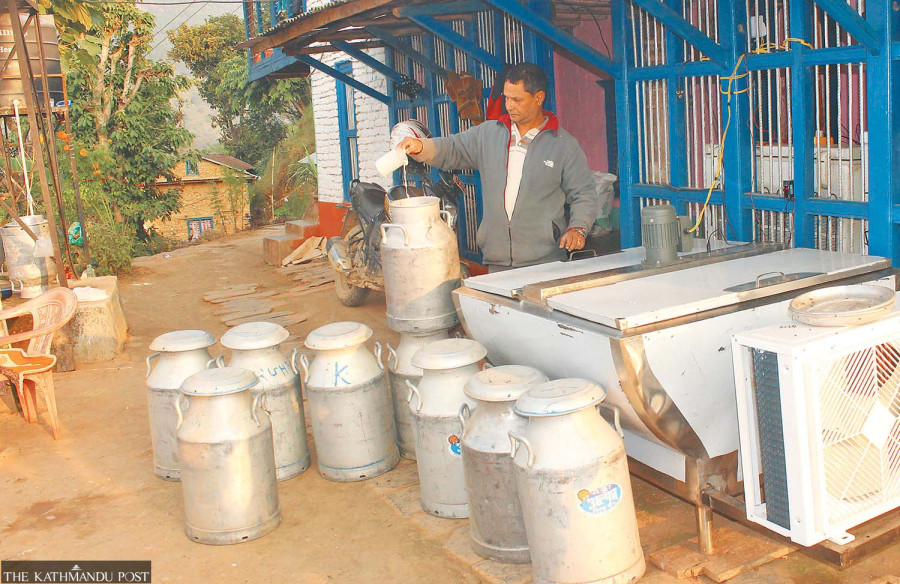
bookmark
Krishana Prasain
Published at : August 25, 2026
Updated at : August 25, 2026 10:29
Kathmandu
The Supreme Court has ordered the government to develop a system to ensure dairy farmers are paid regularly, in line with a tripartite agreement reached between the Ministry of Agriculture and Livestock Development, dairy entrepreneurs and farmers in June 2024.
The court issued the full text of its verdict last week in a case filed against the government and private dairy companies. In December 2024, a division bench had ruled on a writ petition filed by advocates Punya Prasad Khatiwada and Dipak Bikram Mishra.
When the petition was filed in March 2024, dairy farmers were owed around Rs7 billion. Of the total, private dairy companies represented by the Dairy Industry Association and the Nepal Dairy Association owed around Rs6 billion, while the state-owned Dairy Development Corporation owed around Rs900 million.
The court said it was also the government's responsibility to ensure that dairy farmers receive their payments on time. It warned that agreements reached between the government and stakeholders should not become merely a means of diverting or suppressing the concerns of farmers who have limited access to authorities.
Despite the agreements, the court said it had not received evidence that the payment cycle had become regular or that all outstanding dues had been cleared.
The government and stakeholders had reached agreements in March and June 2024 on various issues related to dairy farmers and the payment of their dues. The agreements sought to establish a payment cycle by setting deadlines for clearing outstanding payments and to minimise the impact of seasonal fluctuations in milk production.
Under the agreements, the government was also expected to support the production of milk powder and other dairy products when milk production exceeded demand and provide subsidies to promote exports of dairy products.
The agreements also provided for loans to dairy entrepreneurs against their stocks of dairy products as collateral, with the Agriculture Ministry facilitating interest subsidies on such loans. They also called for improvements to livestock insurance programmes.
The court directed the government to conduct awareness campaigns on provisions in laws, policies and programmes related to dairy farmers. Such campaigns should cover access to finance, subsidised loans, veterinary services and technology under animal health programmes, quality feed for cows and buffaloes, and the nutritional value of dairy products.
The issue of delayed payments became particularly acute from December 2023, after the retail price of milk reached Rs100 per litre and prices of other dairy products also increased. Both state-owned and private dairy companies said an economic slowdown weakened demand, disrupting their cash flow and increasing their liabilities to farmers as dairy products remained unsold for months.
Although dairy companies struggled to sell fresh milk, they processed excess milk into powder and butter. However, demand for these products also weakened, leaving large stocks in warehouses.
The payment crisis put farmers under severe financial pressure. With high inflation and delayed payments, farmers said they struggled to meet household expenses and feed their livestock. Many also became unable to service the interest on loans taken for dairy farming.
The Dairy Development Corporation currently collects between 95,000 and 100,000 litres of milk a day from farmers across the country. The corporation pays around Rs65 per litre. The collected milk is processed into pasteurised milk and other dairy products for domestic consumption.
According to the Nepal Dairy Association, the domestic market currently receives around 3.6 million litres of milk a day.
Sharan Kumar Pandey, general manager of the Dairy Development Corporation, said the corporation had cleared its outstanding payments to farmers and was currently paying them every 30 days.
“We don’t have dues remaining to be paid to farmers. We are currently paying farmers in a 30-day gap and are aiming to make a cycle of paying farmers every 15 days,” Pandey said.
He said the corporation had had outstanding dues of Rs680 million accumulated over three months, which it had recently cleared.
“If our business increases, there will be no problem making payments to farmers on time,” he said.
The corporation currently holds stocks of butter and milk powder sufficient for 15 to 20 days, according to Pandey. It is also exploring overseas markets to reduce its stocks.
“We recently exported DDC products to Dubai and have already received a demand for two tonnes. Demand is also coming from Japan, South Korea and Malaysia,” he said.
Private dairy companies have also claimed that they have cleared their outstanding dues to farmers.
“We have already cleared the dues and have been making payments to farmers every 25 to 30 days,” said Prahlad Dahal, president of the Nepal Dairy Association.
Krishana Prasain
Krishana Prasain is a business reporter for The Kathmandu Post covering markets. Before joining The Kathmandu Post in 2018, she spent 3 years in New Business Age magazine covering business.




Most Read from Money

Why does an hour long flight to Dhangadhi cost more than a flight to New Delhi?

Nepal travel agents threaten to stop selling Thailand trips over visa rules
Malaysia rejects Nepal’s demand to open recruitment to all manpower agencies

No school, but a graduation cap for women dairy farmers
Nepal arrests four medical service providers as Malaysia recruitment row deepens
Editor's Picks




E-PAPER | October 24, 2026

×