



 14.81°C Kathmandu
Sat, Oct 24, 2026
Money
Nepal’s trade routes to China suffer repeated monsoon disruptions
Repeated landslides, unfinished roads and weak infrastructure disrupt northern trade, raising costs and limiting Nepal’s exports to China.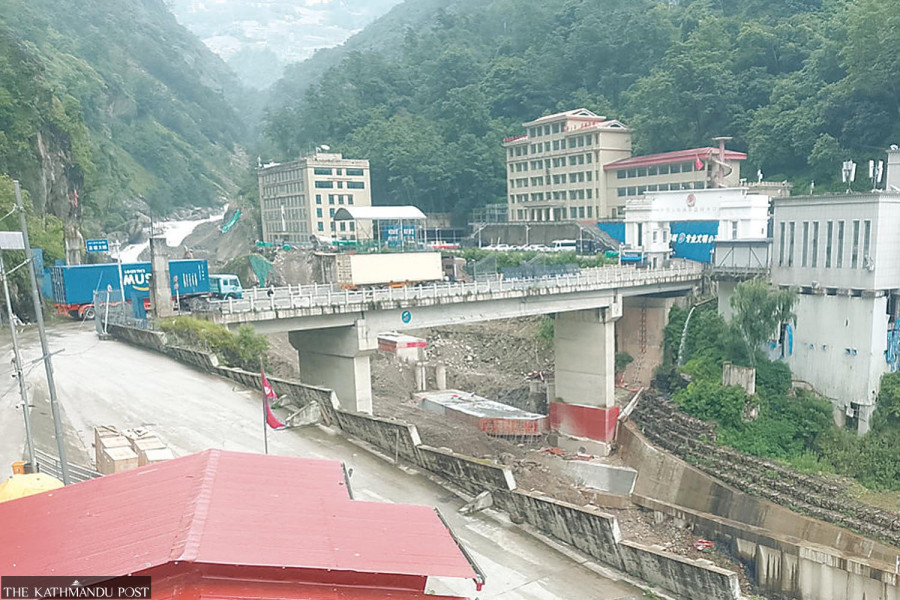
bookmark
Krishana Prasain
Published at : August 22, 2026
Updated at : August 22, 2026 19:44
Kathmandu
Every monsoon, Nepal’s northern trade routes are disrupted by landslides and floods, blocking roads, washing away bridges and bringing cargo movement with China to a near halt.
The problem has persisted for nearly a decade, and this year is no different. The disruption comes just as Nepal enters its peak festival season, leaving traders and consumers to bear the rising costs.
The problem is partly geographic. Nepal’s two main overland routes to China run through steep, unstable terrain along fast-flowing rivers. Narendra Pariyar, chief district officer of Rasuwa, describes landslides as “frequent” and the road as one that “goes on and off during monsoon”.
But experts say the recurring disruptions are not simply a product of Nepal’s difficult terrain. They also reflect years of inadequate planning and investment.
“Engineers only design the road, ignoring the geography connected to the road,” said Kalpana Adhikari, general secretary of the Nepal Geotechnical Society. Slope investigations and protection measures are often overlooked during road construction.
The current government’s decision to allocate separate budgets for slope studies and protection is a positive development, she said.
Trade officials and business leaders estimate that stabilising the worst landslide-prone section could cost around Rs200 million. Yet even projects that have been contracted have failed to materialise.
A Rs480 million contract to repair a vulnerable section was cancelled after China offered to undertake the work itself. Years later, neither side has acted, leaving the section unfinished.
Tatopani, which has operated since 1967 at the end of the Araniko Highway, is now completely closed because of landslides along the Tatopani-Bahrabise section.
The closure is hardly an isolated event. For the past eight to 10 years, the road has been hit by landslides of varying severity almost every monsoon, cutting off the border for weeks or months.
Krishna Prasad Sharma, assistant chief district officer in Sindhupalchok, said the geography makes the road particularly vulnerable. The highway runs along a steep slope, with the Bhotekoshi river cutting directly below it.
The crossing’s problems date back even further. The 2015 earthquake devastated the area, and the route has never fully recovered. Exports to China through Tatopani have not resumed since the earthquake because China has not reopened the crossing to outbound cargo.
In normal times, the point handles 30 to 40 trucks a day. Officials had hoped to generate Rs25 billion in annual revenue from the crossing. That target is now out of reach with the border closed at the beginning of the fiscal year.
Traders have instead been forced to route goods through Kerung, on the Chinese side of the border. The detour has more than tripled the cost of transporting a consignment to Kathmandu, from around Rs90,000 to about Rs300,000, while also lengthening delivery times.
“Summer goods can end up arriving in winter”, said Rajendra Sangraula, president of the Nepal Freight Forwarders Association. Delays also mean higher detention charges for containers stranded on the route.
Rasuwagadhi faces a similar problem, although its immediate trigger is different.
The Syabrubesi-Rasuwagadhi road, opened by the Nepali Army in 2018, was supposed to be upgraded under a 2019 Nepal-China implementation agreement using Chinese grant assistance. The work remains incomplete.
The 16-km stretch continues to flood and wash out during the monsoon. Last July, a flash flood on the Lhende river swept away the Miteri Bridge connecting Nepal and China and severely damaged the customs yard.
A Bailey bridge has since replaced the original crossing, but its capacity is roughly half that of the old bridge. Daily cargo movement has fallen from 60 to 70 loaded containers to around 30 to 40.
The Integrated Check Post at Rasuwagadhi is also unfinished. According to Pariyar, construction is only around 60 percent complete. Customs operations on the Nepali side continue from a makeshift facility.
Kewal Prasad Bhandari, former secretary of the National Planning Commission and former chief of the Tatopani Customs, said the lack of proper facilities is another constraint on northern trade. “Rasuwagadhi still lacks smooth customs infrastructure”, he said.
Korala, a newer crossing that opened for international trade last fiscal year, has provided another route but handles only limited cargo and remains far less significant than Tatopani and Rasuwagadhi.
The consequences of the disruptions are being felt beyond the border districts.
Rerouting goods through Kerung alone adds an estimated 20 to 25 percent to their cost by the time they reach consumers. Freight operators expect overall logistical costs to rise to around 30 percent this year, from 22 percent last year.
The additional cost comes at a particularly difficult time, as consumers prepare for Teej, Dashain and Tihar and the demand for imported goods increases.
The disruption also exposes a much larger imbalance in Nepal-China trade. Tatopani and Rasuwagadhi together handled more than Rs93 billion in imports last fiscal year. Exports to China, meanwhile, remained below Rs2 billion, according to trade data.
Poor road connectivity is part of the problem. But traders and experts say Nepal’s weak export infrastructure is an equally important constraint.
Nepal lacks functioning laboratory testing and quarantine facilities needed to meet Chinese phytosanitary requirements. Its national trade strategy also focuses its priority export products largely on the Indian market rather than China.
“The underlying issue is diplomatic as much as physical,” said Posh Raj Pandey, chair emeritus of the South Asia Watch on Trade, Economics and Environment. “Diplomatic negotiation needs to be done for the trade route that is cost efficient.”
According to Pandey, Nepal’s trade diplomacy has historically focused more heavily on India, leaving the northern route under-prioritised in infrastructure and export planning. He also pointed to what he sees as an inconsistency in dealing with non-tariff barriers: restrictions affecting exports to India attract immediate political attention, while similar barriers facing Nepali goods entering China receive far less scrutiny.
Trade experts say the infrastructure problems reflect a broader weakness in Nepal-China trade relations.
Rabi Shankar Sainju, a trade expert, said the two countries’ basic trade framework has failed to keep pace with changing economic realities.
“The Trade and Payments Agreement is outdated and this needs to be reviewed as we stand at a completely different trade era now,” he said.
The 2018 transit agreement gave Nepal access, in principle, to Chinese seaports and dry ports. But the two countries have yet to finalise the standard operating procedures needed to make the arrangement fully functional.
A provision requiring the agreement to be reviewed every two years has also seen little meaningful implementation, with the mechanism meeting only once or twice, largely ceremonially, according to Sainju.
Krishana Prasain
Krishana Prasain is a business reporter for The Kathmandu Post covering markets. Before joining The Kathmandu Post in 2018, she spent 3 years in New Business Age magazine covering business.




Most Read from Money

Why does an hour long flight to Dhangadhi cost more than a flight to New Delhi?
Nepal travel agents threaten to stop selling Thailand trips over visa rules
Malaysia rejects Nepal’s demand to open recruitment to all manpower agencies

No school, but a graduation cap for women dairy farmers
Nepal arrests four medical service providers as Malaysia recruitment row deepens
Editor's Picks




E-PAPER | October 24, 2026

×