Balendra Shah government announces rollback of 3 percent health, education fees
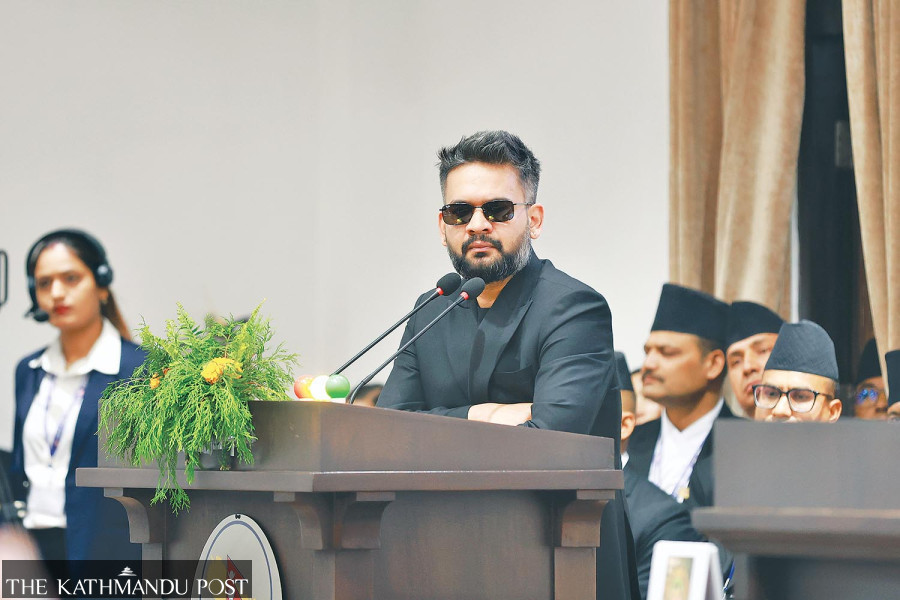
Prime minister says the proposed three percent levy will not be enforced, but legal questions remain as taxes approved by Parliament require formal Cabinet and legislative procedures to be amended. Prime Minister Balendra Shah speaking at Parliament for the first time at the end of May. Post file photo
Prime Minister Balendra Shah on Tuesday announced that the government would not enforce the newly introduced three percent “equity fees” on private education and health services, responding to mounting public criticism just days after the levies came into effect.
The announcement, made through the prime minister’s social media accounts, marked a sharp reversal of one of the government’s most criticised fiscal measures. But it also raised immediate legal and procedural questions, as the fees were introduced through the Finance Act passed by both the House of Representatives and the National Assembly.
Legal experts say a social media announcement alone cannot overturn a law. Any amendment to taxes enacted through the Finance Act must follow the same constitutional process through which they were approved, including a formal Cabinet decision and the procedures required under existing law.
The government had introduced the three percent education equity fee and health equity fee to help finance social welfare programmes.
Explaining the reversal, Shah said he had consulted Finance Minister Swarnim Wagle before deciding not to implement the levies.
“Implementing the three percent equity fee on private education and health services as proposed would impose an additional financial burden on the general public and create unnecessary hardship,” Shah wrote on Facebook. “Therefore, following consultations with Finance Minister Swarnim Wagle, it has been decided not to enforce the education equity fee and health equity fee for the time being.”
The prime minister said the proposal was originally intended to improve education and healthcare in remote and disadvantaged areas, support Dalit, marginalised and low-income children, expand health insurance coverage and generate resources for these programmes while broadening the country’s tax base.
He said the government had reconsidered the measure after taking note of widespread public opposition.
“Our commitment to listening to the people remains firm,” Shah wrote. “If the public expresses dissatisfaction with any policy, the government will always be prepared to review and improve it.”
Shah also reiterated that the government would continue implementing its policy requiring private hospitals to reserve 10 percent of beds and private colleges and universities to allocate 10 percent of seats for disadvantaged citizens through a transparent process.
Although the prime minister announced the policy reversal, he did not say whether the decision had been formally endorsed by the Cabinet. Government sources said Monday’s Cabinet meeting did not approve the withdrawal.
Finance Minister Swarnim Wagle described the move as a suspension rather than a permanent withdrawal.
“In a parliamentary system with a strong prime minister, what the prime minister says is final,” Wagle told Kantipur. “We consulted each other when introducing the fees, and the decision to suspend them was also reached through mutual consultation.”
Asked whether the decision had been approved by the Cabinet, Wagle said the proposal was ready to be presented.
“The proposal for the Cabinet has been prepared under Section 18 of the Financial Act. I spent about an hour discussing this issue with the prime minister on Monday, and today’s announcement was made on that basis,” he said.
Minister Wagle said the education and health equity fees were originally intended to finance a dedicated equity fund.
The government had planned to pool revenue from several sources, including the education and health equity fees, excise duties on alcohol and tobacco, and certain charges on foreign currency used by Nepalis travelling abroad, to create a multi-billion-rupee fund.
According to the finance minister, the fund would finance nutrition programmes for Dalit and marginalised children, expand health insurance coverage and improve public educational institutions.
“The decision announced today only suspends the education and health equity fees,” Wagle said. “The work to establish the Equity Fund will continue, but alternative revenue sources will be explored.”
He said the government is drafting an executive order to establish the fund, similar to the Reconstruction Fund created after the 2015 earthquake.
On the question whether the government had underestimated the public response before introducing the fees, Wagle declined to comment.
Section 18 of the Finance Act allows the Ministry of Finance to reduce, increase or exempt certain taxes and fees during the fiscal year under specified conditions. However, any such changes must follow the legal procedures set out in the law.
The Act requires the ministry to present details of any tax changes to the federal parliament and publish the decision in the Nepal Gazette.
As of Tuesday evening, no Cabinet decision or Gazette notification had been issued to give legal effect to the prime minister’s announcement, leaving uncertainty over when the suspension will formally come into force.
The announcement has nevertheless been welcomed by consumer groups and sections of the public who had criticised the fees as an additional financial burden at a time of rising living costs.




 14.4°C Kathmandu