Foreign study costs outpace growth in Nepal’s service exports
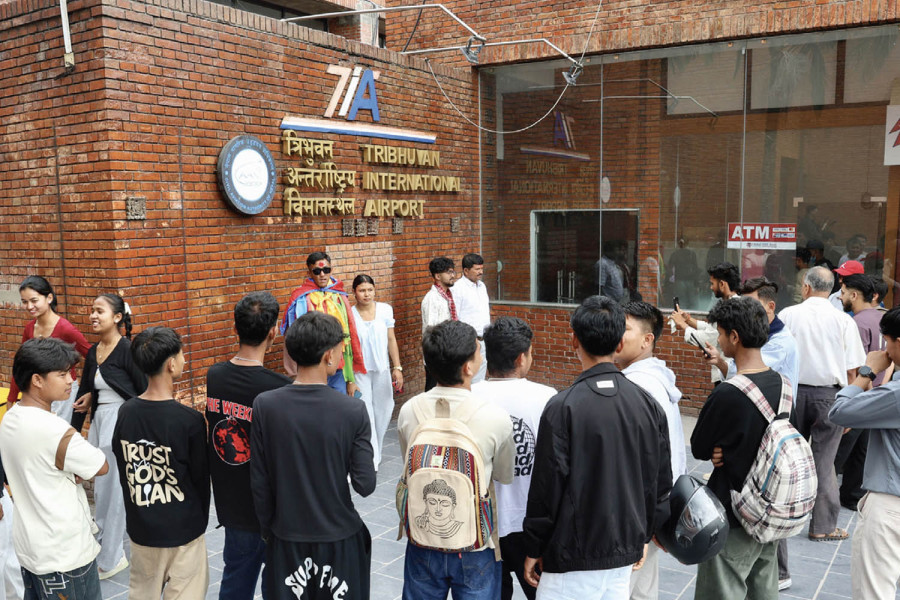
Education spending abroad has become the biggest drain on Nepal’s service trade balance, outweighing gains from tourism and other exports. Youths gather outside the departure lounge at Kathmandu airport to see off a friend heading abroad for higher studies last week. RSS
Every year, thousands of Nepali students leave the country for higher education, taking billions of rupees in foreign exchange out of Nepal. Their educational expenses have become the single largest driver of Nepal’s widening service trade deficit, overshadowing gains from tourism and the country’s fast-growing information technology (IT) exports, according to the government’s latest trade report.
Nepal recorded a service trade surplus of Rs9.85 billion in the fiscal year 2015-16, exporting services worth Rs136.47 billion while importing Rs128.62 billion. Less than a decade later, the situation has reversed dramatically.
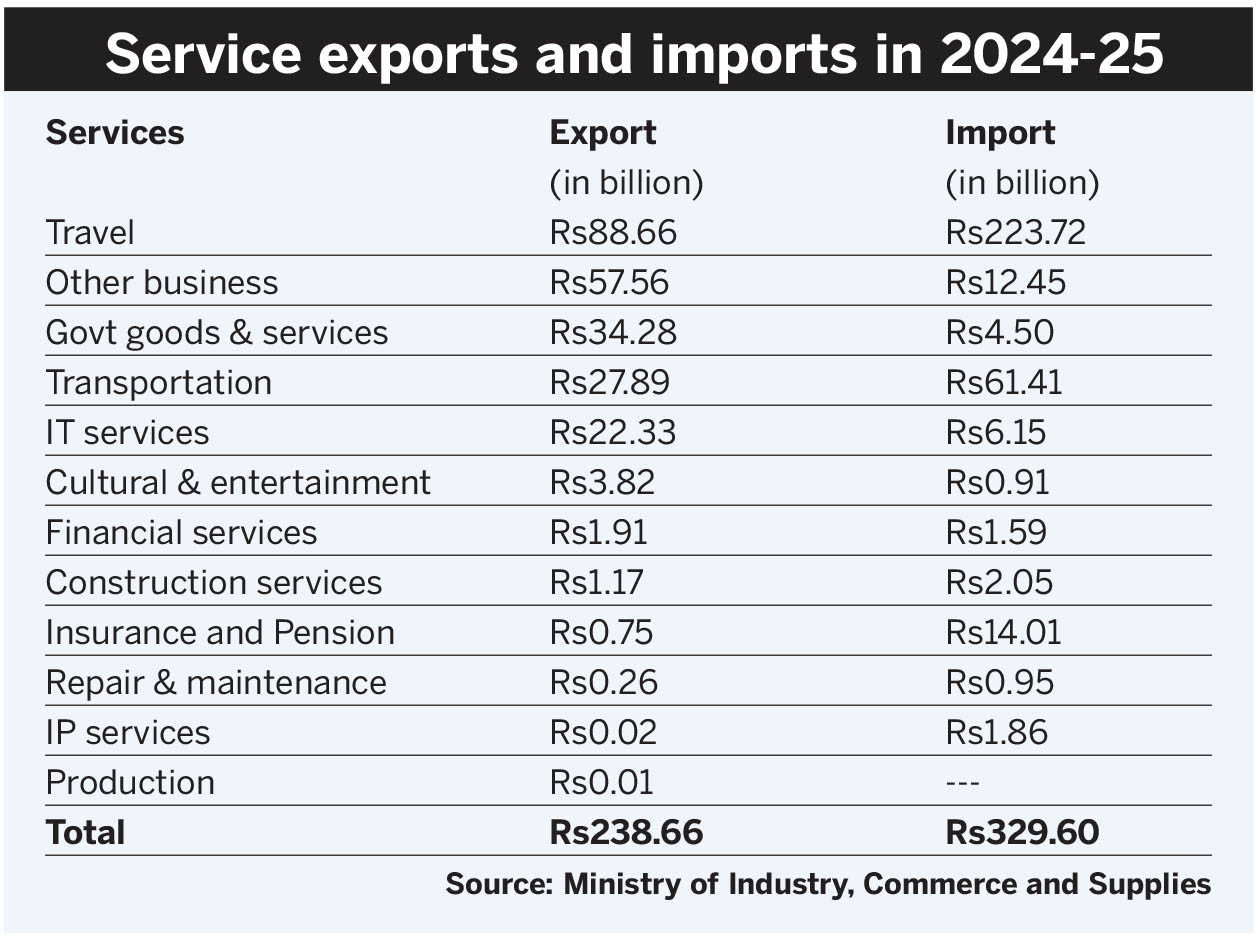
By the fiscal year 2024-25, service exports had risen to Rs238.66 billion, but service imports had surged to Rs329.60 billion, leaving Nepal with a service trade deficit of Rs90.94 billion.
Education services accounted for the largest share of service imports.
Nepal spent Rs138.48 billion on education services in 2024-25 alone. Spending has grown at an average annual rate of around 18 percent over the past three fiscal years.
By contrast, education service exports stood at just Rs3.89 billion during the same period and have grown by only about 2 percent annually over the past three years.
As more Nepali students enrol in universities abroad, spending on tuition, accommodation and living expenses has climbed to record levels, making education the country’s largest service import.
While education is widening the deficit, the IT sector is emerging as one of Nepal’s most promising service export industries.
Software development, business process outsourcing, digital freelancing, web and mobile application development, graphic design and other IT-enabled services are generating rising foreign earnings, although much of the income remains absent from official statistics.
Telecommunications, computer and information services generated exports worth Rs22.33 billion in the fiscal year 2024-25, accounting for 9.36 percent of total service exports.
Industry experts, however, say the real figure is far higher.
A study by the Institute for Integrated Development Studies estimated Nepal’s IT service exports at Rs67.93 billion ($515 million) in 2022. Industry representatives argue that exports have increased further since then, but much of the income is never recorded because freelancers and software companies often receive payments through overseas platforms, foreign bank accounts or third-country companies instead of Nepal’s formal banking system.
Gaurav Raj Pandey, president of the Nepal Association for Software and IT Services (NAS-IT), said most foreign currency earned by IT professionals is recorded as remittance rather than service exports.
“As a result, there are no reliable statistics on Nepal’s IT service exports,” he said.
According to Pandey, NAS-IT estimates industry growth by tracking annual salary increases among IT professionals.
“The IT sector has been growing by 15 to 20 percent annually, and salaries are increasing at roughly the same pace,” he said.
The government report also acknowledges that official statistics underestimate the true size of Nepal’s IT exports because many freelancers receive payments outside Nepal’s banking system.
It says the rapid expansion of Nepal’s digital workforce and growing global demand for outsourced technology services offer one of the country’s best opportunities to narrow the widening service trade deficit.
Capturing IT earnings through formal channels could substantially strengthen Nepal’s foreign exchange reserves and reduce dependence on traditional service exports such as tourism, the report says.
Software development, web and mobile applications, graphic design, digital marketing, business process outsourcing, data processing and freelancing are becoming increasingly competitive in international markets. As more young Nepalis acquire digital skills and demand for remote services continues to grow worldwide, IT is emerging as a major source of export earnings.
With reforms to foreign exchange regulations, easier international payment systems and tax incentives, IT-based services could become Nepal’s largest service export industry, according to the report.
The service sector now contributes more than 62 percent of Nepal’s GDP. In fiscal year 2024-25, services accounted for 21.44 percent of the country’s total foreign trade.
The report says Nepal’s impending exit from the Least Developed Country category will gradually reduce preferential market access, export concessions and development assistance.
“In this context, rather than relying solely on limited and traditional merchandise exports, developing high-value-added, knowledge-based and competitive service exports must become a key pillar of Nepal’s national economic strategy,” it says.
The report identifies tourism, electricity, construction and IT as the country’s major growth sectors for future service exports. It notes that Nepal’s new international airports in Bhairahawa and Pokhara, expanding hydropower exports to India and Bangladesh, and the growing international competitiveness of Nepali construction firms could all help diversify service exports.
The expansion of energy trade is expected to make a significant contribution to service exports, foreign exchange earnings, and Nepal’s participation in the regional energy market.
Construction services are also emerging as a potential export industry. Over the past two decades, rapid infrastructure development has significantly enhanced the experience and capacity of Nepali construction companies, engineers, technicians, and skilled workers.
Although institutional capacity still needs strengthening to undertake large and complex projects, several Nepali construction firms have already won international tenders and completed projects abroad.
Given the competitive skills and labour costs of Nepali professionals, there is considerable potential to expand construction service exports to South Asia, the Middle East, and beyond.
The report also shows that Nepal maintained a service trade surplus between fiscal years 2015-16 and 2017-18 before slipping into persistent deficits.
Travel remained Nepal’s largest service export category in 2024-25. It earned Rs88.66 billion and accounted for 37.15 percent of total service exports. Other business services contributed Rs57.56 billion, followed by government goods and services at Rs34.28 billion, transportation at Rs27.89 billion and IT services at Rs22.33 billion.
On the import side, travel services—which include education, tourism and overseas medical treatment—totalled Rs223.72 billion, accounting for 67.87 percent of total service imports.
Transportation services followed at Rs61.41 billion, while insurance and pension services, other business services and telecommunications, computer and information services made up the remaining major import categories.
The report says Nepal’s service exports are becoming increasingly diversified. While tourism once dominated the sector, exports are now expanding in information technology, digital services, professional consulting, construction, education, healthcare and electricity, laying the foundation for a more resilient and sustainable service export sector.
Krishana Prasain is a business reporter for The Kathmandu Post covering markets. Before joining The Kathmandu Post in 2018, she spent 3 years in New Business Age magazine covering business.




 15.71°C Kathmandu