Consumer Court settles over half its cases in first year, but access remains limited
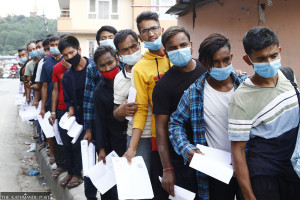
The specialised court has delivered verdicts in 23 of 45 cases, awarding millions in compensation, but consumer rights activists say its reach must expand beyond the Kathmandu Valley.Nepal’s only consumer court is in Kathmandu, with calls to open it in all seven provinces. Post File Photo
On May 21, Nepal’s Consumer Court ordered Qatar Airways to pay Rs26.19 million in compensation to Priti Thapa after hot coffee spilled on her during a transit flight from Doha to Kathmandu.
Thapa had filed the case on July 25 last year, alleging that the airline's cabin crew spilled hot coffee on her and behaved rudely during the incident.
In another landmark ruling, the court on May 22 awarded Rs11 million in compensation to Rajina Manandhar in connection with the severe injuries suffered by her husband, Sajil Man Shakya, who was electrocuted in a swimming pool at Hotel Square in Jhamsikhel, Lalitpur, in August 2023.
The case was initially filed at the Lalitpur District Court in February 2024. Manandhar later petitioned the Patan High Court to transfer the case to the Consumer Court, which approved the request in February this year.
These are among the landmark decisions handed down by Nepal's Consumer Court, which settled more than half of the cases filed during its first year of operation.
Court officials say that of the 45 cases registered in the last fiscal year, which ended on July 16, the court delivered verdicts in 23, while four cases were resolved through out-of-court settlements.
The country's first Consumer Court came into operation on March 15 last year.
Most of the cases registered during the last fiscal year were related to medical negligence and disputes over the purchase of goods and services, followed by automobile-related complaints.
According to the court, 12 cases involved allegations of medical negligence, while another 12 were related to disputes over the purchase of goods and services.
Eleven cases were related to automobiles, and five involved internet services and maintenance.
Similarly, two cases were related to tourism disputes, while one case each involved home construction, banking and airlines.
Consumer rights activists say the specialised court has become an effective mechanism for delivering justice and that public awareness of consumer rights is gradually increasing.
"Consumers have received compensation of more than Rs10 million. The specialised court delivers decisions quickly, and even the possibility of consumers approaching the Consumer Court has made traders more cautious before engaging in unfair practices," said Bishnu Prasad Timilsina, general secretary of the Forum for Protection of Consumer Rights-Nepal.
"This shows the Consumer Court's effectiveness is growing, but it is still not sufficient," he said.
However, Timilsina said the court currently handles only a small fraction of consumer disputes, and its jurisdiction is limited to the Kathmandu valley, leaving consumers in the rest of the country with limited access to justice.
Consumer-related cases that previously remained pending in district courts for years are now being resolved within two to three months by the Consumer Court, he said.
On February 20, 2022, the Supreme Court directed the government to establish Consumer Courts in all seven provinces following a petition by the Forum for Protection of Consumer Rights-Nepal.
However, more than a year after the Consumer Court began operation, no provincial Consumer Court has been established.
"The Balendra Shah-led government has a plan in its policies and programmes for the current fiscal year to establish consumer courts in all seven provinces. We hope the government will honour its commitment and expedite the process," Timilsina said.
He added that consumer courts should eventually be established at the local level to ensure faster resolution of disputes and curb consumer fraud, black marketing and other unfair trade practices.
Consumer rights activists also argue that government agencies have failed to make full use of the Consumer Court by filing cases against businesses found violating consumer protection laws.
"For instance, the Department of Commerce, Supplies and Consumer Protection and the Department of Food Technology and Quality Control usually impose administrative fines when they find businesses violating regulations," Timilsina said.
"Instead of merely imposing fines, these departments should file cases in the Consumer Court so that offenders face stronger legal consequences."
According to Timilsina, the government's reluctance to file cases has weakened the court's effectiveness, as it has not filed a single case since the Consumer Court came into operation.
"If inspection teams discover expired food products or goods contaminated with harmful substances, simply imposing a fine is not enough. Such cases should be prosecuted in the Consumer Court," he said.
Krishana Prasain is a business reporter for The Kathmandu Post covering markets. Before joining The Kathmandu Post in 2018, she spent 3 years in New Business Age magazine covering business.




 22.21°C Kathmandu