



 22.94°C Kathmandu

Thu, Oct 22, 2026
Money
Nepal targets exports worth 20 percent of GDP in two years, but experts call goal unrealistic
Updated plan aims to narrow down the trade deficit by boosting exports, diversifying products and markets, but economists and exporters say policy bottlenecks make the target unattainable.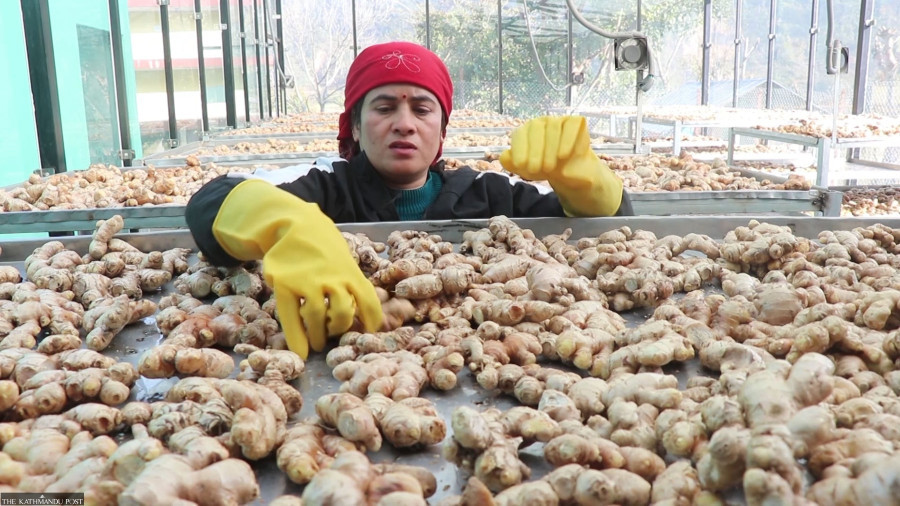
bookmark
Krishana Prasain
Published at : July 15, 2026
Updated at : July 15, 2026 06:49
Kathmandu
The government has updated its national trade strategy, setting an ambitious target of increasing the value of goods and services exports to 20 percent of Nepal’s gross domestic product (GDP) within the next two years.
Last fiscal year, exports of goods and services accounted for 8.7 percent of GDP, up from 6.3 percent in the base year of 2021-22. However, much of the increase was driven by a surge in exports of edible oils—items Nepal does not produce commercially but re-exports after importing raw oil for minimal processing.
The National Work Plan to Minimise the Trade Deficit, first introduced in 2021-22, was recently updated after three years of implementation.
Despite the revised strategy, economists and exporters say the target is far too ambitious and unlikely to be achieved even over the next two decades.
The updated plan seeks to reduce Nepal's widening trade deficit by expanding exports. While exports account for just 8.7 percent of GDP, imports stand at 33.2 percent, leaving the country with a massive trade imbalance.
The ruling Rastriya Swatantra Party (RSP) has pledged to raise Nepal's exports to $30 billion within a decade as part of its broader vision of expanding the economy to $100 billion over the next five years. The strategy prioritises information technology, energy and value-added manufacturing to reduce the country's dependence on remittances.
"The 20 percent target within the next two years is highly improbable," said Paras Kharel, executive director of the South Asia Watch on Trade, Economics and Environment (SAWTEE).
"If the benchmark is the export-to-GDP ratio, there has been little meaningful progress once vegetable oil exports are excluded from the calculation."
During the first 11 months of the current fiscal year ended mid-June, Nepal exported goods worth Rs277.96 billion. Of that volume, soybean, palm and sunflower oils alone accounted for Rs128.49 billion.
Nepal imports crude soybean, palm and sunflower oil, processes them with limited value addition and re-exports the finished products.
Kharel noted that the Nepal Trade Integrated Strategy (NTIS) 2023 had already set a target of raising exports to 20 percent of GDP by 2027-28.
"The updated work plan appears to be off track to achieving even that timeline and highlights the structural challenges facing Nepal's export sector," he said.
According to him, discussions on import substitution and reducing the trade deficit have continued for years, but successive government plans have failed to produce the desired results.
Exporters also doubt the target can be achieved, arguing that the current policy environment discourages production and exports.
"The only way the target could be met is through another temporary boom in edible oil re-exports," they said.
"The government has imposed a 13 percent value-added tax (VAT) on imported raw materials over the past two to three years, significantly increasing production costs," said Hari Dhakal, vice-president of the Export Council of Nepal.
"Most export-oriented industries rely on imported raw materials, and the VAT policy has made them less competitive."
Dhakal said the government had also suspended export incentives that previously ranged from 3 to 5 percent for garment exporters and 5 to 8 percent for handicraft producers.
"On one hand, producers are paying 13 percent VAT on raw materials, and on the other, the incentives promised by the government have been withheld for the past two years," said Dhakal, who also owns Creative Nepal Exports, a manufacturer and exporter of woollen garments.
"In such an environment, it is difficult to expect production and exports to grow."
He added that many export industries—including garments, felt products and handicrafts—depend heavily on imported raw materials, while sectors such as dairy, large cardamom and ginger lack adequate processing facilities.
Rising logistics costs, both by air and sea, have further eroded the competitiveness of Nepali products in international markets, Dhakal said.
"Given all these challenges, I don't believe the 20 percent target can be achieved even in the next 20 years."
Economists also cite unstable government policies, fluctuating bank interest rates and poor coordination among government agencies as major obstacles to export growth.
The Ministry of Industry, Commerce and Supplies revised the work plan that was introduced in 2022, although the updated version contains few substantive changes.
The strategy aims to increase the production and productivity of competitive goods and services, diversify export products and markets, and promote domestic agricultural and industrial production to reduce the trade deficit.
It also proposes multilateral, regional and bilateral trade negotiations to preserve market access after Nepal graduates from the least developed country (LDC) category, while reducing trade and transit costs through improved trade facilitation.
In May, Nepal formally initiated the process to defer its graduation from LDC status from November 24, 2026, to November 2029.
The revised work plan assigns implementation deadlines to the concerned agencies, with the Office of the Prime Minister and Council of Ministers and the Ministry of Industry, Commerce and Supplies responsible for coordinating activities involving multiple government bodies.
Nepal's merchandise trade deficit widened by 6 percent to Rs1.52 trillion in the last fiscal year, with imports reaching Rs1.8 trillion and exports standing at Rs277 billion.
The trade deficit stood at Rs1.39 trillion in 2020-21, rose to Rs1.72 trillion in 2021-22, declined to Rs1.45 trillion in 2022-23 and remained at Rs1.44 trillion in 2023-24 before increasing again last fiscal year.
Krishana Prasain
Krishana Prasain is a business reporter for The Kathmandu Post covering markets. Before joining The Kathmandu Post in 2018, she spent 3 years in New Business Age magazine covering business.

Most Read from Money
Nepal travel agents threaten to stop selling Thailand trips over visa rules

Why does an hour long flight to Dhangadhi cost more than a flight to New Delhi?
Malaysia rejects Nepal’s demand to open recruitment to all manpower agencies

No school, but a graduation cap for women dairy farmers
Nepal arrests four medical service providers as Malaysia recruitment row deepens
Editor's Picks




E-PAPER | October 22, 2026

×