For Nepal’s stock market investors, the installation of a new government was expected to usher in a new era of confidence.
A government led by the Rastriya Swatantra Party (RSP) with a near two-thirds majority was expected to bring political stability, clearer policies and renewed investor confidence. Instead, the market has moved in the opposite direction.
In the 106 days since the RSP took office, Nepal’s stock market has delivered more disappointment than hope.
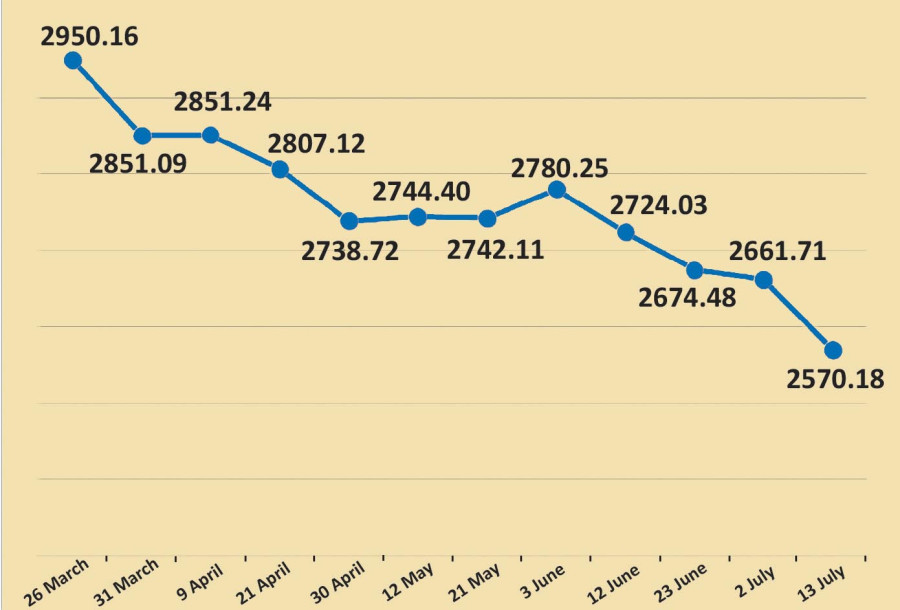
Of the 73 trading days during this period, the Nepal Stock Exchange (Nepse) index declined on 47 days and gained on only 26 days. Over the period, the market lost over 380 points.
On Monday, the market broke the strong support level of around 2,580 points and closed at 2,570.28 points, the lowest level in more than six months. Market analysts said the fall showed that sellers had gained the upper hand. The index had last closed below this level at 2,581.24 points on December 22, 2025.
Investors had expected the formation of a new government to bring an end to political uncertainty and create policy stability, which they believed would have a positive impact on the stock market. But contrary to those expectations, the market continued to slide, with investor confidence failing to recover.
The Nepse index stood at 2,950.50 points on March 26, 2026, a day before Balendra Shah became prime minister. By Monday, it had fallen to 2,570.28 points, a decline of more than 380 points that showed the depth of investor pessimism.
Over the same period, the total size of the stock market shrank by nearly Rs600 billion, eroding the value of investors’ holdings.
Market capitalisation, which stood at Rs5.009 trillion on March 26, had fallen to Rs4.416 trillion by Monday.
Investor confidence remains weak
Weak investor confidence amid ongoing investigations into stock-market-related incidents and uncertainty over the government’s intentions have been blamed for the market decline.
Although current government policies are considered favourable for the stock market, uncertainty over the government’s intentions and lingering fear among investors have prevented Nepse from recovering, said Narendra Raj Sijapati, former president of the Stock Brokers’ Association of Nepal.
“After the new government was formed, investigations were launched against some major businesspeople in the name of promoting good governance. Most of those cases involved stock market transactions. This mainly increased fear among large investors,” he said. “Because of that fear, large investors have stayed on the sidelines. This is the main reason the market has failed to recover.”
Sijapati said the fear has also spread because Nepalis generally support stronger governance but they become uneasy when government action affects people in their own sectors.
“The government’s move to collect property details has also created fear in the stock market,” he said. “Recently, the court instructed the government not to proceed with investigations into property details. But citizens still fear when the government may restart such investigations.”
He said investors are holding back because of this uncertainty, preventing fresh investment from entering the market.
As of Monday, 7.986 million people had opened demat accounts for share trading. Among them, 4.7 million had opened Trading Management System (TMS) accounts for online transactions in the secondary market.
However, only around 400,000 are considered active investors. Nepse generally defines active investors as those who have bought or sold shares at least once a year.
The number of active investors is closely linked to market performance. It usually increases when the market rises and declines when the market falls. Nepse said the recent downturn has reduced the number of active investors.
Despite the growing number of demat account holders and wider participation in the market, stakeholders say the government has failed to live up to investors’ expectations.
Tara Prasad Phullel, president of the Share Investors Association, said the market has continued to fall because the government has failed to meet investors’ expectations.
“The expectations investors had from the government were not fulfilled. Instead, there has only been fear,” he said. “Not only liquidity and interest rates, but even policies are favourable for the market. However, investor confidence has still failed to improve.”
Phullel said investors had expected the new government to provide policy stability and support the stock market, but confidence in the government’s commitment has remained weak.
Declining market hits government revenue
The prolonged market downturn has also affected government revenue.
Capital gains tax (CGT) collected from the stock market declined by around 37 percent in the first 11 months of the current fiscal year compared with the same period last year.
The government collected Rs15.306 billion in CGT from the stock market during the first 11 months of the previous fiscal year. In the same period this year, revenue from the tax dropped to Rs9.64 billion.
Capital gains tax is levied on profits from share transactions, meaning revenue rises when the market performs well and declines when the market weakens.
Nepse spokesperson Murahari Parajuli said the decline in the market had directly reduced capital gains tax collection.
“Capital gains tax has declined this year compared with last year because the market has fallen,” he said. “Normally, transaction volume rises when the market rises and falls when the market declines. Since transaction volume has declined this year, shareholders’ profits have also decreased, resulting in lower tax revenue.”
Subash Chandra Dhungana, a share investor and former member of the RSP’s Currency and Capital Markets Department, said the market declined because investors lacked confidence in existing state policies and the government.
“During the 11 trading days after the March 5 parliamentary elections, before the government was formed, Nepse had increased by 9 percent. At that time, there were expectations from the new government,” he said. “But after Prime Minister Balendra Shah took the oath, the stock market failed to continue its recovery. Both trading volume and market capitalisation kept declining.”
According to Dhungana, average daily trading volume, which stood at around Rs13 billion before the government was formed, has now fallen to Rs5.6 billion.
He said uncertainty over whether the government’s decision to increase capital gains tax through the budget would be implemented also prevented investors from becoming confident.
“This time, Nepse reacted differently. Investors could not take it positively,” he said. “As a result, the index fell by around 50 points in the two trading days after the monetary policy was issued.”
Dhungana said these factors have led investors to believe that the stock market is not a priority for the government.
“Investors have adopted a wait-and-see approach. They are unwilling to take risks,” he said.
Market composition
By mid-May, 294 companies were listed in Nepse, up from 271 during the same period in the previous year.
Among the listed companies, 133 are banks and financial institutions and insurance companies. There are also 103 hydropower companies, 28 manufacturing and processing companies, nine hotels, seven investment companies, four trading companies and 10 companies under “other” categories.
Banks and Financial Institutions (BFIs), and insurance companies account for 50.7 percent of total securities market capitalisation.
Hydropower companies account for 17.5 percent, followed by manufacturing and processing industries at 8.8 percent, “other” category at 8.3 percent, investment companies at 6.9 percent, trading companies at 4.6 percent, and hotels at 3.3 percent.




 15.26°C Kathmandu