



 17.6°C Kathmandu
Thu, Oct 22, 2026
Money
Nepal’s dog chew exports rise 7 percent despite US tariff
Exporters say sales could top Rs10 billion if Nepal meets EU animal health standards and gains access to the European market.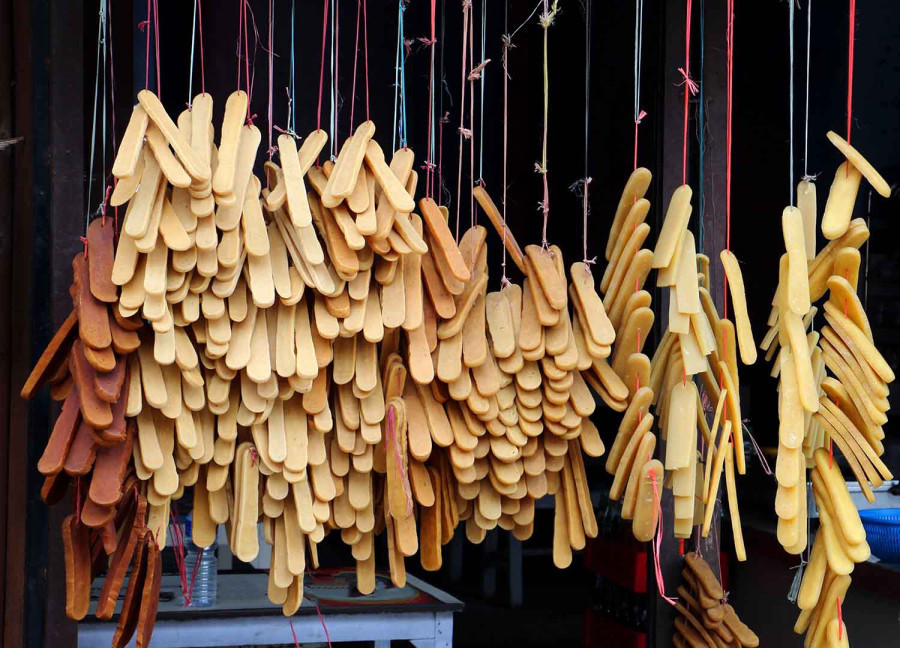
bookmark
Krishana Prasain
Published at : July 13, 2026
Updated at : July 13, 2026 06:47
Kathmandu
Nepal's dog chew exports rose by 7 percent in the first 11 months of the current fiscal year, despite a 10 percent tariff imposed by the United States on Nepali products.
According to the Trade and Export Promotion Centre (TEPC), Nepal exported 2,733 tonnes of dog chews, locally known as chhurpi, worth Rs4.29 billion during the review period.
The United States remained by far Nepal’s biggest market, accounting for roughly three-fourth of total exports. It imported 2,042 tonnes worth Rs3.75 billion. Canada was the second-largest buyer, importing 327 tonnes valued at Rs261 million.
On April 5 last year, the administration of US President Donald Trump imposed a 10 percent baseline tariff on imports from Nepal as part of a broader package of reciprocal tariffs affecting multiple trading partners.
Nepal exported dog chews worth Rs4.51 billion in the last fiscal year.
Other major destinations included the United Kingdom, which imported 76 tonnes worth Rs108.84 million, Japan with 119 tonnes worth Rs75 million, Denmark with 11 tonnes valued at Rs19.96 million, South Korea with 13 tonnes worth Rs18.64 million, and Hong Kong with 73 tonnes worth Rs10.61 million.
Nepali dog chews were also exported to Australia, Brazil, the Czech Republic, France, Gabon, Germany, Greece, Israel, Italy, Lebanon, Malaysia, the Netherlands, New Zealand, Singapore, Slovakia, South Africa, Taiwan, Thailand and the UAE.
"The 10 percent tariff imposed by the US has not had any immediate impact on exports of Nepali dog chews. Despite concerns over supply chain disruptions, major US brands have continued to source dog chews from Nepal," said Dhurba Raj Regmi, director and chief executive officer of Native Nepali Agro Suppliers, a commercial dog chew producer.
However, he said smaller importers that typically purchased one or two tonnes at a time have been discouraged by the higher tariff.
His company exported around 100 tonnes of dog chews to 12 countries during the current fiscal year, up from nearly 80 tonnes in the previous fiscal year.
Most dog chews exported from Nepal are produced in the eastern hill districts of Ilam, Taplejung and Panchthar.
Made primarily from Himalayan yak milk produced at high altitudes, along with cow milk, Nepali dog chews have carved out a niche in international pet markets as a natural, high-protein product.
The chews contain no added preservatives, artificial colours or chemicals. They are made by hand using traditional processing methods.
Dog chews contain more than 60 percent protein, along with calcium and essential vitamins. They are made almost entirely from yak and cow milk, with small quantities of lime juice and salt added during processing.
Manufacturers and exporters say Europe remains the industry’s biggest untapped market, but the European Union does not allow imports of dairy products from Nepal. They argue that if the government meets the bloc's animal health and quality standards, exports of Nepali dog chews could increase substantially.
"Exports of dog chews could reach Rs10 billion if Nepal gains access to the European market," Regmi said.
According to him, the European Union has barred imports of Nepali dog chews because Nepal continues to grapple with foot-and-mouth disease (FMD) across all 77 districts, along with outbreaks of lumpy skin disease.
"The US and several other countries accept the veterinary and quarantine certificates issued by Nepal's Department of Livestock Services," Regmi said.
India, by contrast, is allowed to export dog chews to Europe because it is included on the European Union's list of authorised countries for animal product exports.
Regmi said China could also become a promising market, but the prevalence of foot-and-mouth disease has prevented Nepal from expanding exports there.
"The government needs to work actively to eliminate foot-and-mouth disease. That would automatically help Nepal explore new export markets for dairy products and earn more foreign exchange," he said.
Exporters also say logistics costs have surged following the recent US-Iran conflict, with freight charges increasing two- to threefold.
"I used to export dog chews through Kolkata by sea for about $5,000 per refrigerated container. That has now tripled to about $15,000 per container," Regmi said, adding that air freight charges have also risen by 30 to 40 percent.
In January, the government approved new standards for chhurpi, including dog chews, to align the product with international food safety requirements.
The regulations cover production, processing, packaging, handling, storage and transportation in line with food safety guidelines issued by the Ministry of Agriculture and Livestock Development.
Nepal's overall merchandise exports increased by 12.28 percent to Rs277.96 billion in the first 11 months of the current fiscal year, which ended in mid-June.
Krishana Prasain
Krishana Prasain is a business reporter for The Kathmandu Post covering markets. Before joining The Kathmandu Post in 2018, she spent 3 years in New Business Age magazine covering business.

Most Read from Money

Nepal travel agents threaten to stop selling Thailand trips over visa rules

Why does an hour long flight to Dhangadhi cost more than a flight to New Delhi?
Malaysia rejects Nepal’s demand to open recruitment to all manpower agencies

No school, but a graduation cap for women dairy farmers
Nepal arrests four medical service providers as Malaysia recruitment row deepens
Editor's Picks




E-PAPER | October 22, 2026

×