



 23.98°C Kathmandu

Fri, Oct 23, 2026
Money
Global oil prices tumble, but Nepal unlikely to see major fuel price cuts soon
Falling crude prices ease inflation and import costs, but supply constraints and LPG shortages mean consumers may see only modest relief, with half-filled cooking gas cylinders set to continue.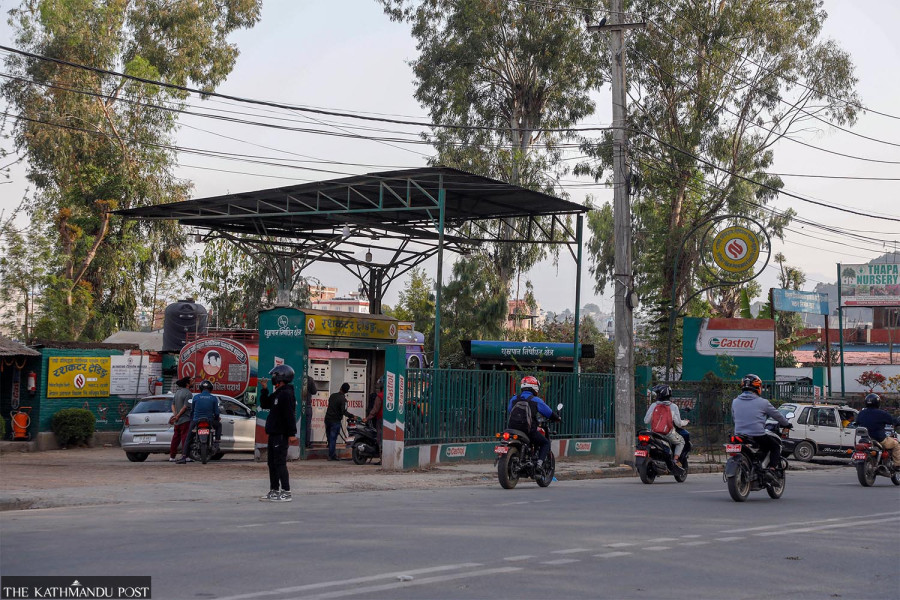
bookmark
Krishana Prasain
Published at : June 29, 2026
Updated at : June 29, 2026 19:38
Kathmandu
International crude oil prices have fallen to their lowest levels since before the Iran conflict started in February-end, offering Nepal a significant economic cushion by easing inflationary pressures, reducing the country's import bill and improving the government's fiscal outlook.
Oil prices started declining after the US and Iran signed an interim agreement on June 17 to end the conflict and reopen the Strait of Hormuz, a crucial shipping route in the Persian Gulf.
Despite the sharp correction in global oil prices, however, Nepali consumers are unlikely to see significant relief in fuel or cooking gas prices when the Nepal Oil Corporation (NOC) revises rates on Tuesday.
"We are hopeful that petrol, diesel and aviation fuel prices will come down slightly when the Indian Oil Corporation (IOC) sends its new price list. But it is too early to say by how much," said Manoj Kumar Thakur, deputy director of the NOC.
The IOC, Nepal's sole petroleum supplier, reviews export prices for petrol and diesel every fortnight, while LPG and aviation turbine fuel prices are revised monthly.
According to Thakur, the sharp fall in crude oil prices has not translated into a comparable decline in refined fuel prices because refinery damage has constrained production.
"LPG prices are also unlikely to change because demand remains high while production is limited," he said.
The state-owned supplier says it is currently losing Rs1,174 on every LPG cylinder sold, amounting to a monthly loss of around Rs36 billion. Despite the losses, the corporation says it has cleared all outstanding payments to the IOC.
Officials also confirmed that the policy of distributing half-filled LPG cylinders will remain in place.
The NOC introduced the temporary measure on March 12 to conserve supplies amid fears of disruptions caused by the conflict in West Asia. Since then, bottling plants have been distributing 7.1 kg of LPG instead of the standard 14.2 kg per cylinder.
"The situation in West Asia remains uncertain," Thakur said. "Although the IOC has been supplying LPG regularly, the volume is still insufficient for us to resume full-cylinder distribution."
According to him, the IOC is currently dispatching 80 to 85 LPG bullets a day, while Nepal requires at least 100 daily to restore normal supplies.
"We are in constant discussions with the IOC," he said. "They have advised us to continue with the current arrangement and wait another 10 days before deciding whether to resume full-cylinder distribution."
Global oil prices retreated sharply last week as expectations of increased crude supplies from the Middle East outweighed concerns over demand. Brent crude, which had surged to as high as $126.41 a barrel during fears of prolonged port disruptions and a possible closure of the Strait of Hormuz, has since fallen to around $72.68. The benchmark recovered slightly on Monday, trading between $73 and $74 a barrel.
Lower international oil prices generally reduce transportation and manufacturing costs, ease inflationary pressures and lower governments' fuel subsidy burdens. For Nepal, which imports all petroleum products from India, cheaper crude could improve the trade balance and provide greater fiscal flexibility.
Fuel-intensive sectors such as aviation, logistics, paints, chemicals and consumer goods manufacturing are also expected to benefit from lower input costs.
Every month, the NOC orders around 49,500 tonnes of LPG from the IOC. Under normal circumstances, India supplies between 45,000 and 46,000 tonnes. Since Nepal shifted to half-filled cylinders, monthly imports have dropped to around 35,000-36,000 tonnes.
The corporation says it is aware of the inconvenience faced by consumers and bottling companies but insists there is no immediate alternative.
Nepal imported 475,980 tonnes of LPG worth Rs52.21 billion during the first 11 months of the current fiscal year, which ends mid-July.
During the crisis, the NOC raised LPG prices twice, pushing the retail price up by 13 percent to Rs2,160 per cylinder. Even after the increase, the corporation says it continues to lose more than Rs1,000 on every cylinder sold.
The Nepal LP Gas Industry Association says the prolonged half-cylinder policy has created serious operational challenges.
Association president Diwan Bahadur Chand said around 66 percent of LPG cylinders remain with consumers, creating an acute shortage of empty cylinders needed for refilling.
"The half-filled cylinder policy has disrupted the entire supply chain," Chand said. "It has complicated bullet movement, cylinder circulation, maintenance, transportation and delivery."
He added that bottling plants with limited production capacity have been forced to fill significantly more cylinders than they were designed to handle, and this has increased operational costs and maintenance requirements.
The government, meanwhile, appears in no hurry to reduce retail fuel prices.
Addressing Parliament on Sunday, Finance Minister Swarnim Wagle said that although international fuel prices had declined, the benefits had yet to reach Nepali consumers.
"It will take time for lower international oil prices to be passed on to consumers in Nepal," Wagle told lawmakers.
The conflict between the United States and Iran, which escalated in late February, triggered a sharp rise in fuel prices. During the three-month period, petrol prices climbed 38.21 percent to Rs217 per litre, while diesel prices jumped 58.45 percent to Rs225 per litre.
The surge in fuel costs also pushed up consumer prices. Nepal's inflation rate rose to 5.04 percent in May from 4.47 percent in April, reflecting higher transportation and energy costs across the economy.
Krishana Prasain
Krishana Prasain is a business reporter for The Kathmandu Post covering markets. Before joining The Kathmandu Post in 2018, she spent 3 years in New Business Age magazine covering business.


Most Read from Money
Nepal travel agents threaten to stop selling Thailand trips over visa rules

Why does an hour long flight to Dhangadhi cost more than a flight to New Delhi?
Malaysia rejects Nepal’s demand to open recruitment to all manpower agencies

No school, but a graduation cap for women dairy farmers
Nepal arrests four medical service providers as Malaysia recruitment row deepens
Editor's Picks




E-PAPER | October 23, 2026

×