



 22.06°C Kathmandu
Tue, Oct 20, 2026
Money
West Asia conflict drives up Nepal’s trade costs, fuels inflation fears
Freight, fuel and insurance surge as import-dependent economy braces for 50 percent price rise across goods.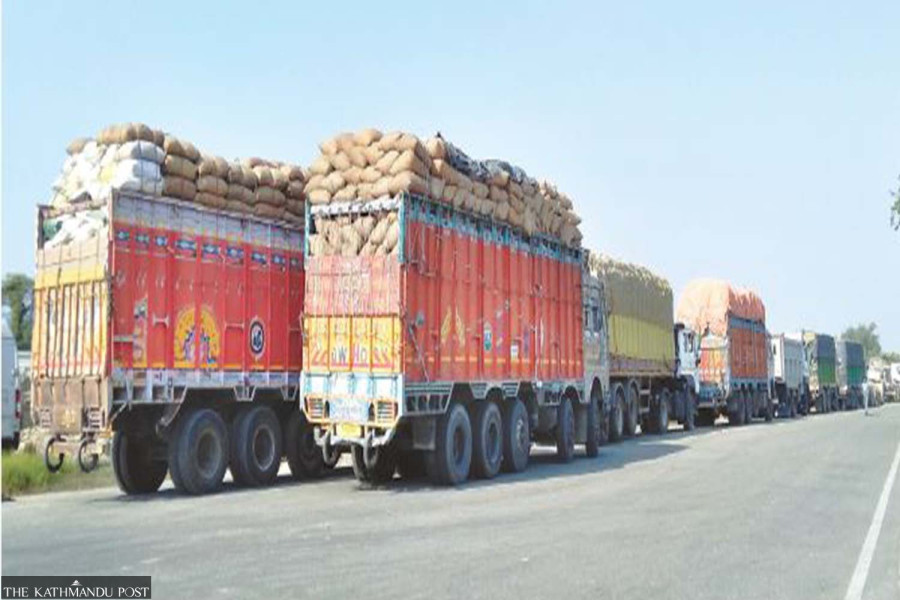
bookmark
Krishana Prasain
Published at : April 4, 2026
Updated at : April 4, 2026 08:49
Kathmandu
For import-dependent Nepal, a sharp rise in trade costs triggered by the ongoing West Asia conflict is pushing up prices from kitchen staples to industrial goods, with analysts warning of deeper economic strain ahead.
Industry insiders say prices of goods have already risen by as much as 50 percent in some segments, with further increases likely if the conflict escalates.
Nepal’s imports of goods and services make up a significant share of its gross domestic product—generally around 30 to 35 percent or higher—underscoring the country’s structural dependence on foreign supply and its persistent trade deficit.
The country imports large volumes of food and agricultural goods, including paddy, rice, edible oil, maize, fruits and fertiliser. It also relies heavily on foreign supplies of raw materials such as crude oil and iron, as well as high-value finished products like automobiles, electronics and branded goods.
The ongoing tensions in West Asia—home to major oil producers such as Saudi Arabia, Iraq and Iran—are having wide-ranging implications for Nepal despite its geographic distance.
The most immediate impact is on fuel prices. Nepal imports all its petroleum products through the Nepal Oil Corporation, which depends on supplies from the Indian Oil Corporation. Any rise in global crude prices is passed down through India, leaving Nepal with little room to cushion the shock.
On Friday, the Nepal Oil Corporation raised the prices of petrol and diesel/kerosene by Rs15 a litre each, marking the third hike in less than a month. Petrol now costs Rs202 a litre in the Kathmandu Valley, while diesel is priced at Rs182 a litre.
Despite the increase, the state monopoly said it continues to incur losses—Rs34 per litre on petrol, Rs120 per litre on diesel and Rs416 per cylinder of cooking gas—although its monthly losses have narrowed to Rs11.71 billion.
Earlier this week, the corporation also sharply increased aviation turbine fuel prices. Rates for international airlines surged 77.63 percent to $1,716 per kilolitre in Kathmandu, while domestic carriers saw prices nearly double, rising 97.63 percent to Rs251 per litre.
“As freight charges have increased by three times, market prices could rise by up to 50 percent. If tensions escalate further, it will be a disaster,” said Rajendra Sangraula, president of the Nepal Freight Forwarders Association.
Rising geopolitical risks—particularly involving the United States and Iran—have pushed up insurance premiums, adding further cost burdens for traders. These additional costs are ultimately passed on to consumers.
Ocean and air freight costs have already surged, while land transport costs are expected to follow. Transit times have increased by up to 15 days, with higher container charges compounding the pressure on importers.
“This has caused the price of all goods, both consumable and non-consumable, to rise sharply, making daily household expenses more expensive,” Sangraula said.
Higher fuel costs are feeding directly into inflation. Transport becomes more expensive, raising the cost of everything from food to construction materials. In Nepal, where difficult terrain already inflates logistics costs, even modest fuel price increases can have an outsized impact
Low- and middle-income households are expected to bear the brunt, as rising prices erode purchasing power and deepen economic hardship.
Remittances—another pillar of Nepal’s economy—also face uncertainty. Millions of Nepali workers are employed in Gulf countries such as Qatar, United Arab Emirates and Saudi Arabia, with remittances contributing more than a quarter of GDP.
While higher oil prices can initially boost revenues in these economies and sustain employment, prolonged instability could disrupt construction and service sectors, potentially reducing job opportunities and remittance inflows. This would weaken Nepal’s foreign exchange reserves and widen external imbalances.
Tourism is another sector at risk. Rising aviation fuel costs are increasing airfares, making travel to Nepal more expensive and potentially deterring visitors. Airlines operating to Kathmandu are already facing higher operating costs, which could affect flight frequency and passenger demand, particularly from long-haul markets.
Trade and logistics expert Rajan Sharma said Nepal’s vulnerability is amplified by its limited export base and fragile logistics systems
“Being an import-dependent country with weak export diversification, Nepal has little capacity to offset rising trade costs,” he said. “Export competitiveness, already low, will deteriorate further.”
According to government data, Nepal’s imports rose by 13.25 percent to Rs1.8 trillion in the last fiscal year, while exports increased by 81.80 percent to Rs277 billion—largely driven by re-exports of refined soybean, palm and sunflower oil.
Data from the central bank show merchandise exports grew 20.8 percent to Rs191.11 billion in the first eight months of the current fiscal year ended mid-March, compared to a 57.2 percent rise in the same period a year earlier.
Exports to India increased by 25.3 percent and to other countries by 7.8 percent, while shipments to China dropped sharply by 53.7 percent.
Meanwhile, imports climbed 12.5 percent to Rs1.28 trillion during the review period, with purchases from India rising 5.1 percent, China 21.2 percent and other countries 26 percent.
Sharma warned that supply chains for fuel, machinery, raw materials and pharmaceuticals are likely to face delays, adding further pressure on domestic markets.
A strong US dollar, rising fuel costs and supply chain disruptions are expected to strain foreign exchange reserves, push up inflation and widen the trade deficit, he said.
Demand for Nepali exports such as garments, carpets and handicrafts could also decline due to higher costs and delivery delays, potentially causing long-term damage to the country’s export sector.
“If the conflict persists, prices of finished and unfinished goods could rise by 20 to 25 percent,” Sharma said.
A recent report by the United Nations Conference on Trade and Development highlights the global scale of the disruption. The Strait of Hormuz—a critical artery for global energy trade—has seen activity fall dramatically, with daily ship transits dropping from around 130 in February to just six in March, a decline of about 95 percent.
The disruption is affecting a significant share of global oil and gas supplies, with cascading effects on production, trade and consumption. It is also spilling over into transport systems, including maritime routes, air cargo and port logistics.
Global merchandise trade growth is now projected to slow from around 4.7 percent in 2025 to between 1.5 percent and 2.5 percent in 2026, as demand weakens and uncertainty rises—adding to the challenges facing economies like Nepal that are heavily reliant on imports.
Krishana Prasain
Krishana Prasain is a business reporter for The Kathmandu Post covering markets. Before joining The Kathmandu Post in 2018, she spent 3 years in New Business Age magazine covering business.

Most Read from Money
Nepal travel agents threaten to stop selling Thailand trips over visa rules

Why does an hour long flight to Dhangadhi cost more than a flight to New Delhi?
Malaysia rejects Nepal’s demand to open recruitment to all manpower agencies

No school, but a graduation cap for women dairy farmers
Nepal arrests four medical service providers as Malaysia recruitment row deepens
Editor's Picks




E-PAPER | October 20, 2026

×