



 14.81°C Kathmandu
.jpg)
Sat, Oct 24, 2026
Money
Gulf war batters Pokhara tourism as half of peak-season bookings cancelled
American and European arrivals via Qatar and Dubai routes plunge as West Asia conflict disrupts travel plans.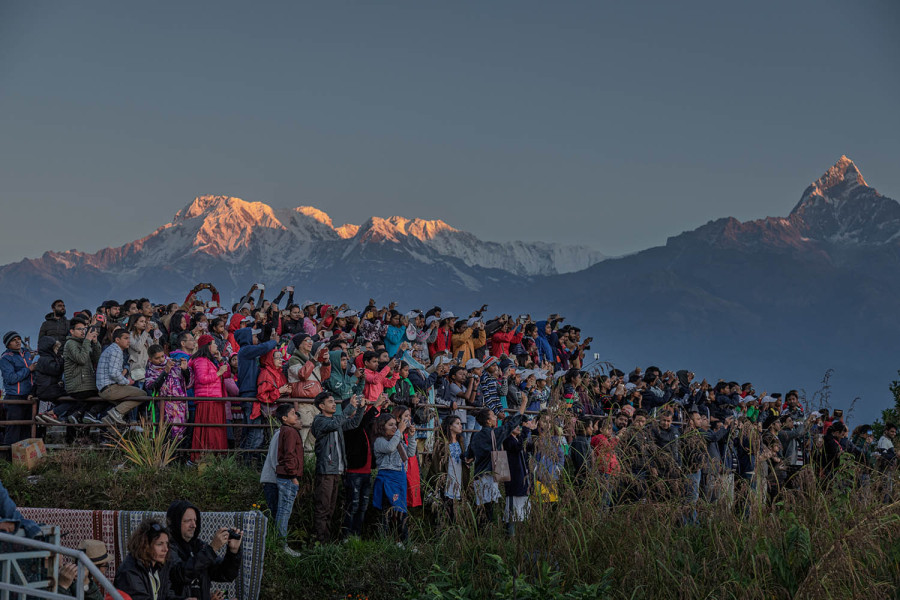
bookmark
Deepak Pariyar
Published at : March 26, 2026
Updated at : March 26, 2026 06:51
Pokhara
By mid-February, the hills of Ghorepani are typically ablaze with vibrant rhododendron blooms. The trekking route begins from Nayapul in Kaski, passing through Birethanti, Ulleri, Banthanti and Nangethanti before reaching Ghorepani. From there, tourists usually stay overnight and hike early next morning to Poon Hill to witness the sunrise.
The Ghorepani–Poon Hill trek remains one of Nepal’s most popular routes, offering panoramic views of the Annapurna and Dhaulagiri ranges, sunrise vistas and the charm of rhododendron-covered hills. The trail extending from Ghorepani through Tadapani and Ghandruk to Annapurna Base Camp is especially favoured by international trekkers.
But by the second week of March, the number of American and European tourists along this route has dropped sharply—primarily due to the ongoing Gulf conflict.
The escalating war in West Asia has begun to hit tourism in Pokhara and the wider Annapurna region at the height of the spring season. Despite this being a peak period, arrivals of American and European trekkers have declined significantly, dealing a direct blow to hotels, restaurants and trekking businesses.
Krishna Acharya, chairperson of the Gandaki chapter of the Trekking Agencies’ Association of Nepal, said around 50 percent of foreign tourists who had planned to visit in March have cancelled their bookings.
“Most cancellations have come from American and European tourists transiting through Dubai and Qatar,” he said.
Some European travellers have rerouted via Istanbul, Turkey, but not enough to offset the decline.
“This is the second peak season for tourism, but the Gulf war has devastated the sector,” Acharya said. “Large groups, in particular, have cancelled bookings. Even those planning to visit in April are in a wait-and-see mode.”
He warned that Nepal’s tourism recovery will remain fragile until the situation in West Asia stabilises.
Nepal’s tourism industry has already been reeling from crises in recent years.
The shock began with Covid-19, which brought international travel to a near standstill and exposed the country’s heavy dependence on foreign visitors. As arrivals began to recover, a string of air and road accidents raised fresh safety concerns, denting Nepal’s reputation among risk-conscious travellers.
Domestic disruptions added further uncertainty. The Gen Z protests—youth-led demonstrations amplified through social media—created an image of instability during key tourist seasons, discouraging some visitors and tour operators from committing to travel plans.
At the same time, operational bottlenecks at Kathmandu’s Tribhuvan International Airport, the country’s main gateway, have long frustrated airlines and passengers. Congestion, delays and limited infrastructure have constrained Nepal’s ability to scale up arrivals even when demand exists.
Although Nepal has built two new international airports to ease pressure on Kathmandu, a lack of effective marketing strategy has left them underutilised—turning them into what analysts describe as “white elephants”.
Perhaps most damaging to Nepal’s global image has been the fake rescue scam, which has drawn international scrutiny. Reports of tourists being unnecessarily evacuated by helicopter for profit have raised ethical concerns and shaken trust among travel insurers and international partners. This has resulted in stricter insurance policies and, in some cases, reluctance among tourists to choose Nepal.
These challenges have not occurred in isolation. Instead, they have overlapped—just as one issue begins to ease, another emerges—leaving the tourism sector in a cycle of recovery and relapse.
“The Gen Z protests affected the previous season, and now the Gulf war has hit tourism again,” Acharya said. “This could have long-term consequences. Authorities need to come up with new strategies to attract tourists.”
Tourists from the United States, Australia and European countries such as Germany, France, Austria and the Netherlands are typically the main visitors to the Annapurna region. In Pokhara now, however, Indian, Korean and Japanese tourists are more visible than their Western counterparts.
At Bar Peepal Resort in Lakeside, Pokhara—usually a favourite among European visitors—occupancy would typically reach around 85 percent during this season. But due to cancellations linked to the Gulf conflict, occupancy has dropped to about 50 percent.
Resort operator Jitu Gurung said large groups of 12 to 15 tourists have been cancelling their March bookings. While April reservations remain intact, many visitors are adopting a cautious “wait-and-see” approach.
“Even European tourists who had already reached India are returning home without coming to Nepal due to uncertainty caused by the war,” he said. “If this situation continues through April, Pokhara’s tourism industry could face a serious crisis.”
Mani Raj Lamichhane, chief of the Gandaki Provincial Office of the Nepal Tourism Board, said Nepal should now pivot towards East Asian markets as the West Asia conflict continues to disrupt arrivals.
“We need to intensify promotional campaigns in countries like Thailand, Malaysia, Singapore, Korea and Japan. The Tourism Board has already been working in that direction,” he said. “It is also important to create an environment that encourages Indian tourists to explore trekking routes.”
He added that Nepal should also target countries with direct flight connectivity, as well as emerging markets such as Vietnam, Cambodia, Australia and New Zealand, to sustain tourism inflows amid ongoing geopolitical uncertainty.
Deepak Pariyar
Deepak Pariyar is the Kaski correspondent for Kantipur Publications.


Most Read from Money

Why does an hour long flight to Dhangadhi cost more than a flight to New Delhi?
Nepal travel agents threaten to stop selling Thailand trips over visa rules
Malaysia rejects Nepal’s demand to open recruitment to all manpower agencies

No school, but a graduation cap for women dairy farmers
Nepal arrests four medical service providers as Malaysia recruitment row deepens
Editor's Picks




E-PAPER | October 24, 2026

×