Poshilo takes traditional Sattu global with modern branding
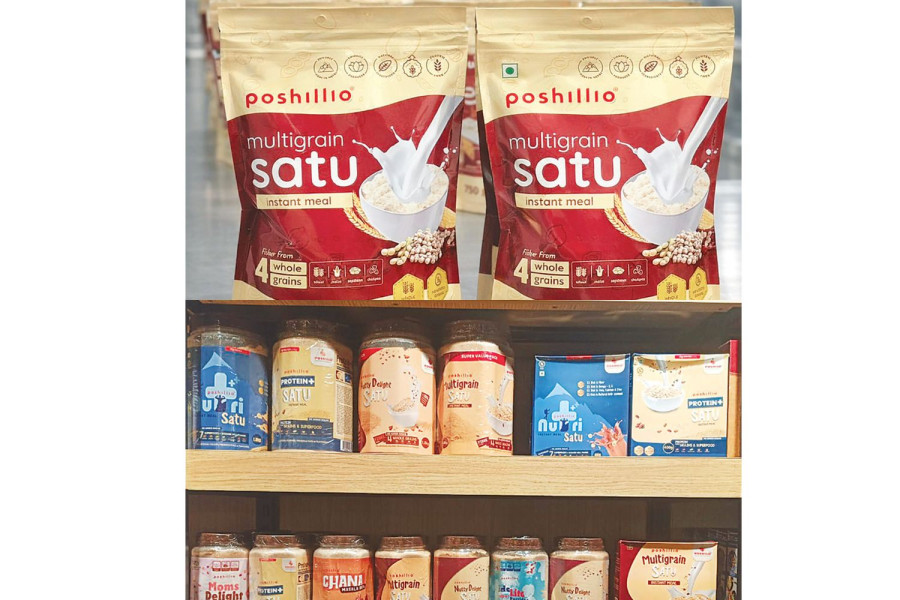
Young entrepreneur turns traditional Nepali staple into export-ready health food, expanding from Pokhara to US and Indian markets. Various Poshilo products put on display. Photos Provided to the Post
In 2020, after the first phase of the Covid pandemic, Prithvi Kalyan Parajuli, who had set out on a trek in the Annapurna region, noticed people grinding maize and soybeans in a traditional stone mill.
He took a handful of sattu (roasted flour) and tasted it. The flavor instantly reminded him of his childhood. During the pandemic, there was a strong trend in Nepal, as elsewhere, to seek nutritious foods that boost immunity. Returning to Pokhara, he gave traditional Nepali sattu a modern packaging and named it “Poshilo”.
Established in January 2022 in Pokhara, Poshilo Foods Pvt Ltd has now expanded its operations to Jhapa and is exporting its products to the United States via India. Started with an investment of Rs10 million, the company recently brought in the reputed exporting firm Manaram Group as partner.
Following this partnership, Poshilo sattu has made significant strides in international markets. Leveraging the strong network of ‘Himalayan Dog Chew’, through which Manaram Group has been exporting chhurpi to the US for the past two decades, Poshilo has established a firm presence in the American market.
In just the past six months, more than 1.5 tonnes of sattu have been shipped to the United States, and it is now available in around 200 stores there.
During the pandemic, Parajuli had completed his BBA in Business and Market Management. Rather than seeking a job, he aspired to start his own business.
After conducting market research for a year, he founded Poshilo Foods at the age of 23. He raised Rs1 crore by selling shares, seeking family support, and taking a bank loan.
The company began production in Pokhara-18, Pokharabesi, with an initial output of 100 kg of sattu on the first day. Gradually, production increased to 150 kg, then 200 kg, and eventually 400 kg. Consumer response was encouraging, and the growing health awareness during the Covid period helped Poshilo build a strong market.
The key strength of Poshilo sattu lies in its purity and nutritional value. In addition to local grains such as maize, soybeans, wheat, and chickpeas, it includes peanuts, cashews, flax seeds, dried fruits, walnuts, sesame seeds, and various superfoods.
Currently, Poshilo produces eight major varieties of sattu, including “Multigrain,” “Nutty Delight,” “Protein Plus,” and “Nutri Plus”. These blends meet the nutritional needs of different groups, including fitness enthusiasts, athletes, pregnant women, children, and the elderly. The products are available in packages ranging from half a kg to two kilograms.
According to the company, no artificial colours, flavours, or preservatives are used, making the product 100 percent natural and healthy.
“I took a professional leap to reintroduce sattu, which had disappeared from urban areas, to the younger generation,” said Parajuli, the chairman. “Poshilo sattu is a traditional and nutritious Nepali snack—truly a high-nutrition product.”
About a year ago, Parajuli decided to partner with Manaram Group, which acquired a 50 percent stake in the company. The Pokhara factory was closed, and a new, modern factory was established in Birtamod, Jhapa. Equipped with Nepal’s first automated sattu processing system, the factory has a daily production capacity of 10,000 kg.
Currently, the factory produces around 3,000 kg of sattu daily, according to Parajuli.
The company employs 45 people across production, marketing, sales, administration, and procurement.
“It is due to our internationally standard grain processing system that our products can compete in foreign markets,” he said.
Poshilo’s entry into the US market is closely tied to its collaboration with Manaram Group. Agricultural produce from Manaram’s own farms is currently used in Poshilo products. Manaram is the same group whose company ‘Himalayan Dog Chew’ has been exporting Nepal’s chhurpi to the US for the past two decades as a healthy dog treat. This same network and experience are now being utilised for Poshilo sattu.
According to Parajuli, within six months of the partnership, more than 1.5 tonnes of sattu have already reached the US in two shipments, and Poshilo is now available in over 200 stores. Distribution and online marketing in the US are also being handled by Manaram Group.
Poshilo is also establishing a strong foothold in India’s vast market. Its products are being sold across India through Amazon, in stores in Kolkata and Mumbai via Blinkit, and in outlets such as Delhi’s Modern Bazaar chain. Last year, Poshilo showcased its products at the prestigious Aahar Expo in Delhi.
Traditionally, sattu was made by roasting and grinding whatever grains were available in villages. Today, Poshilo has combined science and tradition to produce eight varieties tailored to different age groups and lifestyles.
The production process begins in the fields of Nepali farmers. Grains are sourced through agricultural cooperatives, with maize, soybeans, and wheat domestically produced. After procurement, the grains undergo automated cleaning and grading, followed by roasting, milling, mixing, and packaging before reaching the market. Machines are sanitised daily, and each batch is inspected by the company’s quality control team, the company said. Employees are trained in production hygiene.
The company has also started grading and marketing Nepali grains, helping farmers receive fair prices while establishing the identity of high-quality domestic produce.
Parajuli said Poshilo is not just a business. “We are also conscious of our social responsibilities,” he said. “The company supports Nepali athletes, educates children on nutrition, and empowers farmers with improved agricultural practices.”
The company aims to promote Nepali grains globally, increase exports, and contribute to the country’s GDP. Its plans include creating 100 additional direct jobs by the next fiscal year, expanding markets in Nepal, India, and the US, entering new countries, and developing new products from Nepali grains.
“When I first started this business, I had doubts about what would happen,” he said. “But seeing the positive response from consumers now, I feel it was the right decision. Our goal now is to take this nutritious Nepali snack to more corners of the world.”




 18.55°C Kathmandu
.jpg)