



 13.73°C Kathmandu

Fri, Oct 23, 2026
Money
Nepal’s 17 pride projects may take 41 years to finish, warns World Bank
Tree and land clearance approvals take two years each due to compensation disputes and red tape, says report.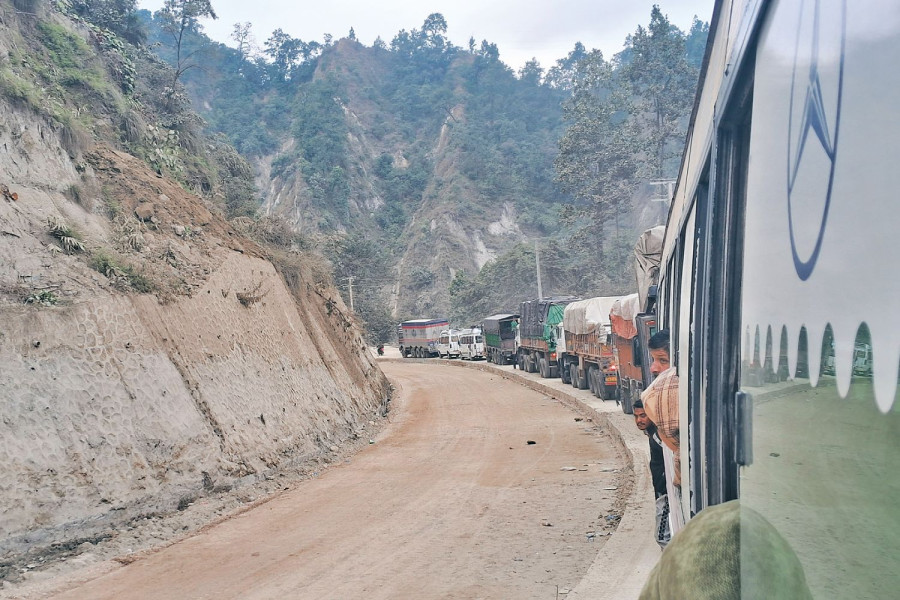
bookmark
Sangam Prasain
Published at : March 16, 2026
Updated at : March 16, 2026 06:25
Kathmadnu
On December 30 last year, Binod Pariyar was returning home to Butwal from Kathmandu.
He reached Dumkibas at around 10 pm, taking four hours, but it took him another 10 hours to cover just seven kilometres up to the Daunne Temple.
“It took 12 hours to cross 14 kilometres in normal winter conditions. There is nowhere to buy food, nowhere to use a toilet. How long are passengers supposed to suffer like this?” he vented his ire.
For children, elderly people and the sick, the journey is like a harsh punishment.
Drivers share the same frustration while driving along the arduous road section.
Kiran Giri, a truck driver from Gulmi district, regularly transports goods from Butwal and other western markets to Kathmandu. Whenever traffic snarls intensify at Daunne, heavy vehicles are stopped at Dumkibas or Bardaghat, with priority given to passenger buses.
“Cargo trucks can be stuck on both sides for up to four days. We face dust, health problems, and daily uncertainty,” said Giri.
Delays have plagued the Daunne-Dumkibas road upgrade work since its inception.
The project, meant to be completed in 44 months, remains unfinished after seven years.
Construction began in April 2019, with an initial completion deadline of August 2022. The deadline has since been extended four times, most recently to August 2026.
Only 74 percent of the work has been completed.
This is not the case for a single project. Multiple projects in Nepal face similar delays.
According to the World Bank, the multilateral funding agency, Nepal approves far too many poorly prepared projects. And this spreads resources thin.
At current funding levels, the World Bank estimates that completing the ongoing 17 national pride projects, which were started years or decades ago, would take 41 more years.
For example, the Nagdhunga–Naubise–Mugling road is one of Nepal’s most vital transport corridors, connecting the Kathmandu Valley to the Tarai and onward to India. A part of the Asian Highway, it carries an estimated 60-70 percent of all goods entering Kathmandu, including food, fuel, construction materials, and medicines.
Recent upgrades under the Strategic Road Connectivity and Trade Improvement Project have improved pavement quality, road safety, and travel times along the 94.7 km stretch.
However, progress came at a cost.
According to the World Bank report entitled Nepal Capital Expenditure Bottlenecks Analysis, land acquisition alone took 35 months—nearly 150 percent longer than planned—exposing the systemic delays that continue to slow infrastructure delivery in Nepal.
This project reflects a broader challenge facing major investments in the country.
Another example is the Kathmandu–Tarai/Madhesh Expressway, also known as Fast Track, an under-construction road connecting Kathmandu and Nijgadh in the southern Tarai region of Nepal. On May 28, 2017, the then prime minister Pushpa Kamal Dahal laid the foundation for the expressway.
The 70.97-kilometre-long expressway, being constructed by the Nepali Army and originally scheduled to be completed by September 2021, now has a new completion target of April 2027. However, analysts say that deadline too remains unachievable.
“Everyone—the government, the Army—is lying,” said Engineer Arjun Jung Thapa, former government secretary and an infrastructure expert.
The Rs213 billion project has only a year remaining to meet the revised deadline. So far, Rs84 billion has been spent, and for this fiscal year Rs22 billion has been allocated, making a combined expenditure of Rs106 billion.
“There is no logic that the project will be able to spend another Rs107 billion in a year,” said Thapa. “Still, the government has not been able to determine whether the project will connect to the Ring Road in the Kathmandu Valley.”
“This is an actual national pride project, because it not only saves time and fuel [fuel worth Rs18 billion annually], but also lives,” said Thapa. “The project can be completed within the next three years if resources are concentrated. The government should stop most projects and focus on a few to get results.”
Take the example of the Mid Hill Highway project.
The Pushpalal (Mid-hill) Highway, Nepal’s longest national highway—a 1,879 km road project connecting 24 districts and 225 villages—has achieved 77 percent progress in a decade and a half decades since construction began.
“The project suffered not only from funding crunches but also political interference,” said Thapa, adding that the government was pressured to change the alignment due to the interests of political parties seeking to cover more and more of their constituencies. “The alignment was changed to include new villages but there was no funding.”
Likewise, the progress on the Postal Highway, which runs across the country’s southern belt, is not satisfactory either. It has been 16 years since construction began, but only 75 percent of the 1,792 km road has been completed.
“In the case of the east-west railway project, in the current funding scenario, the proposed Rs1,500 billion project may take another 500 years to build,” said Thapa.
“The government should complete critical projects selectively, and then build other projects from the revenue they generate.”
Large investments in roads, hydropower, irrigation systems, and water supply projects are routinely approved, but implementation delays and incomplete projects remain widespread.
Nepal’s persistently low execution of infrastructure projects has significantly constrained the accumulation of public capital, creating substantial barriers to economic growth.
Given Nepal’s challenging geography and topography, improved connectivity infrastructure is essential for job creation, private sector development, tourism growth, productivity gains, and broader economic expansion.
However, structural challenges in capital expenditure execution have contributed to a considerable deterioration in Nepal’s public capital stock (the total value of physical assets owned by the government that support the economy and public services)—from approximately 75 percent of Gross Domestic Product (GDP) in the mid-1990s to approximately 54 percent in 2019, the World Bank said.
Nevertheless, consolidated capital spending has declined steadily since fiscal year 2020-21, reaching 7.9 percent of GDP in 2023-24. This level of public investment is inadequate to address Nepal’s infrastructure requirements.
According to the World Bank’s 2019 Infrastructure Sector Assessment, Nepal would need to invest 10 to 15 percent of GDP over 2020-2029 to bridge existing infrastructure gaps.
The report said that at the federal level, the share of the capital budget in the total budget declined from 27.1 percent in 2020-21 to 20.9 percent in 2023-24, with only around 62 percent of these allocations executed on average. As a result, federal capital expenditure as a share of GDP fell from 5.3 percent to 3.4 percent.
Combined with underspending at the subnational level, total capital expenditure across all three tiers of government fell from 11.4 percent of GDP in 2020-21 to 7.8 percent in 2023-24, well below the 10–15 percent of GDP estimated as necessary to close the country’s infrastructure gap.
These trends carry real economic consequences: delayed infrastructure projects raise investment costs, slow service delivery, constrain economic growth, and limit job creation.
Why does public investment fail at the implementation stage?
According to the report, on paper Nepal appears to have a sound public investment management system. In practice, weaknesses appear throughout the project cycle—from selection to funding and contract management.
The report said that project preparation is slowed mainly by delays in tree-cutting clearance and land acquisition. For infrastructure projects, tree-cutting approval processes take two years on average due to multiple approval procedures, duplicate surveys, and limited use of digital tools.
Land acquisition takes two to three years on average because of outdated valuation methods, fragmented records, and frequent compensation disputes.
Quarterly cash rationing leads to a year-end spending surge—over 40 percent of capital spending occurs in the last month—reducing quality.
Projects face added delays due to low disbursements, especially in donor-funded projects, and frequent staff turnover.
As an example, poor planning combined with inflexible in-year fund reallocation rules resulted in a 60-day delay to reallocate the periodic maintenance budget under the Strategic Road Connectivity and Trade Improvement Project, significantly slowing project implementation.
Finally, procurement is a major bottleneck: Nepal has the longest World Bank–financed project procurement timeline in South Asia—231 days compared to the regional average of 192 days.
Mandatory use of the lowest-bid approach, strict termination penalties, paper-based decision-making processes, and unclear guidance stall contracts, the report says.
The World Bank has suggested reform areas.
It recommends a tighter project pipeline where only investment-ready projects enter the budget and new approvals wait until existing commitments are funded. Public money would then go to fewer, better-prepared projects, improving value for money and reducing the stock of stalled investments.
It also calls for faster land acquisition and environmental clearances through digital records, standardised valuation, and streamlined approvals before projects are included in the budget.
Such reforms would allow projects to break ground sooner, reduce idle allocations, and significantly cut implementation delays linked to land and tree cutting.
The report also suggests more credible cash forecasts, protection of capital budgets from mid-year cuts, and fund releases aligned with realistic work plans. This would enable smoother project execution throughout the year—reducing stop-go spending, improving construction quality, and avoiding year-end spending rushes.
Simpler and delegated reallocation rules within clear accountability limits could allow funds to move quickly from stalled to performing projects, keeping implementation on track without weakening fiscal control.
Finally, clearer bid evaluation, screening of abnormally low bids, enhancement of the e-procurement system, balanced risk-sharing, and stronger procurement capacity could accelerate contract awards, reduce disputes, and ensure more reliable delivery of infrastructure projects, according to the World Bank.
Sangam Prasain
Sangam Prasain is Business Editor at The Kathmandu Post, covering tourism, agriculture, mountaineering, aviation, infrastructure and other economic affairs. He joined The Kathmandu Post in October 2009.


Most Read from Money
Nepal travel agents threaten to stop selling Thailand trips over visa rules

Why does an hour long flight to Dhangadhi cost more than a flight to New Delhi?

Malaysia rejects Nepal’s demand to open recruitment to all manpower agencies

No school, but a graduation cap for women dairy farmers
Nepal arrests four medical service providers as Malaysia recruitment row deepens
Editor's Picks




E-PAPER | October 23, 2026

×