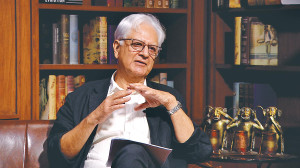
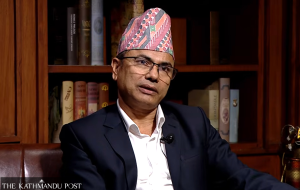
Former Reconstruction Authority chief Govinda Raj Pokharel on the urgent need for a permanent, powerful disaster ministry
Warning against compounding risks from clustered dams and melting glaciers, Pokharel calls for strict infrastructure codes, cross-border early warning systems with China and India, and a rapid pivot toward high-altitude Himalayan solar energy. Govinda Raj Pokharel, former chief of NRA Post Photo: Deepak KC
The flash floods of August 26 along the Bhotekoshi and Trishuli river systems have left a trail of immense destruction. With over 1,300 people confirmed dead, around 5,000 still missing, and billions of dollars worth of property destroyed, the disaster is the most catastrophic event Nepal has faced in a decade. The scale of the disaster is being compared to the 2015 earthquakes, which claimed around 9,000 lives and left around 22,000 injured. Having led the National Reconstruction Authority (NRA) through the aftermath of the cataclysmic earthquakes, Govinda Raj Pokharel brings a wealth of administrative experience to Nepal’s latest climate catastrophe.
In a conversation with The Post’s Biken K Dawadi, former NRA chief Pokharel reflects on the staggering human and economic toll of the disaster, the failures of current infrastructure codes, and why Nepal urgently needs a permanent, powerful disaster ministry rather than a temporary reconstruction authority.
How do you read the scale of the Bhotekoshi flood? Are we facing a loss that surpasses the 2015 earthquakes?
We must evaluate this through multiple lenses. From a strictly governmental perspective, the damage to state-owned property is actually lower. The cost of repairing public infrastructure directly from the state treasury will be less than what we faced in 2015. However, the private sector tells an entirely different, far more devastating story. A decade ago, a typical house in these mountain valleys was worth perhaps a million rupees. Today, those same valleys are lined with modern buildings worth tens of millions. The financial exposure of private citizens is immense. We are seeing colossal losses in private infrastructure—hydropower projects, sprawling hotels, factories, and local trade enterprises along the highway have been entirely swept away. When you factor in these private investments, the scale of economic ruin is immense.
What about the land itself?
This is the critical differentiator. In 2015, despite the terrifying tremors, the physical land remained largely intact. You had to rebuild the houses, but the plots were still there. Today, the very earth has been washed away. Torrential waters have erased entire landscapes, leaving nothing but barren riverbeds. For the government, this is a logistical nightmare. It is no longer a matter of handing out building materials. We have to find entirely new, stable land to resettle these communities, which is an incredibly complex undertaking.
How do you begin to resettle entire villages when the ground beneath them has dissolved?
It requires a blend of rigorous technical assessment and economic pragmatism. During the 2015 recovery, when residents migrated down to places like Khalte, we made them a clear promise: If the technical experts declare the ground safe, we will build your homes here. If not, we must relocate. Our technical teams eventually found that Khalte was unsafe, and the residents had to move elsewhere. This is the hard truth we must face again. But relocation cannot happen in a vacuum. You cannot simply dump people on a safe mountainside. In Nepal, settlements thrive where economic corridors exist. A highway without a bazaar or a local trade centre makes no sense. We must align our infrastructure so that relocated settlements are physically connected to vibrant economic activities. If you sever that connection, the recovery will fail.
Our post-earthquake building codes were designed to prevent structural collapse from tremors. Do they hold up against these climate-induced disasters?
They do not, and they cannot. The lessons of 2015 are valuable, but this disaster offers entirely new, painful insights. When we build infrastructure now, ‘building back better’ is no longer a sufficient mantra. We must build back better in a safer place. We have massive river catchments—the Koshi, the Gandaki, the Karnali—and each demands customised safety parameters. For instance, bridges must be constructed with significantly higher clearances and robust structural resilience. Our hydropower plants and irrigation canals require entirely new safety factors to withstand flash floods. We need a comprehensive set of national ‘Infrastructure Construction Codes’ that apply to all developments, whether public or private.
Should these codes be mandatory before any ground is broken?
Absolutely. No major infrastructure project, public or private, should proceed without a rigorous disaster due diligence assessment. We must establish clear, enforceable standards to verify that we are not building roads, bridges, or energy plants in active disaster zones. It is a matter of survival. We must adapt our engineering to the landscape, creating a system of standards that prevents us from repeating these catastrophic losses in the future.
After 2015, the state established the National Reconstruction Authority, under your leadership. Should the government form a similar, single-focus authority for this flood recovery?
No, that would be a step backwards. We must look at this in three ways. First, we must move away from temporary, ad-hoc committees. Nepal needs a permanent, powerful Disaster Ministry. This ministry should have the teeth to set national standards, enforce due diligence, and actively monitor the reconstruction work of other government bodies. Second, we do not need a bespoke, independent reconstruction agency today. In 2015, we were in a delicate political transition toward a federal structure, which necessitated an agile, temporary institution to bypass bureaucratic inertia. Today, things are different. We have developed robust standards, protocols are well-established, and the NDRRMA is doing an excellent job.
In that case, how do we prevent line ministries from becoming bogged down?
The solution is a decentralised yet highly coordinated execution model. Every line ministry involved in the recovery must establish a dedicated, internal reconstruction and rehabilitation unit specifically tasked with addressing the Bhote Koshi disaster. These specialised units will manage resources, engineering designs, and personnel. Crucially, their progress and adherence to safety guidelines must be strictly monitored by the NDRRMA. This ensures that while individual ministries execute the physical work, we maintain a unified standard of climate-resilient construction across the board.
What are the key pillars of this recovery that must not be overlooked?
We must design a multi-dimensional recovery that addresses the full spectrum of loss. Physical reconstruction with updated, hazard-resilient standards is merely the first pillar. The second is the immediate implementation of advanced early warning systems. The third is a dedicated framework for economic reconstruction. Finally, we must implement a comprehensive social reconstruction programme to heal our communities.
In the post-earthquake era, local governments were crucial in verifying damage and distributing grants. Can they play the same role today?
They are actually in a far stronger position today than they were in 2015. We now have vastly superior digital infrastructure. Detailed household data, land ownership details, and registration records are safely stored on secure websites. Even if a physical municipal building is destroyed, the vital registries—birth certificates, national identity data, PAN registrations, and passport databases—remain fully accessible online. We must mobilise local governments immediately to identify the exact number of households that have lost their properties and livelihoods.
Beyond data collection, what role should local units play in the actual physical relocation?
They must lead the local conflict resolution process. Relocating people is a deeply sensitive, emotional, and politically charged task. You are asking families to move away from highly lucrative economic centres along the highway. If those families survive, they will naturally demand equivalent, commercially viable plots in the new settlement zones. Officials in Kathmandu cannot possibly manage these micro-level, highly localised disputes. We must involve local communities, local civil societies, and local elected representatives to mediate these conflicts.
Let’s turn to our energy sector. Nepal has aggressively expanded its hydropower capacity. Yet, we are building multiple dams in close proximity upstream. Are we creating a dangerous cycle of compounding risks?
We are, and we must proceed with extreme caution. The rapid development of our hydropower potential over the last few decades is a major economic achievement. But we cannot ignore climate realities. When you have multiple dams lined up along a single river system, you risk a cascading failure where one upstream collapse triggers a domino effect downstream. To balance our energy ambitions with safety, we must establish rigorous disaster due diligence as an absolute prerequisite for issuing any generation licenses, whether to private developers or state-owned enterprises.
But is hydropower alone enough to secure our energy future in an era of melting glaciers?
No. Climate change is rapidly reducing the long-term reliability of our river basins. Glaciers are melting at an unprecedented rate, meaning the water volumes we project today may not exist in the future. We must urgently diversify our national energy mix. Fortunately, our high-altitude Himalayan regions receive exceptional solar radiation, offering far better power generation per square metre than many lower-lying areas. We must actively invest in solar energy alongside hydro, ensuring our national energy grid is resilient to climate-induced hydrological shifts.
When it comes to rebuilding homes, should we stick to the owner-driven reconstruction model used after the 2015 earthquake?
Yes, the owner-driven model is non-negotiable. The state should never attempt to construct private homes directly. Instead, the government must establish clear structural guidelines, safety standards, and provide financial grants alongside robust technical support. The homeowners themselves must lead the physical reconstruction. This ensures local ownership, cost-efficiency, and adherence to personal needs.
Let’s change track. How should the government approach the international community to secure funding for this recovery?
Our pitch must be built on credible, facts-based preparation. We must produce a flawless, transparent, and highly reliable Post-Disaster Needs Assessment. Crucially, this assessment must not focus solely on government losses like destroyed roads and public bridges. It must comprehensively document private sector losses—the destroyed hotels, the wiped-out businesses, the ruined crop fields, and the local tourism assets. Private loss is, after all, a loss to the entire nation.
Should we frame this recovery around the global climate crisis?
Yes, but with highly sophisticated, clever diplomacy. We must avoid aggressive, activist-style rhetoric in international forums. Pointing fingers or naming specific nations for their historical emissions is counterproductive and erodes goodwill. Climate change is a shared global challenge. We must present our case with quiet, dignified and compelling facts. We must articulate a clear narrative: Nepal is a highly climate-sensitive nation that has contributed almost nothing to global emissions, yet our communities are bearing the direct, devastating brunt of this global crisis.
We saw a lot of public anger online regarding international financial institutions offering concessional loans for disaster recovery.
The public backlash against institutions like the Asian Development Bank offering concessional loans for flood recovery is entirely understandable. The citizens are right to feel aggrieved. Why should a climate-affected nation bury itself in debt to rebuild from disasters triggered by global emissions? This is why our diplomatic efforts must be unyielding. We must present our vulnerability so clearly that our international partners feel a moral obligation to provide direct, non-repayable grants.
During the 2015 recovery, the NRA was plagued by fraudulent damage claims and agonisingly slow property assessments. How do we avoid those failures this time?
The structure of our governance has changed fundamentally since then. Under the permanent Disaster Ministry I propose, the actual execution of the rebuild is distributed across specialised line ministries and local governments, who are much closer to the ground. In 2015, we were dealing with newly formed, inexperienced local bodies. Today, our local governments are highly functional, legally empowered, and deeply familiar with their communities. If the central government issues clear, standardised guidelines and releases the necessary resources swiftly, the local authorities can execute assessments without delay. We must also abandon rigid, counterproductive interpretations of the ‘one-door policy’.
What do you mean by a flexible ‘one-door policy’?
In the past, some bureaucrats interpreted the ‘one-door policy’ as a requirement that all relief materials and physical assets must physically pass through a single coordinator’s office. That is administrative madness; it creates massive bottlenecks. A true one-door policy simply means that all participating actors—NGOs, private donors, and local charities—must strictly obey the standardised guidelines, safety codes, and rules developed by the government. They are free to execute projects directly on the ground, provided they follow the state's blueprint. This prevents duplication of effort while maintaining speed and local flexibility.
The PM’s Disaster Relief Fund has received an unprecedented volume of donations, crossing seventy million dollars, including a massive ten million dollar personal contribution from the CEO of Nvidia. How do we manage this historic sum without triggering public suspicion?
Transparency is the absolute key to maintaining this public trust. Why have we received such a historic outpouring of support? First, the sheer tragedy of the Bhotekoshi floods, documented raw on social media, broke the hearts of people globally. Second, the public trusts the current government. It is perceived as clean, without the heavy baggage of systemic corruption that plagued previous administrations. This is an incredibly advantageous position for the state. To preserve this trust, the government must immediately launch a live, public digital dashboard.
What should this dashboard display?
It must update in real-time, detailing exactly how much money has entered the fund, which bank accounts it rests in, and precisely which reconstruction projects and administrative areas it is being allocated to on a daily basis. When people can see exactly where their money is going, their willingness to support grows exponentially. I have personally visited these flood-affected areas, and I can tell you there is absolutely no shortage of immediate relief materials. Individuals, NGOs, and the government have flooded the valleys with food, tents, and clothes. In fact, we must actively discourage well-meaning citizens from sending more sacks of rice and cooking oil. The government should run a campaign advising donors that if they wish to support the long-term recovery, they should deposit cash directly into the Prime Minister's Relief Fund.
If immediate relief is sufficient, where should this financial capital be directed?
We must focus heavily on the economic and social dimensions of recovery, which we unfortunately neglected during the 2015 physical rebuild. A decade ago, we focused almost exclusively on physical structures—on brick, mortar and concrete. We forgot the human livelihood component. Many families who migrated from the hills to these lower river valleys have now lost absolutely everything. If we do not come up with a comprehensive, rigorous economic reconstruction package, we will be left with a massive population of landless, impoverished citizens living in sub-standard conditions.
As a final reflection, what other vital lessons did we miss in 2015 that we must implement now?
We completely ignored architectural aesthetics and local cultural heritage. When we rebuilt houses after the earthquake, we let the landscape be overrun by uniform, unattractive concrete structures topped with cheap corrugated iron sheets. It stripped these historic valleys of their soul. This time, when the government issues standard architectural designs for public buildings—whether it is a municipal office in Rasuwa or a school in the hills—we must make it mandatory to incorporate local materials and traditional cultural aesthetics. We must not build generic concrete blocks and import expensive, characterless granite from abroad.




 22.6°C Kathmandu