Nepal steps up vigilance amid Nipah outbreak in West Bengal
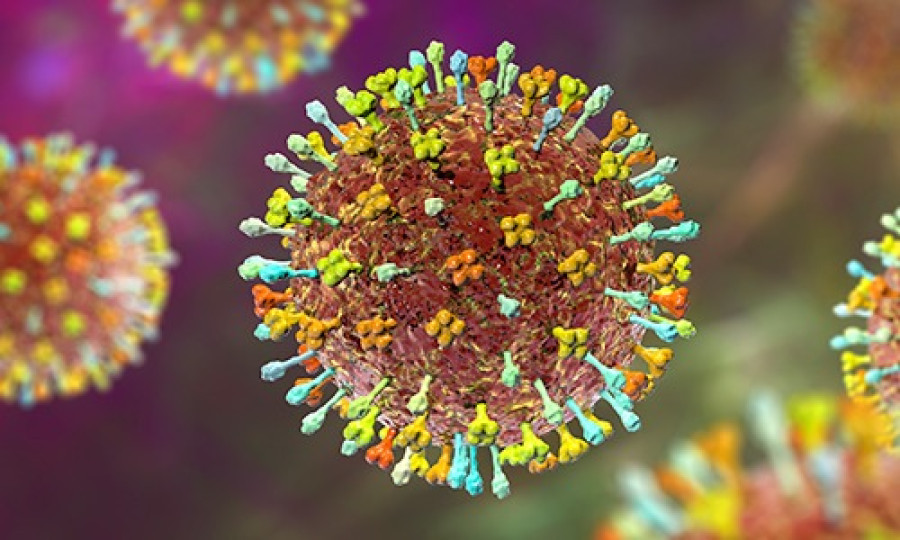
Health desks at eastern border points and Tribhuvan International airport put on alert. The Nipah virus. Photo: European Centre for Disease Prevention and Control’s website
Nepal’s Epidemiology and Disease Control Division has directed hospitals across the country to report sudden patient deaths and patients showing Nipah virus-like symptoms.
The directive comes amid concerns over a possible outbreak of the deadly virus in Nepal, as neighbouring Indian state of West Bengal has reported fresh infections.
At least five people have tested positive for the Nipah virus infection in a week, and around 100 people have been sent into home quarantine, according to Indian media reports.
“Chances of Nipah virus-infected persons with symptoms entering the country through land crossings are low, as infected patients usually become serious and are generally unable to walk or travel by bus,” said Dr Amrit Pokhrel, an official at the division. “Such patients are likely to reach hospitals directly, and we have directed hospitals to increase vigilance. Health desks set up at border crossings have also been alerted about the risks.”
The World Health Organisation says that people infected with the Nipah virus typically develop symptoms within 3 to 14 days, with fever, headache, cough, sore throat, and difficulty breathing. Some people may also experience brain swelling or encephalitis, where severe symptoms can include confusion, drowsiness and seizure. In some cases, patients can fall into a coma within 24 to 48 hours.
The disease has a fatality rate of 40-70 percent, according to the UN health body.
Media reports said the condition of one of the infected patients is “very critical” and the patient is being treated in an intensive care unit.
“We have also asked health workers deployed at the health desk at the Tribhuvan International Airport to remain vigilant about passengers entering the country from Kolkata, India,” said Pokhrel. Kolkata is the state capital of West Bengal. “The National Public Health Laboratory has facilities to carry out polymerase chain reaction (PCR) tests on samples from patients suspected of Nipah virus infection.”
Doctors say just like the coronavirus, Nipah is a zoonotic virus, which is transmitted from animals to humans. But Nipah is far more deadly than the coronavirus that has wreaked havoc throughout the globe. Transmission generally occurs when people come in direct contact with infected animals or through the consumption of the meat of infected animals.
But cases of human-to-human transmission of the virus have also been reported in many places, including in India, among the families and caregivers of the infected people.
Officials said Nepal is at risk of a Nipah virus outbreak, as fruit bats, the virus's primary hosts, may also be present in Nepal. West Bengal shares a land border with Nepal’s Koshi province, where hundreds of people cross daily.
Doctors say that most of the symptoms of the Nipah virus are similar to those of Covid, but in the case of Nipah infection, the condition of the patients deteriorates quickly.
The Nipah virus was first detected in 1999, after farmers and others who came into close contact with infected pigs in Malaysia and Singapore developed severe respiratory problems and brain inflammation. According to the US Centres for Disease Control and Prevention, nearly 300 people were diagnosed with the disease then, and more than 100 of them died.
India’s West Bengal recorded the deadliest Nipah virus outbreak in 2001, in which 66 people were infected, and 45 of them died. The virus resurfaced in 2007 when five people were infected, and all died.
The virus claimed 17 lives in Kerala of India, in 2018. Between 2018 and 2025, outbreaks were reported almost annually in Kerala. The deadly virus has resurfaced in West Bengal after a 19-year gap, according to media reports.
Experts said that authorities should take the issue seriously as the virus is far deadlier than the coronavirus, with up to a 70 percent death rate in humans.
Doctors say that fruit bats from India, which carry the Nipah virus, can easily enter Nepal due to the proximity and similar environments. Moreover, there is a high likelihood that any disease seen in India will enter Nepal due to the free movement of people between the two countries, doctors say.
The World Health Organisation said that although the virus has caused only a few known outbreaks in Asia, it infects a wide range of animals and causes severe disease and death in people, making it a public health concern.
Doctors say most of the symptoms of the Nipah virus match those of other regular viruses, including the coronavirus, which increases the chances of misdiagnosis.
There is no treatment for the Nipah virus at present. Health workers provide symptomatic treatments only, according to them.




 25.51°C Kathmandu