Bhagawan Koirala’s paediatric hospital opens in Kathmandu
Hospital promises affordable care for all and aims to solve the shortage of paediatric specialists outside Kathmandu. KIOCH’s central hospital at Budhanilakantha-7 has currently 50 beds for inpatient service.
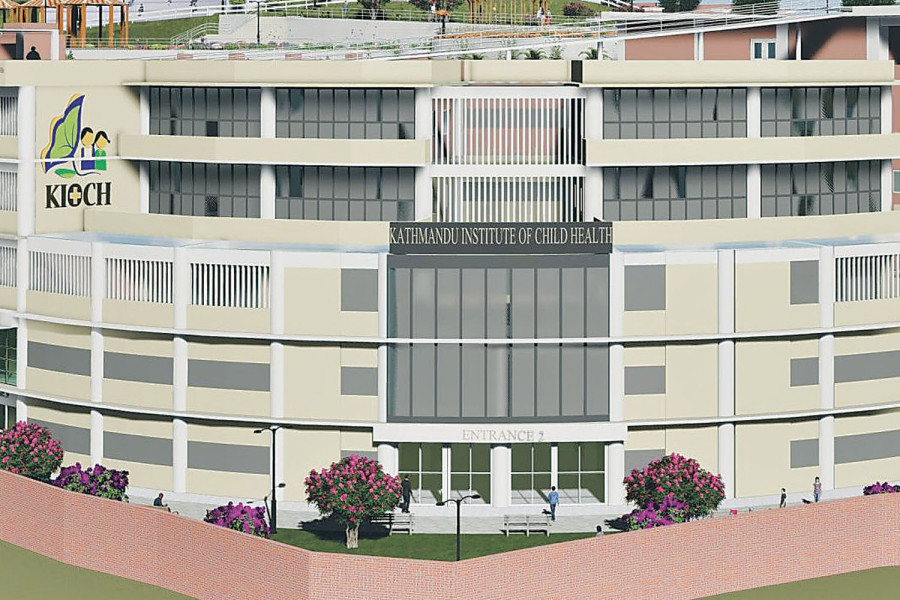
The Kathmandu Institute of Child Health (KIOCH), an ambitious project of eminent Nepali cardiologist Dr Bhagawan Koirala, has started outpatient services from Sunday.
The hospital administration said that it has also been working to start inpatient services within the next two weeks.
“A dream to provide specialised paediatric care has come true,” Koirala told the Post. “We have started outpatient services with consultant paediatricians, and are also working to start other services at the earliest.”
Dr Koirala, a cardiac surgeon renowned for pioneering open heart surgery in Nepal, played a key role in setting up the Gangalal National Heart Centre and in establishing the Manmohan Cardiothoracic Vascular and Transplant Centre. Over the years, Koirala has worked tirelessly to elevate Nepal’s public hospitals and health institutions to new levels of care.
After retiring from government service, he started setting up comprehensive paediatric hospitals in all seven provinces to provide all kinds of care to children under a single roof.
KIOCH, which is based in ward 7 of Budhanilakantha Municipality, is the central hospital. At present, the hospital has 50 beds for inpatient services and plans to increase the number of beds to 100 within the next six months, and 200 beds within a year, according to officials.
Along with outpatient services, the hospital has also started lab services.
Koirala said that the Kathmandu hospital will work as a hub and a resource centre, where human resources and knowledge can be primarily centralised and then be shared to peripheral hospitals.
“We need such a hub where many doctors, trained nurses, technicians and specialists work,” said Koirala. “The plan is to make arrangements from such hubs so that doctors can go to hospitals outside Kathmandu on a rotational basis. This way, we can address the problem of human resource crunch in hospitals away from the city.”
A study carried out in the past about the availability of human resources shows 90 percent of all paediatricians are concentrated in Province 3, which includes 13 districts including those in the Kathmandu Valley.
Doctors say nobody wants to go to the rest of the country, unless there are adequate benefits and infrastructure. Also, Kathmandu itself has a population of around four million, permanent and floating, and even for this population, there are not enough paediatric beds.
According to Koirala, there are some excellent hospitals in the country—including a central children's hospital, the Kanti Children’s Hospital, in Kathmandu and paediatric departments in several institutions—that provide care for general paediatric problems. But specialised branches of paediatrics are not available under one umbrella.
He said existing hospitals in the country provide good care for one organ, but there could be a problem in another organ, for example, stroke and kidney failure. This can require patients to be shifted from one hospital to another—and while doing so, patients are at risk.
“When you focus on one organ and provide incomplete care, that is always going to be an issue,” Koirala said.
Due to a lack of comprehensive care centres for ailing children, doctors have often been forced to transfer ailing children from one hospital to another, which makes patients suffer.
KIOCH offers comprehensive care in all areas of child health, according to Koirala.
The institute is already running a paediatric hospital in Damak of Jhapa district.
KIOCH is also planning to start a provincial hospital in Karnali or Sudurpaschim province in the near future, according to Koirala. He said that hospitals and services will be non-profit, accessible, and likely free for those who cannot afford to pay.
“The institution will charge a fee from those who can pay, and those who want more comfortable rooms and services, and then subsidise the poor,” said Koirala.




 19.27°C Kathmandu