Rich or poor, educated or uneducated, many refuse free vaccines
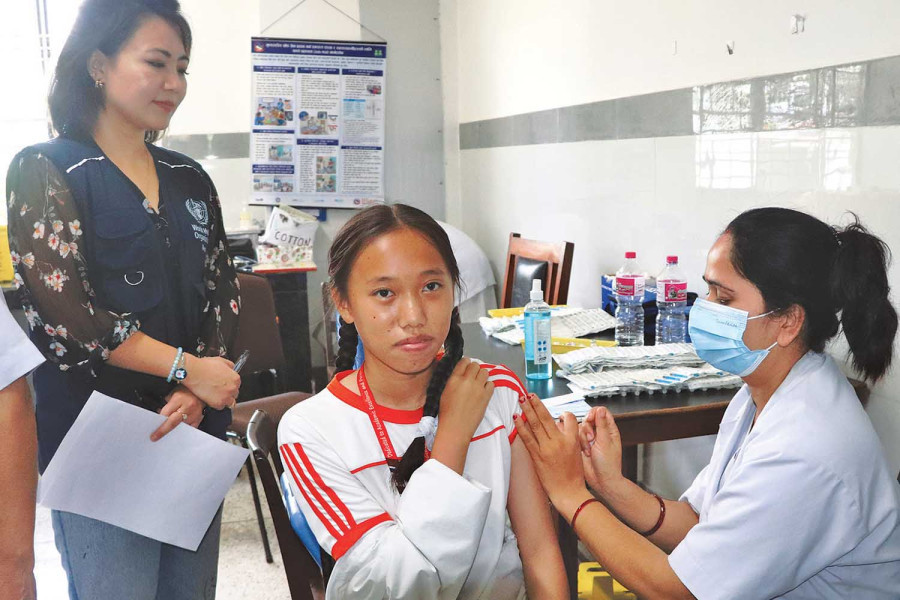
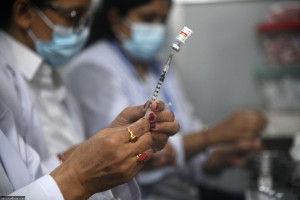
Human papillomavirus (HPV) vaccine uptake has been lowest in Kathmandu Valley as big schools and well-off families refuse to vaccinate their children. A girl receives a dose of human papillomavirus vaccine in Pokhara in September 2023. RSS File Photo
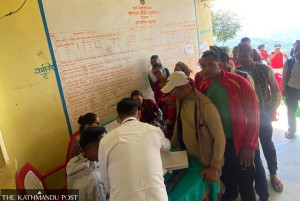
Immunisation workers, who visited some renowned private schools for the human papillomavirus (HPV) drive in February initially struggled to gain entry.
Once inside, when they requested permission to administer the vaccine to eligible students, teachers objected, saying the children cannot be vaccinated without consent of parents.
After hours of discussion, the school administration agreed to collect the consent of parents, but not all parents allowed their children to be vaccinated.
“Parents of some children inquired with their family doctors, who asked them to take vaccines offered free of cost in the drive,” said Satish Bista, a senior public health administrator at the Public Health Office Kathmandu. “The HPV vaccine is too costly in private clinics, and conflicts of interest might have influenced some parents to refuse the vaccine.”
Health officials said HPV vaccine uptake rate in the Kathmandu Valley is even lower than in the districts of the Madhesh Province, where coverage of most of public health programmes are generally low compared to other provinces.
They said that low uptake among slum dwellers and in Madhesh is somewhat understandable—due to level of awareness, unemployment, conservative beliefs, and living conditions, among others—but even well-off and educated people refusing to participate in government programmes is what surprises them.
“Earlier, we had to make extra efforts to make the uneducated people aware about the importance of vaccines and public health programmes,” said Dr Abhiyan Gautam, chief of the Immunisation Section at the Family Welfare Division under the Department of Health Services. “Some educated and well-off families buy the same vaccine from private clinics for over Rs6,000, yet refuse to have their children vaccinated for free under the government campaign.”
Health officials say coverage of health care programmes in big cities including the district of the Kathmandu Valley, districts of Madhesh Province, Lumbini Province is very low compared to remote areas of Karnali and Sudurpaschim provinces. Health workers also complain that convincing uneducated and poor people residing in remote areas is far easier than persuading educated people in big cities.
Officials say that some educated people refuse to listen to female community health volunteers, who they think are less educated than themselves. Well-off people also deny access to health workers to their apartments, and in some cases have even unleashed dogs on volunteers.
Due to low coverage rate of healthcare programmes and compromised water and sanitation conditions, the risk of outbreaks of communicable and vaccine preventable diseases is high in big cities, according to officials.
Meanwhile, the Ministry of Health and Population said that it is preparing to administer the HPV vaccine to all 10-year-old girls or those studying in class six during a month-long campaign from mid-January. Although the HPV vaccine has been included in the routine immunisation list, officials say that the vaccination programme will be launched for a month every year.
“We have estimated that around 350,000 girls are 10 years old,” said Gautam.
Human papillomavirus is a viral infection that spreads through skin-to-skin contact and is a leading cause of cervical cancer—the second-most common cancer in the developing world. Cervical cancer is a major cause of death among Nepali women, with hundreds diagnosed every year.
Although the exact number of patients suffering from cervical cancer in Nepal is not known, it is estimated that every day, at least four women die of the disease.
Doctors say HPV exists in more than 100 different forms, ranging from low-risk to high-risk infections. HPV types 16 and 18 are frequently associated with invasive cervical cancer compared to other types, meaning that they are more carcinogenic than other types.
They say most cases of cervical cancer are associated with HPV. Widespread immunisation could significantly reduce the impact of cervical cancer and other HPV-related cancers. Early treatment can prevent up to 80 percent of cervical cancer cases, according to them.




 19.85°C Kathmandu